Saturday, June 9, 2012

Can Sita be the Role Model for Contemporary Women?


 Ram Puniyani

Women’s struggle to break the shackles of patriarchy and come of their own is a part of democratization/secularization process of society. In India while this equality has been granted right with the implementation of Constitution in free India, the social realities are far from those of equality. With the rise of cultural, religious and social norms, which accompany politics in the name of religion, the matters are worse off as far as struggle for gender justice is concerned. While women’s movement has been asserting the longing for equality, this process has got several obstacles and these obstacles, when couched in the language of religion become much more difficult to overcome.

The observation of Bombay High Court (March 2012) that married women should be like Goddess Sita and should give up their all to accompany their husband like Sita did, is what is desirable. The learned judges were opining on a case of divorce in which woman is not willing to join her husband, who has got a job in Port Blair and she is living in Mumbai. The judge’s observation and taking a cue from the mythological figures itself has lot of problems. On the top of that the analogy of Sita may be most painful as far as women are concerned. Despite various versions of Lord Ram story prevailing around the most common and well known in this part of the country is the one of Valmiki. This Valmiki version has been made more popular byMahrshi Ramanand Sagar through his serial Ramayan. Here the character of Sita is most servile and subservient to the Lord. For example when Ram faces the dilemma of banishing her to forest on the alleged rumours of Sita’s chastity, Sita in Ramanand Sagar’s version herself prods her husband to send her to forest, quite a retrograde fall over the version of Valmiki himself.

Sita's Agni-Pariksha
As such in most versions of Lord Ram Story what is common is that Sita is an abandoned child found by Raja (King) Janak while doing the ritual and ploughed the field. She is married off to Ram, who is exiled by his father Dashrath to keep the promise to one of his queens, Kaikeyi. From here the misery of Sita starts. Ravan, who wants to take revenge of insult of his sisterSurpnakha at the hands of Ram- Laxman duo, abducts Sita and takes her to Lanka, where she is made to live in Ashok Vatika. Ravan, himself shows a desire for him but she refuses.  Her rescue is also full of insult for her. Lord Ram tells her that he has rescued her to save his own honor! Sita is made to give ‘Trail by Fire’, agnipariksha to prove her chastity. She passes the test and is brought back to Ayodhya to be coroneted along with her husband.

The misery intensifies. There is a rumour questioning the chastity of the queen. The King, Lord Ram, is witness to the agniparikshka. At this point instead of protecting his wife, who is pregnant, he asks his loyal brother Laxman to dump her in a forest. Exiling a pregnant wife can not by any standard be part of the justice at any time in the history. Years later when Ram meets Sita by coincidence, Ram hesitates to take her back and at this point Sita commits suicide. Probably amongst all the mythological figures, Sita’s is the most tragic tale.

While all this is part of the popular folklore, how come the learned judges give the advice to any married woman to emulate Sita? No woman can have a life worse than this. The other point is in the present society trying to march towards democratic values; can we think of giving the examples from mythology to be emulated today? The period of society depicted in mythologies is the one which was having values of kingdoms. Kingdoms had the values of ‘birth based hierarchy’ of caste and gender. While the claims are that in ancient India, women had a glorious and respectable life, the truth comes out from the values given in the Manusmirti, a book where the women has the status totally subservient and secondary to man. It was precisely because of the caste and gender hierarchy of this ‘holy’ book, that Dr. Ambedkar burnt it.

With women’s movement coming up and gender subservience being questioned, surely our laws and courts have to be sensitive to the aspirations of women. The very concept of woman losing her basic identity after marriage has to be consigned to the dustbin of history. The adjustment between couples has be more innovative, few examples of which one sees in the contemporary times more so in western countries and in good measure around here as well. Here in India also there are couples who chart their own course for togetherness, without losing their basic identities and choices. We need to bring our thinking in tune with the times, the democratic set up, away from the birth based hierarchies towards the concept of equality. The intrusion of feudal and other primordial values has been wearing the garb of fundamentalism, in various religions. Christian Fundamentalism, Islamic Fundamentalism and Hindutva are examples where the subordination of women is legitimized in the language of religion.
In India with the rise of religion based politics with Ram Temple movement, there has also been a religio-cultural accompaniment in the form of  Godmen, modern Gurus, who are talking of status quo of social relationships in a refined language. Manu Smriti’s values are being dished out in the clever disguise by the five star Gurus, with massive following. Many a television serials are also playing a very retrograde role as far as the norms of gender equality are concerned. The TV-Baba combination is very lethal for values desirable in a democratic set up, in a set up where we create social situations to dump patriarchal norms for good.
The analogy of Sita in particular is very painful but as such any analogy from mythological and periods of history before the democratic culture starts coming in has to be shunned. One hope courts and legal structures think of the fate of Sita before ordaining such a life for women in current times.

 Please contact author: rpuniyani08@gmail.com


Thursday, May 31, 2012

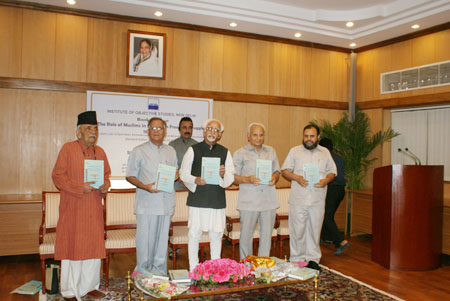
IOS Book on Freedom Struggle


L-R: Shri Akhilesh Mittal, Historian; Prof. Z.M. Khan, Secretary General, IOS; Shri M. Hamid Ansari, Hon'ble Vice President of India; Prof. Refaqat Ali Khan, General Editor of the Volumes; Prof. M. Afzal Wani, Member, Governing Council IOS

New Delhi, May 31: The Vice President of India, Shri M. Hamid Ansari released a three-volume book from the Institute of Objective Studies (IOS) titled “The Role of Indian Muslim’s in the Indian Freedom Struggle (1857-1947)” at the Vice President’s House here last evening.

As the chief guest of the ceremony, he said that he had already inaugurated the first volume sometime ago at the same venue, and had expressed the desire to the IOS Chairman Dr. M. Manzoor Alam to soon inaugurate the entire set.

Dr Alam was not in the country yesterday. The Vice President said he missed him on such a momentous occasion.

He said the freedom movement was a response of Indian people to British colonial dominance. They fought as Indians, not as followers of some religion or members of some caste or ethnic group.

However, they often articulated the struggle in religious terms like Jehad for freedom, or Gandhiji’s ideal of Ram Rajya.

The series editor of the book, Prof. Refaqat Ali Khan, emphasised the fact that 1857 was a people’s movement in which all sections participated. “The urban India at revolt had the armed support of the peasants and tribes.”

He said the Muslim struggle for independence was inclusive, a part of national struggle for freedom, in which all sections of society worked together. During the Non-Cooperation Movement, in many areas as many as two-thirds of those arrested were Muslims.

The argument that such massive participation of Muslims in Non-Cooperation Movement was due to the Khilafat Movement does not hold ground if one considers the equally large Muslim participation in the Civil Disobedience Movement.

Historian Akhilesh Mittal said the communal divide was the handiwork of the British. “In 1857 the country stood as one man. Among the warriors against the British, 31 percent were Brahims and 34 percent Rajputs.” However, over the decades the British succeeded in dividing them, he concluded.

The programme was conducted by Prof. Afzal Wani.

Sunday, May 27, 2012

The age controversy of Gen. V K Singh may open a Pandora’s Box


by MG Devasahayam 
Ex-IAS officer,

Tuesday, March 27, 2012


This agenda is in vast variance with the ‘growth aspiration’ the country started with at independence. In the vision of the Father of the Nation, Independent India would be sui generis, a society unlike any other, in a class of its own.

Gandhi’s India would not go for gigantic, FDI-funded development projects and large-scale industry and mining, typical of market-led growth under capitalism. Instead, India would pursue an equitable, participatory, small-is-beautiful, need-based, inclusive, balanced development while conserving nature and livelihoods. It is to nurture this socio-economic ethos that IAS was established and covenanted in the constitution.

The present-day neo-liberal agenda is just the opposite, seeking an India of market-making MNCs, millionaires and billionaires, a middle class of 300 million providing that market and the rest of 800 million Indians surviving as barely literate, malnourished multitude. This agenda is being driven by a new breed of adhocracy within the IAS that has come about through inbreeding and rank favouritism.

Ever since UPA government under Manmohan Singh assumed power (2004) two kinds of adhocracy have been shaping up. One was born of the ‘clan-within-clan’ inbreeding being practiced by a ‘linguistic-parochial’ group that at one point of time occupied almost every top-job in Delhi’s corridors of power.

The other is the ‘loyalist-core’ put together to implement the neo-liberal agenda. With the active participation of PMO patriarchs, spread of ‘clan-within-clan’ adhocracy was fast and furious capturing several key positions of ‘might and money’. And barring honourable exceptions, other coveted positions went to agenda-men anointed by the ‘Moneyed and the Mighty’.

Bureaucracy was meant to administer through laid down rules. The ICS was called the steel frame, precisely for this reason. ICS men viewed any deviation from the rules as a misdemeanor. Its successor, the IAS endeavoured to keep up the standards. Though there were hiccups, the bureaucratic system by and large ensured that men/women with merit were not denied their due place in promotions and postings.

Adhocracy on the other hand is being nurtured through blatant violation of processes and procedures to ensure that the top positions of Government, Joint Secretaries, Additional Secretaries and Secretaries, are held only by the clansmen and their agenda-abiding loyalists. Such adhocracy, which is antonymous to rule-bound bureaucracy, has substantially skewed and compromised the decision making process and standards. The result is for all to see; policy failure in almost all fronts, suffocating corruption and near total collapse of governance.

As if by intent, adhocracy seem to have permeated the Army Headquarters also as it did in the civil citadel. Sometime in 2005, out of the blue, the then Chief of the Army Staff (General JJ Singh) initiated the unique ‘look down policy’ to determine the ‘line of succession’ to the top position in the Army.

He was not looking for immediate succession but was looking deep-down to the year 2012 and found one favourite - Brigadier Bikram Singh. The Chief also realised that events and dates relating to the then Major General VK Singh, who was sure shot to become Army Chief in 2010, needed to be manipulated if Bikram Singh was to succeed him in 2012!

Once this sub-agendum was set, things started moving. Someone in the MS Branch ‘discovered’ VK Singh’s UPSC application form mentioning 1950 as his year of birth and this was the ‘brahmastra’ to be used to truncate and restrict VK Singh’s tenure as the Chief of Army Staff (COAS) to a two year period, so that the passage could be cleared for Bikram Singh to take over in May 2012. The massive documentary proof establishing 1951 as General’s YoB was ignored. A dismal charade of seeking ‘acceptance’ of 1950 from VK Singh as his YoB was played out.

But there were more hurdles. At that point of time, this favourite was not a front-runner as there were other officers ahead of him, who needed to be ‘eliminated’ at the COAS’s level itself with a bit of deft manoeuvring. A list was prepared, nick-named ‘Op MOSES’ which implied that the Chief would part the waters like in the ‘Ten Commandments’ for Bikram Singh to smoothly walk through! Like a family tree in reverse, Op MOSES listed few potential threats - Brigadiers and Major Generals of higher calibre - who were dealt with and pushed out one by one either through supersession and non-empanelment! For this purpose even ‘records of service’ were tinkered and tampered with and some even made to disappear.

The fallout of this crude manipulation indulged in by the military adhocracy was the sordid age-row of VK Singh that has rocked the nation. The actual DoB is a matter of record as rightly observed by the Supreme Court. But what is of concern is the manner in which the controversy was first stoked, then fanned and finally, brought into play. This calls for thorough investigation.

This is all the more urgent because it is alleged that TKA Nair, Principal Secretary to the Prime Minister was behind this brazen manoeuvring. Well before the age controversy came out in the open, Nair is reported to have told his confidants that VK Singh had to go in May 2012 because the ‘Prime Minister had assured his wife that General Bikram Singh would be the next COAS’. Incidentally this gentleman was the chief mentor of the civil service adhocracy!

We have seen the neo-liberal agenda for creating and nurturing the civil adhocracy. But what is the agenda for the military adhocracy? This begs the question. But corruption and carpet bagging could be a possible answer. It is believed that there are IB reports about massive kick-backs in the still-born Eurocopter deal and a top Army brass has reportedly transferred 22 million Euros (Rs. 145 crores) to his relative in Paris through hawala post. But unfortunately for him the deal fell through and he had the consternation of returning the moolah! As if to compensate, this man was rewarded with a coveted civil position with powers to award thousands of crores worth of construction contracts! Now, with huge weapon/equipment purchase deals either being processed or pending in the Army HQ a pliable adhocracy is needed to serve the MNC agenda.

With the state turning into a non-functioning kleptocracy, corruption is the common denominator between civil and military adhocracy. Of late we have seen several cases of swindling and misappropriation in which General Officers have been court-martialed and dismissed from service. Many more must be lying buried.

Sensing danger the civil-military adhocracy has combined to hound out General VK Singh who does not fit into the adhocracy mould. Bulk of the media including ‘reputed’ scribes and defense analysts partnered with the kleptocrats in this despicable task, which indeed is the real tragedy!

http://indiamydreamland.blogspot.in/2012/03/age-controversy-of-gen-v-k-singh-may.html

An Unpleasant Gift Dr Mohammad Manzoor Alam’s perspective on UPA-II’s three years in office and the beginning of the fourth.


Dr.Manzoor Alam

UPA-II’s anniversary celebrations seem to have come at an inopportune time. Caught up in a media blizzard, seemingly orchestrated to facilitate a transition in 2014, the Congress Party led UPA has few options.

Cornered and desperate to wriggle out of a sticky situation, the coalition is taking one mis-step after the other. Even measures that could make some economic sense would be political disasters as they do not go well with the voter.

A considerably large lobby within India and the United States is busy projecting Narendra Modi as the future prime minister of India – a business-friendly, no nonsense guy, who thinks he is some kind of a reincarnation of the “Iron Man”, Sardar Vallabhbhai Patel. Recently, the American news magazine Time  did a transparently dishonest cover story on him with the title, “Modi Means Business.”

The woman who did the story (Jyoti Thottam) did not ask the opinion of the sufferers of 2002 anti-Muslim pogrom or the activists who are fighting for their cause. For her, the sorrow of Muslims did not matter, and it had to be either excised out of the narrative or to be given an insignificant play. The net result was that the victims’ voices were silenced in the story.

Modi suits the global corporate agenda of overpowering the state systems of developing countries, silence the people’s voices and subvert their independent political agenda. A part of the propaganda against UPA is driven by this powerful lobby.

Not that UPA has not contributed to this in generous measure. It has always wanted to be seen doing things without really doing them. One example is a senior government minister claiming in public that 80 per cent of the Sachar Committee recommendations had been implemented.

The government’s chief economist, Kaushik Basu, has admitted in an interview to the Times of India  that decision-making has stalled in the UPA in the aftermath of repeated scams and an “excessively cautious bureaucracy.”

The economy is sputtering, causing worried foreign investors to withdraw their money. The rupee’s fall vis-à-vis the dollar is seemingly unstoppable. In that wake comes the Rs 7.5 hike per litre in petrol prices. Diesel and gas have soon to follow. Then will come the turn of other petroleum products like naptha, urea and all kinds of polymers and polyester yarn.

All this is going to create a havoc on the lives of common people because this will drive prices of every commodity in turn, pushing the cost of living for all of us. This is not a pleasant anniversary gift from the UPA-II.
 g

Wednesday, April 25, 2012

How Serious is the UPA Crisis?


Dr.Muhammad Manzoor Alam
Sonia and Rahul


The Congress-led UPA-II government at the Centre is completing three years in office next month. That is the time for review of its performance by its leadership as well as for an appraisal by the people at large and the opposition in particular.

Dr.Prime Minister Man Mohan Singh
In fact, the appraisal has already begun. The most vociferous in denigrating the government is, of course, the BJP, which does not carry conviction in any case unless you love to see riots and communal discord all around you.

For the BJP it is plainly a case of sour grapes. Naturally, it cribbed and carped on the first and second anniversaries of UPA-II. It has already started doing the same.

The BJP is at the centre of a grand international plan to discredit the UPA as business-unfriendly and inefficient, and build up Narendra Modi as the great achiever, the favourite of India Inc and a cheaper version of the Iron Man. With that kind of tactic it hopes to capture power at the Centre. If that requires the revival of the Ayodhya movement and communal polarisation, no problem. This party has by now accumulated enough experience to pull the trick at short notice.

But how does the UPA fare, irrespective of what the BJP says? Well, it is a mixed bag of achievements and missed opportunities. The assembly polls have shown that the main UPA constituent – the Congress Party – is not always a good choice for running the states. It is not the voters’ choice for running the Delhi Municipal Corporation either, as evident from the latest polls in Delhi. However, it does not mean that it is less suited to run the Centre than it was three years ago.

At this point we must remember that being capable is one thing and looking capable is quite another. The BJP looks capable of governance, but is not, while the Congress Party does not look capable, but is certainly more capable than the BJP. However, it does not look the part.

That said, the UPA has to remember that the good work it began must be finished within the period allotted to it.

The pro-people initiatives of Mrs Sonia Gandhi resulted in laws like Food Security Bill and empowering legislation like Right to Education Act. The Right to Information legislation has not only empowered the citizenry versus the state machinery, but also put curbs on corrupt practices in important ways.

The BJP is preparing an attack on UPA-II on the of its third year on corruption, but its own credibility has been seriously undermined by the record of men like Yedurappa.

As Indians we do not feel happy about the continuing high prices of essentials, and as Muslims we feel being treated like the “Other” by state agencies. Muslim youth are still being rounded up arbitrarily, tortured and thrown into jails on false charges.


On April 23, Justice Markandey Katju wrote in the Indian Express: “Today the situation is that whenever any bomb blasts take place, immediately Muslim groups and individuals are blamed for it.” How true! Sadly, all this is going on mostly under Congress-ruled states. The Congress-led UPA government at the Centre cannot absolve itself of its responsibilities. Surely, this is going to give it a negative rating.
  g

Muslims urged to fix priorities adopting collective wisdom

Dr.Muhammad Manzoor Alam


| 0 comments

New Delhi:

 The three-day 14th International conference organised by the well-known think tank Institute of Objective Studies, (IOS), on “Minority Rights and Identities: Challenges and Prospects in an Unfolding Global Scenario” here at the Constitutional Club of India concluded on Sunday last (April 15, 2012) with the consensus that in the Indian Constitution and the laws framed in the light of this grant rights to the minorities in all respects.


However, the ground reality is that in day to day life of the minorities, specially Muslim community, these rights granted by the Constitution remain a far cry and are not available to the Muslims, who feel cheated and are left high and dry. This not only leads to frustration in minorities but violation of the Constitution and the laws enacted therein also takes place.
Hence, it was felt it is utmost necessary that a law be framed that can be used against those responsible officials who in case do not comply and implement in letter and spirit the government’s decisions and policies for minorities formulated in the light of Indian Constitution and the existing laws and rules. Then only the minorities and other marginalised persons will be able to enjoy the fruits of development as other citizens of India.


Meanwhile, delivering the valedictory address at the end of the three-day conference Mr. K. Rahman Khan, Rajya Sabha member, requested IOS to dedicate the next 25 years after the silver jubilee celebrations as to what the Muslim community has to achieve priority wise through collective wisdom. The roadmap has also to be defined as to what will be the community’s role and contribution in India’s development. To attain this through collective wisdom first the community will have to sort out its differences by working within.


Mr. Rahman Khan lamented that the Muslim community has not done its job of what it should it get, what are its priorities and what is the roadmap of future. This job the government of the day cannot do for the community but it should be the collective wisdom of the community to do it.
“We are ourselves divided in views be it political, religious or social leadership. We are divided due to ego problem as no one is ready to sacrifice it”, he moaned.
  
Presiding over the valedictory function Dr. Mohammad Manzoor Alam, chairman of IOS who is devoted, dedicated and dignified personality, in his concluding remarks appealed Mr. Rahman Khan and Zafaryab Jilani, Additional Advocate General of Uttar Pradesh, to convey to the powers that be the hurt and painful feelings of the Muslim community about the illegal arrests of their innocent youths over trumped up terrorism charges and atrocities of police on them. He urged them to use their good offices to provide succour to the affected families in getting their wards released and end their woes.


Dr. Alam announced the formation of “Foundation for Education” by IOS for the poor, who have been deprived of education, on the occasion with an appeal to all and sundry to make contributions of minimum Rs.5 per month so as to create funds for the noble cause.


A 10-point resolution was adopted by voice vote during the valedictory function.

 The resolutions are: 1. A special committee may be constituted to draw future plan of actions based on carrying out the resolutions adopted in Silver Jubilee celebrations’ conferences and achieving basic objectives of creating synergy for security and welfare of marginalised sections in general and Muslims in particular;

 2. There should be a special drive to involve regional chapters of the IOS to study regional aspirations and adopt correct methodology for redressal of grievances at regional and national level;

 3. The IOS in consultation with all concerned should evolve a comprehensive blue-print for minority welfare in India in coming ten years with special reference to globalisation process;

 4. A committee of experts may be constituted to suggest measures for publicizing the understanding of Indian political and economic systems so that the Muslims are aware of all such processes including the electoral strategies; 

5. The IOS should take necessary steps to evaluate various commissions/committees’ report and suggest measures for their implementation;

 6. The IOS should constitute a specialised expert committee to suggest means to draw the attention of corporate sectors to minority potential, heritage and role in development;

 7. It is pertinent to reiterate and reinvigorate the need to have links of IOS with other institutions and organizations to push the agenda forward. The issues of research and survey should form the priority sectors of the policies and prgrammes;

 8. It is urgently needed to go for establishing legal aid cells to promote legal aid through spreading awareness among all sections of society and providing necessary relief to victims, if possible. The innocent Muslim youth, who are charge-sheeted must be tried on day to day basis;

 9. The IOS should coordinate with agencies concerning Muslim’s affairs in areas of awqaf properties in India. This sector needs urgent attention &

 10. It is felt that along with other measures, the recommendations of Sachar Committee and the Rangnath Mishra Committee’s reports should be evaluated and monitored from the point of view of their implementation and impact.

Earlier, Salman Khurshid, Union Minister for Law & Minorities Affairs, speaking after the special lecture of Dr. Abusaleh Shariff, president, Centre for Research and Debates in Development Policy, New Delhi, on “Post-Sachar Report: An Appraisal” said not only the proposal of Equal Opportunities Commission but there are many other issues on which there is no consensus in the whole country or Muslim community. So, it is necessary that first there should be consensus on any issue. As far as Equal Opportunities Commission is concerned its formation is possible but the Muslim community should first collectively agree over the proposal.


Mr. Khurshid said that he is in total agreement with the view of a section of the society that in a country like India there is no need at all for the Ministry of Minorities Affairs. This ministry in fact is Ministry of Coordination. The problems of minorities or Muslims cannot be solved alone by the Ministry of Minorities Affairs but for this departments of various ministries have to be involved, he explained.


He said that reservation of 4.5 percent given to minorities under OBC quota does not mean that they would not get under other provisions. He pointed out that in nine and ten states of the country minorities have been given reservation under sub-category as such they have been given this 4.5 percent reservation under this sub-category. This is half of 8.44 percent, he added.
  
Dr. Abusaleh Shariff, who is also chief economist, National Council of Applied Economic Research, New Delhi, while making a Power Point presentation on “Five Years After Sachar Report 2004-05 to 2009-10” said the report has 14 chapters of which many chapters have not been debated and analysed.


Dr. Shariff said there exists a very wrong general perception about Sachar Committee Report that it has been prepared keeping in mind only the state of affairs of Muslims and their problems. However, the truth is that the report has been prepared while comparing position of Muslims with other religious communities and groups. So, it is better not to call the report of any particular community but term it as a “Relative Report”.

 He candidly said that India can become an eminent nation only when every citizen of the country is given equal opportunity.

Meanwhile, Dr. Arshi Khan, Associate Professor of Political Science & the Director of the Centre for the Promotion of Educational and Cultural Advancement of Muslims of India, AMU, Aligarh, spoke on redefining Minority Rights in India as the constitutional provisions like Article 29 and 30 are only meant for cultural and educational rights whereas these rights have proved to be inapplicable due to the enabling factors like political safeguards.


Dr. Arshi said that India is a plural society where democracy is not limited to merely elections and majority rule but the test of democracy rests with the ability of the government and the State to protect the interests of minorities. Muslims minority is a cultural and religious community and its culture is not the basis of political culture of India or the basis of the State. Merely existence of minority in numbers do not qualify a country to claim democracy but how far this largest minority feels to be the part of the State is the most important aspect.


He said that there are scores of violence, incidents, discriminations, violations of human rights and character assassination of the members of the Muslim community in the country which have not been even partially addressed by the successive governments in the last 60 years. There is a need for the recognition of the fact that Muslims have equal political rights but the enforcement agencies and political elite including many civil societies have not treated them as equal citizens. Therefore, there is a need to view such matters seriously and to take corrective measures to make India a vibrant country in the world, he emphasized.

Friday, April 20, 2012

Chief Minister Ms.Jayalalithaa acceds demands of Dr.Jawahiurllah.


Dr.Jawahirulla, MMK leader and Member of Legislative Assembly (MLA), Ramnad Constituency, who strove for funds, Rs.One Crore(US $209292.591) annully,for Tamil Nadu Urdu Academy,  hails   success while Chief Minister Ms.Jayalalithaa acceded to his demands.


Dr.M.H.Jawahirulla came up at the ongoing Assembly Sessions, telling the plight of Urdu Academy, an organisation which is almost at a verge of extinct, lacking needed funds, care and attention hitherto failed from all sections authorities.


Dr.Jawajirullah who has been fighting tooth and nail to fill the gaps for Urdu teachers in the vacant post in Urdu medium schools, and champion of every section, be it economic failure, deprived society, or any language disparity, exhorted on Urdu Academy, in the Tamil Nadu Legislative Assembly, on Thursday, drawing attention of Ms.Jayalalithaa, what she once promised for the welfare of Urdu Academy in an Iftar Party held way back in 1996 at S.I.E.T.Women’s College, Chennai.


Dr.Jawahirullah also proposed to the Chief Minister Ms.Jayalalithaa, that the Urdu Academy should fetch from the TN government a sum of Rs.One Crore   annully, a staffed secretariat to be established for the purpose. He also put forth a scheme that a girls’ college may be established in Ambur (Vellore Dist) just to avoid the hassle of running to the colleges far away from Ambur.


Tamil Nadu Urdu Academy, Dr.Jawahirullah,MMK,TMMK,Ms.Jayalalalithaa,Chief Minister Tamil Nadu


Tamil Nadu Urdu Academy:Allot Rs.1 Crore Each Year:Jawahirullah

Assembly speech of Dr.Jawahirulla in the Tamil Nadu Assembly on April 19-2012

Monday, April 9, 2012

இரண்டு பிரதம அமைச்சர்கள், தலைமை ஒரு டெஸ்ட் ...?

ஆனால் பிரதம மந்திரி மன்மோகன் சிங் மற்றும் ஜனாதிபதி சர்தாரி தலைமைத்துவத்தை சோதனை கருத்துரைகள் டாக்டர் முகமது மன்சூர் ஆலம், முன்னே உள்ளது.

மும்பை 26/11 தாக்குதல்களுக்கு பிறகு, 2008 ல் இந்தியா பாக்கிஸ்தான் உறவுகளை நிறுத்தி விட்டது. பனி பாக்கிஸ்தான் இருதரப்பு வர்த்தகத்தில் கணிசமான அதிகரிப்பு அதாவது இந்தியா, அன்று (MFN) நிலை பெரும்பாலான Favoured நேஷன் நல்வாழ்வை உடன் மாந்திரீகம் தொடங்கியது.


க்வாஜா மொயின்ருட்டின் கிருஸ்டி உள்ள அஜ்மீர் தர்காவில் ஜனாதிபதி அரிப் அலி சர்தாரி பயணம் ஆழமான கலாச்சார பத்திரங்கள் துணைக்கண்டத்தில் பங்குகள், உடைக்கமுடியாது அந்த பத்திரங்களை அடையாள உள்ளது, ஆனால் மேலும் வலிமை இருக்க வேண்டும். இது MFN நிலையை பிறகு மேலும் ஒரு படி.


சைகை அம்மாநிலத்தை PM அவர்களுக்கு ஏற்பாடு விருந்தில் பிரதமர் மன்மோகன் சிங் மற்றும் காங்கிரஸ் பொது செயலாளர் ராகுல் காந்தி பரஸ்பரம்.


ஜனாதிபதி எண்டொரேஜின் பிலாவல் பூட்டோ ஜர்தாரி நாட்டின் சேர்க்க விருப்பத்தோடு நான்கு தசாப்தங்களுக்கு முன்னர் திருமதி இந்திரா காந்தி சிம்லா மாநாட்டில் அவரது தந்தை பிரதமர் சுல்பிக்கார் அலி பூட்டோ இணைந்த 19 வயது பெனாசீர் பூட்டோ இந்தியர்கள் ஞாபகப்படுத்தியது.


இந்தியா மற்றும் பாக்கிஸ்தான் அடிக்கடி கடினமாக ஒருவருக்கொருவர் வாழ கண்டுபிடிக்க, ஆனால் அவர்கள் கூட அவர்கள் ஒருவரை ஒருவர் இல்லாமல் வாழ முடியாது என்று. அவர்கள் இறுதியில், அவற்றின் வேறுபாடுகள் வாழ கற்று கொள்ள வேண்டும் என்று அவர்கள் மத்தியில் இவ்வளவு பொதுவான உள்ளது. வட்டம், கற்றல் செயல்முறை தொடங்கியுள்ளது.


பார்வையில் கணம் ஆவி வைத்து, இந்தியாவின் ஹபீஸ் பசு பி அதுவும் கடுமையான பிரச்சினை அழுத்தவும் இல்லை, யாருக்கு, ஐக்கிய அமெரிக்க ஒரு $ 10 மில்லியன் ஊக்கத்தொகை அறிவித்துள்ளது.


அதே ஆன்மாவிலும், பாக்கிஸ்தான் கூட பல பாகிஸ்தானியர்கள் மற்றும் இந்திய முஸ்லீம்கள் கொல்லப்பட்டனர் இதில் ரயில் எக்ஸ்பிரஸ் குண்டுவெடிப்பு, பிரச்சினை அழுத்தவும் இல்லை.


இருவருக்கிடையில் (அ) இரு கட்சிகளுக்கிடையில் நல்லிணக்கம் ஏற்படுதல் மற்றும் நம்பிக்கை கட்டிடம் நடவடிக்கைகளை சார்க் மற்றும் அப்பால் தங்கள் வரலாற்று பங்கை இந்தியா மற்றும் பாக்கிஸ்தான் தொடரும் வேண்டும்.


இதுவரை, மிக நல்ல. பிரதமர் மன்மோகன் சிங் ஜனாதிபதி சர்தாரி அழைப்பு அன்று பாக்கிஸ்தான் சென்று போன்ற கடினமான வேலை முன்னால் விரும்புகிறார். சியாச்சின், சர் கிரீக் மற்றும் நீரிழிவு "கே" பிரச்சினை போன்ற கடினமான பிரச்சினைகளை மேசையில் வந்து. எல்லாதாண்டிய பயங்கரவாதம் எந்த குறைவாக அச்சுறுத்தலும் இருக்கும்.


சிறந்த வரலாற்றின் இந்த கட்டத்தில் ஒருமித்த உள்ளாகாத விடயங்களின் மூலம் கீழே சிக்கி் தகுதிகள் இல்லாமல், உறவுகளை ஆழப்படுத்த மற்றும் ஒத்துழைப்பு வலுவூட்டுவதற்கு இருக்கும். ஒத்துழைப்பு, இல்லை மோதல் பதில்.


دو نخست وزیر، یک تست برای رهبری ...؟


اما آزمون از رهبری برای نخست وزیر سینگ و زرداری رئیس جمهور در پیش روست، دکتر محمد MANZOOR علمAlam.


پس از حملات 26/11 در مومبای، در سال 2008 روابط هند و پاکستان بود یخ زده است.
یخ شروع به ذوب با پاکستان اعطا مورد علاقه اکثر ملت 

(MFN) وضعیت در هند، که به معنی افزایش قابل توجهی در تجارت دو جانبه است.

سفر رئیس جمهور عارف علی زرداری به dargah Ajmer خواجه Moinuddin Chishti به پیوندهای عمیق فرهنگی شبه قاره سهام، اوراق قرضه که نشکن نمادین است، اما نیاز به تقویت بیشتر می شود. این هم یک گام به جلو بعد از وضعیت MFN است.


حرکت به گرمی توسط مانموهان سینگ، نخست وزیر و دبیر کل کنگره راهول گاندی متقابلا در ناهار PM سازماندهی برای آنها شد.
گنجاندن بلاول بوتو زرداری در همراهان ریاست جمهوری از روی علاقه به یاد سرخ پوستان از بی نظیر بوتو 19 ساله همراه پدرش نخست وزیر ذوالفقار علی بوتو در اجلاس Shimla چهار دهه قبل با خانم ایندیرا گاندی.
هند و پاکستان اغلب پیدا کردن آن مشکل با یکدیگر زندگی می کنند، اما آنها همچنین می دانیم که آنها نمی توانند بدون یکدیگر زندگی می کنند. بسیار بین آنها مشترک است که آنها باید یاد بگیرند با تفاوت های خود زندگی می کنند، در نهایت وجود دارد. با امیدواری، فرایند یادگیری را آغاز کرده است.
نگه داشتن روح از لحظه ای در نظر، هند بیش از حد سخت موضوع سید حافظ را فشار دهید، در آنها ایالات متحده اعلام کرده است جایزه 10 میلیون دلار است.
در همان روح و معنا، پاکستان بیش از حد بود موضوع Samjhauta انفجار اکسپرس، که منجر به کشته شدن بسیاری از پاکستانی ها و مسلمانان هند را فشار دهید نیست.


اقدامات ایجاد روابط حسنه و تنش زدایی و اعتماد سازی برای هند و پاکستان همچنان نقش تاریخی خود در سارک و فراتر از بازی.


تا کنون، خیلی خوب. سخت تر کار را دوست دارد پیش به عنوان دیدار مانموهان سینگ، نخست وزیر پاکستان به دعوت رئیس جمهور زرداری است. مسائل مربوط به سخت تر مانند Siachen، سر نهر و مخوف "K" مسئله در جدول آمده است. مرزی با تروریسم خواهد بود که کمتر دلهره آور است.


بهترین مسیر برای تعمیق روابط و همکاری را تقویت خواهد شد، بدون گرفتن مسائلی که مخالف اجماع در این مرحله از تاریخ گرفتار. همکاری، تعارض نیست پاسخ 

است. گرم در