Thursday, October 27, 2011

Media should be on people’s side: Katju


By Shafee Ahmed Ko,
Bangalore: Former Supreme Court judge Markandey Katju has asked media to be on people's side. He criticized media for highlighting cricket, Hollywood and celebrity news instead of social issues such as poverty, unemployment and inflation. This attitude of media diverts mass attention from the real problems in the society.
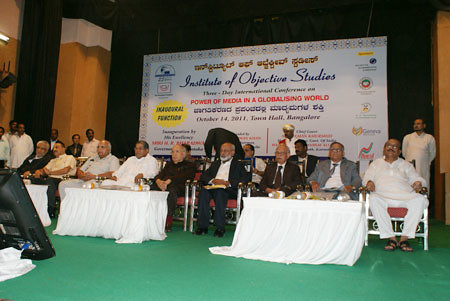
Justice Katju, who was recently appointed Chairman of Press Council of India, was addressing the concluding session of three-day international conference on ‘Power of Media in Globalizing World’. The conference was organised by the Institute of Objective Studies (IOS) here from 14-16 October.


Three-day international conference on ‘Power of Media in Globalizing World’ was organised by Institute of Objective Studies (IOS) from 14-16 October in Bangalore
In his valedictory address, Justice Katju strongly opposed the media for blaming whole minority community for terrorist attacks. He said that every community, be it Hindu or Muslim, has negative elements in it but that does not mean the whole community is bad.
Earlier, the three-day international conference organized by IOS was inaugurated by Karnataka governor H R Bhardwaj on October 14 here at Sir Puttanna Chetty Town Hall in Bangalore. He spoke briefly about the power of media in political awareness. While K Rahman Khan, deputy chairman of Rajya Sabha, presided the inaugural session Salman Khurshid, Union Law Minister was the chief guest.
IOS chairman Dr Manzoor Alam addressed the gathering and spoke about media ethics and responsibility. Vinay Shiri Gautam discussed modernization of media with reference to several social networking sites and its service to people connecting different countries.
Former vice-chancellor of Mangalore and Goa Universities Prof B Sheikh Ali was conferred the Lifetime Achievement Award on the occasion.

Wednesday, October 26, 2011

Amicus report lays the ground for chargesheeting Narendra Modi

VIDYA SUBRAHMANIAM
Rejects SIT's decision to close case against Gujarat CM
The report of Raju Ramachandran, the amicus curiae in the Zakia Jafri case, has laid the ground for Narendra Modi to be charge-sheeted for his alleged role in the 2002 anti-Muslim Gujarat pogrom.
The report is still confidential, though it has now been shared with the Special Investigation Team set up by the Supreme Court to investigate and prosecute cases stemming from the 2002 violence in which more than 1200 persons were killed.

According to informed sources in Ahmedabad, who briefed The Hindu on the report's contents, the report strongly disagrees with the SIT's view that no case against the Gujarat Chief Minister was made out. It says that only the cross-examination of senior Gujarat police officers, including Sanjiv Bhatt — who stated that he was present when Mr. Modi instructed police officials to allow Hindus to vent their anger — could establish whether the Chief Minister was innocent or guilty.

Significantly, the report also says that Mr. Bhatt's statement was made probable by the presence of two Ministers in the Ahmedabad Police Control Room (PCR) at the time Muslims were being attacked.
If the trial court accepts Mr. Ramachandran's view, the sources said, the stage will have been set for the prosecution of the Chief Minister under various sections of the IPC, among them, 153 A (statements promoting enmity between communities), 153 B (imputations and assertions prejudicial to national integration) 505 (statements conducing to public mischief) and 166 (public servant disobeying a direction of the law with the intent to cause injury).

Under Section 166, any public servant who disobeys a direction of the law as to how he should conduct himself as a public servant and knowing the act will cause injury is liable to be punished with imprisonment for a term extending to one year. As the chief executive in control of the administration, Mr. Modi was especially under obligation to quell the riots, the sources said.

The SIT was tasked by the Supreme Court to investigate Ms. Jafri's complaint against Mr. Modi and 61 others. The Court subsequently asked Mr. Ramachandran independently to evaluate the reports filed by the SIT by interacting with witnesses.

The sources said the SIT recommended closing the case against Mr. Modi on the grounds that police officer Bhatt, who was vital to fixing blame on the Chief Minister, was a controversial and unreliable witness. The SIT also concluded that there was no material on record to show interference by the two Ministers who were present in the PCR when Muslims were being attacked across Ahmedabad.

In his testimony to the SIT, Mr. Bhatt had said he was present at the February 27, 2002 meeting where Mr. Modi instructed top police officials to allow Hindus to “vent their anger” against Muslims. The meeting was held late in the evening at the Chief Minister's Gandhinagar residence. The SIT said none of the other officers present at the meeting had corroborated Mr. Bhatt's presence.

The sources said the amicus disagreed with the SIT's conclusions, arguing that evidence has to be weighed and not counted, and this can happen only when Mr. Bhatt and others present at the meeting are cross-examined in the trial court. The amicus' view was that it would be premature and presumptuous to close the case against Mr. Modi without an adversarial party putting the other officers to rigorous questioning: Mr. Bhatt could turn out to have lied. Equally, other officers present could turn out to have lied.

The amicus was in fact credited with the view that the presence in the police control room of two Ministers unconnected to the Home portfolio probablised Mr. Bhatt's statement. More so because the SIT had itself suggested that the Ministers had the Chief Minister's blessings (Tehelka magazine which scooped the SIT report quoted Mr. Raghavan as saying that the presence of the two Ministers fuelled speculation that they were there with Mr. Modi's blessings.)

If the view of the amicus is rejected by the SIT, Ms. Jafri and her co-complainant Teesta Setalvad will have the option to contest it in the trial court. The court can also form its own, independent opinion on the views of the amicus.

Khaki and saffron


Frontline
Volume 28 - Issue 22 :: Oct. 22-Nov. 04, 2011INDIA'S NATIONAL MAGAZINE
from the publishers of THE HINDU


PURNIMA S. TRIPATHI
in Rudrapur

Rudrapur, an industrial town in Uttarakhand, witnesses large-scale rioting and clashes of a communal nature.
PTI 

Vehicles set on fire near a police station in Rudrapur town on October 2.

THE Garhwal and Kumaon regions, which constitute the tiny hill State of Uttarakhand, were totally free of communal disturbances even when the entire country was in the grip of tension following the demolition of the Babri Masjid in Ayodhya in 1992 and the Mumbai blasts in 1993. These regions had always maintained communal peace. But on October 2, the bustling industrial town of Rudrapur, located in the foothills of the Kumaon hills in Udham Singh Nagar district, became the venue of the first communal riots in the State.

The Bharatiya Janata Party (BJP) has been taking great pains to explain that the 2002 Gujarat violence was an exception, something that could not be avoided. What happened in Uttarakhand for three days from October 2 proves yet again that with the BJP at the helm of affairs, the administrative machinery does look the other way when members of the Muslim community are targeted by the majority community.

Rioting went on for three days, and shops and houses of Muslims were looted and set on fire. The town was brought under indefinite curfew following widespread clashes between Hindus and Muslims in which three persons were killed and some 100 injured, some of them grievously. Several people are reported missing. Being an industrial hub, Rudrapur has a large population of migrant labourers; these people are now fleeing the town. At the time of writing this report (October 9), night curfew was continuing and reports of sporadic incidents of violence were coming in.

The mayhem could have been avoided had the administration been more vigilant. The first provocation came on September 29 when miscreants allegedly packed beef and pages torn from the Quran in a bloodstained cloth and placed it outside a Shani temple in Bhadaipura mohalla. Members of the Muslim community, agitated over the desecration of the Quran, demanded action against the culprits, but the administration did not act. The alleged act of sacrilege was repeated in the same mohalla on the night of October 1. This time, pages from the religious book were wrapped in a sheet of paper along with pork and thrown outside the house of one Mustaq Ahmad.
The following morning, over 100 Muslims gathered at the town kotwali (police station) to demand action and resorted to stone throwing, in which some policemen and the Sub-Divisional Magistrate, Vir Singh Budhiyal, sustained injuries.

 The police chased the crowd away by resorting to a lathicharge. However, the Muslims regrouped, and this time a thousand people gathered outside the police station at Indira Chowk, stoned the police, damaged and burnt vehicles that were parked there and threatened to set the station on fire. At this stage, the police reportedly sought the help of the Hindu residents of the nearby Rampura mohalla and, thereafter, the two communities started clashing with each other. Soon the clashes spread to the entire city.

Justifying the police action of calling the Hindu residents to control the Muslim crowd, the new Deputy Inspector General (DIG) of Police, Abhinav Kumar, said that it had been done to save the police station from being burnt down as the number of police personnel available was not sufficient to protect it. But why was the police force not strengthened when signs of trouble were evident on September 29 itself? Besides, two battalion headquarters of the Provincial Armed Constabulary (PAC) are located within three kilometres of the trouble spot. Why were local residents enlisted to join the police action instead of calling for reinforcements from the PAC?
Facing criticism for mishandling the situation, the B.C. Khanduri government removed DIG Amit Sinha and District Magistrate B.V.R. Purshottam. Nobody has answers to questions about the clashes. Abhinav Kumar, who took charge on October 4 after Amit Sinha was removed for perceived lack of efficiency, only offers conjectures. The new District Magistrate, B.S. Jangpangi, only says there was some inefficiency in handling the situation initially.

The initial administrative apathy, however, took a toll on the town. Scores of houses and shops belonging to Muslims were burnt and looted, leaving the community with a deep sense of fear and injustice. The two communities had coexisted without any trouble, but now there is a divide and a sense of mistrust. What has compounded the feeling of insecurity among the Muslims is the fact that not a single leader from the ruling BJP or the government offered their sympathies even six days after the incident. The Chief Minister visited the town on October 3, but he neither met the victims nor visited the affected areas.
PTI 

The police lathicharge the protesters.

This correspondent saw rows of burnt shops in Bhadaipura, Kicchha Road, Transit Camp, the main Durgadevi Road market and Gandhi Colony. In the Durgadevi Road market where shops owned by Hindus and Muslims stood side by side, miscreants had selectively targeted those belonging to Muslims, thrown the goods on the road and set them on fire. In areas where there were rows of shops owned by Muslims, as in Bhadaipura, they were all burnt down.

Asif Ali, an elderly person who had been running an electrical goods shop in Gandhi Colony since 1976, is inconsolable. He told this correspondent that he kept calling up the police helpline when the miscreants were looting and burning his shop, but he heard only laughter on the other side. No police came to help him. He has incurred a loss of roughly Rs.15 lakh. Similarly, Rais Ahmad, who washes and irons clothes in the same area, had his house looted and all his belongings burnt. “We ran away to save our lives, nobody came to protect us,” says Ahmad's wife. Now they do not know where to go, for Ahmad was born here and grew up thinking this was his home. Suddenly he is feeling insecure and vulnerable.

There are others with similar harrowing experiences. Qauser Ali's ironworks shop in the Transit Camp area, Mohammad Omar's cycle shop, and Mohammad Sultan's tailoring shop in the Durgadevi Road market area were all targeted. Sultan, who employed 15 people, has suffered a loss of Rs.15 lakh. “With the administration turning a blind eye to those who burnt and looted our shops, where do we go now for help?” he asks. “If the administration had taken action against those who were responsible for the desecration of the Quran, this trouble would not have happened in the first place. Our grievance went unheeded, naturally there was anger among the people and they gathered at the police station to protest. But why is the government not paying attention to our grievances?” a member of the Muslim community asked this correspondent.
This sense of denial of justice is deepening by the day because the real culprits, who have been named by eyewitnesses, have not been questioned by the police, whereas several Muslims have been rounded up. Many of the alleged attackers are said to be close to BJP and Congress leaders. Eyewitnesses claim to have seen Hindus with Congress and BJP affiliations leading the mobs that set shops on fire.

The district administration too agrees that “the role of political parties cannot be denied in this” but has stopped short of taking any effective action. According to political observers, the Assembly elections scheduled for early next year is making the two political parties nervous and hence the attempt at communal polarisation. “Both the BJP and the Congress are trying to fish in troubled waters,” says Tejinder Singh Virk, a member of the local traders' association and State secretary of the Samajwadi Party.What is shocking is that the members of the Hindu community see nothing wrong in the police seeking their help to quell the agitating Muslims. Mohit Chauhan, an educated youth working in a leading hotel in the town, said, “After all, the Muslims were the ones who started it all. Why did they throw stones at the police station? If they thought there would be no retaliation for their actions, then they have surely learnt a lesson now.”
A Hindu shopkeeper in Gandhi Colony is also of the view that the police were right in seeking the help of the residents of the Hindu-dominated area to control the Muslims as the police station did not have sufficient personnel.

“The police, all young men without training in handling such a situation, were not even equipped with weapons. The trained policemen of the former Uttar Pradesh Police went back to the parent cadre when the State was bifurcated. The concept of mitra police [people-friendly] has done much harm to the morale of the forces. Had the Hindus not assisted them, the police would have been lynched by the mob,” he said. But why harm innocent Muslims instead of those who started the violence? “This happens in any such situation, nobody can help it,” shrugs a shopkeeper at the Durgadevi Road market.

Thursday, October 20, 2011

Moammar Gadhafi dies of wounds after capture: report


Read more: http://www.montrealgazette.com/news/Moammar+Gadhafi+dies+wounds+after+capture+report/5579555/story.html#ixzz1bKNjdiJ0


SIRTE, Libya - Former Libyan leader Moammar Gadhafi died of wounds suffered on Thursday as fighters battling to complete an eight-month-old uprising against his rule overran his hometown, Sirte, Libya's interim rulers said.

His killing, which came swiftly after his capture near Sirte, is the most dramatic single development in the Arab Spring revolts that have unseated rulers in Egypt and Tunisia and threatened the grip on power of the leaders of Syria and Yemen.

"He (Gadhafi) was also hit in his head," National Transitional Council official Abdel Majid Mlegta told Reuters. "There was a lot of firing against his group and he died."

Mlegta had told Reuters earlier that Gaddafi, who was in his late 60s, was captured and wounded in both legs at dawn on Thursday as he tried to flee in a convoy that NATO warplanes attacked. Mlegta said Gadhafi had been taken away by an ambulance.

There was no independent confirmation of his remarks.

An anti-Gadhafi fighter said the ex-dictator had been found hiding in a hole in the ground and had shouted "Don't shoot, don't shoot" to the men who grabbed him.

His capture occurred within minutes of the fall of Sirte, a development that extinguished the last significant resistance by forces loyal to the deposed leader.

The capture of Sirte and the death of Gadhafi would mean Libya's ruling NTC can begin the task of forging a new democratic system, which it had said it would get under way after the city, built as a showpiece for Gadhafi's rule, had fallen.

Gadhafi, wanted by the International Criminal Court on charges of ordering the killing of civilians, was toppled by rebel forces on Aug. 23 after 42 years of one-man rule over the oil-producing North African state.

NTC fighters hoisted the red, black and green national flag above a large utilities building in the centre of a newly captured Sirte neighborhood Thursday, and celebratory gunfire broke out among their ecstatic and relieved comrades.

Hundreds of NTC troops had surrounded Sirte, a Mediterranean coastal town, for weeks in a chaotic struggle that killed and wounded scores of the besieging forces and an unknown number of defenders.

NTC fighters said there were a large number of corpses inside the last redoubts of the Gadhafi troops. It was not immediately possible to verify that information.


Read more: http://www.montrealgazette.com/news/Moammar+Gadhafi+dies+wounds+after+capture+report/5579555/story.html#ixzz1bKNTf5Ge

Sunday, October 9, 2011

Hindus and Muslims in India


There are umpteen websites to tarnish the Image of Islam. It's not new. It has been right from the days of Prophet Mohummad (Sal).

The Moguls ruled 800 hundred years. But the population of Muslim till October 2009 remains only 160,945,000 (13.4 per cent)-http://en.wikipedia.org/wiki/List_of_countries_by_Muslim_population.If the Moghuls had been fanatic rulers, the percentage of Muslim population would have been much higher by way of proselytism.But it did not happen.

This is obvious history that British prospered in India by preaching sectarianism, and pampering Brahmins, and they ruled India by divide and rule policy. 

There are scholarly retaliatory answer to all subversive  attempts. The following article by Dr.Nobel Laureate Professor Amartya Sen is a fitting answer to the fanatics.

'India's Two Great Emperors Were Both Non-Hindu'
Clipping (55kbs) - Outlook, 21-01-2002. By Subhoranjan Dasgupta
Record Number : A0355244
Click to browse by keyword: Education History Hindutva Religion


'India's Two Great Emperors Were Both Non-Hindu' 
http://www.cscsarchive.org:8081/MediaArchive/education.nsf/(docid)/C8B1B1D6979C15B9652571850021F04A
On the Hindutva version of Indian history - and how India was never a Hindu rashtra.

Though extremely busy with a workshop on 'education, equity and human security' in Calcutta, Nobel Laureate Professor Amartya Sen still took time out to talk to Outlook, and articulate his views on the Hindutva version of Indian history. Sen had condemned the Babri Masjid demolition in 'Threat To Secular India', published in the New York Review shortly after the epoch-changing incident. Here he describes the Hindutva version of Indian history as sectarian and combative, and argues that India was never a Hindu rashtra. Excerpts from an exclusive interview with Subhoranjan Dasgupta:

In your address to the Calcutta History Congress last year, you described the spirit and discipline of history as 'capacious heterodoxy'.

"To study history, we have to have a sense of space. Heterodoxy is important in understanding history." 

That's a wonderful expression. Could you please elaborate on it?

Well, I'm glad you like the expression. What I intended to say by that is that in order to study history, we have to have a sense of space—that there could be different ways of looking at past events and in case there are differences, we should be able to argue it out. Heterodoxy is important because understanding history requires different approaches. Furthermore, heterodoxy itself is sometimes among the most interesting things to study in the history of a civilisation or a culture. So, for both these points of view—heterodoxy as a method and as well as a subject matter to be studied—history has to be deeply concerned, I believe, with it. If you want to know what exciting things are happening at a certain period in a certain country, you look not just at what the ongoing tradition is, but where people are disagreeing and in what way. I am not a historian but that is the way I tend to see history, a subject on which I occasionally try to write and which I greatly like reading.

If the study of Indian history is infused by this spirit, what sort of textbooks should our schoolgoers be reading? Because there is a current effort, for instance, to portray the Muslim period as an age of darkness. 

Obviously blacking out the Muslim period—what you are describing as the "Muslim period"—as an age of darkness would be just a gross mistake. Textbooks should contain truths rather than falsehoods. It's not just a matter of understanding our past, but also our present. If you look at anything today—Indian painting, music, literature, philosophy, history itself as a discipline—the great contributions of Muslim scholars, intellectuals and artists are part and parcel of the richness of Indian civilisation. I think it's also important to emphasise that we cannot talk about the history of this period as if it could be split into Muslim activities and Hindu activities. They were interactive. Really, in every branch of art or intellectual study, you will find Hindu and Muslim activists, artists and scholars working side by side and interacting with each other. So, there's no way we can talk about the period without taking into account the massive contribution made in an interactive way by those who happened to be Muslims by religion as opposed to others who were Hindus or Sikhs or Parsis or Christians.

"There is a 'category mistake' in thinking that comparisons with terrorists is a cogent way to assess historians."

Your grandfather Kshitimohan Sen wrote the classic text Hinduism (Penguin Books, 1960). In what basic sense does his vision of Indian history and civilisation, or for that matter the vision of Rabindranath Tagore, differ from the saffron family's version?

I shouldn't really comment on this as I am not a great expert on Hindutva of any kind, and my role in my grandfather's book on Hinduism was primarily that of a translator.

I think the remarkable difference between the book and a sectarian view of Hindutva is that my grandfather's as well as Tagore's vision is not combative at all. They were both keen on seeing what different influences operated on Hinduism. Both authors locate themselves in an interactive environment. In The Religion of Man, the lectures that Tagore gave at Oxford, he mentions that his family was situated at the confluence of three sets of influences—Hindu, Muslim and European. The same would apply to my grandfather. As a Sanskritist, he was educated in Benares, in traditional centres of learning, which were, at that time, open and non-sectarian.

"In 'The Religion of Man', Tagore mentions his family was situated at the confluence of three sets of influences—Hindu, Muslim, European."

I should also mention that one of my grandfather's books—which I don't think is available in English, only in Bengali, called Hindu Musalmaner Jukta Sadhana (The Joint Work of Hindus and Muslims)—is quite a major work in the cultural history of India, showing that there is no substantial area of artistic or intellectual activity in which Hindus and Muslims have not worked together. You cannot think of Hindus and Muslims as somehow mechanically mixed together, rather than being chemically compounded in an integrated civilisation.

Isn't there an affinity between the saffron version of Hindutva and Samuel Huntington's categorisation of Indian civilisation as Hindu?

I think you are right there that Huntington's description of Indian civilisation as Hindu civilisation almost seems to be taken out of the writings of the Hindutva champions. In Huntington's case, the problem was that he wanted to classify the world according to one principle only and that was what he called 'civilisation', which in his case ended up being primarily religion. So he had to contrast Islamic civilisation with Western, Christian civilisation or Buddhist civilisation, etc. Then, well, how do I accommodate India? Since Islamic was already spoken for, he classified India as just a Hindu civilisation. Well, that's a serious mis-description. India has more Muslims than any country in the world with the exception of Indonesia and marginally Pakistan. Also, the entire cultural and intellectual history of India has been an integrated one, as we just discussed.

Historian Romila Thapar has described Hindutva's history as propaganda where the past is manipulated as political instrument. What is the political goal in question—a Hindu rashtra?

Well, I don't really know what the political goal in question is. Romila Thapar, of course, is one of our leading historians. I haven't seen this particular writing of hers, but I guess what she's pointing out is that a lot of writing on history by people who are champions of Hindutva seems to have an underlying political agenda. Whether this is meant to be a preparation for a Hindu rashtra or whether it is just a misunderstanding of the nature of India, I don't know. You have to ask them.

India was never a Hindu rashtra, even before Muslims came to India. In the first millennium BC as well as the millennium that followed, the Gupta period for example, India had a powerful presence of Buddhism along with Hinduism and Jainism. Christians came to India by the 4th century AD latest, and there were Christians here well before there was a single Christian in Britain. Similarly, Jews came to India very early. Parsis came when persecution began in Iran. Also, Muslims came first as traders across the Arabian Sea, well before the Muslim military conquests in the north. India has had a variety of religious influences all this time. Just to mention one thing—if you are thinking of the two greatest emperors of India, you would tend to think of Ashoka and Akbar. One was a Buddhist and the other a Muslim.

Must a 'Hindutva' history necessarily depend on half-truths, lies and legends to sustain itself? For example, that ancient India revered the cow as 'gomata' and did not consume beef; that Akbar was a foreigner, despot and sectarian?

Well, I think if one has a particular way of looking at the past and if there are uncomfortable facts which do not fit into that narrow way of looking, then the proponents of that way of looking would naturally tend to deny the facts.It's fairly easy to point out that these are not half-truths; these are not truths at all. Actually, I can give you many other examples of this kind.

"The introduction of European scholars to the Upanishads was mostly based on the Persian translation by Dara Shikoh."


Could you give just one?

The introduction of European scholars to Hindu scriptures, in particular the Upanishads, was to a great extent based on the Persian translation of the Upanishads done by Dara Shikoh, the first-born son of Shah Jahan. Dara Shikoh was not a great Sanskrit scholar but he did work hard with the help of Hindu pundits to learn Sanskrit and he translated parts of the Upanishads into Persian. It is this translation that William Jones (pioneering Indologist) first read which attracted him to India and to the study of the Hindu religion. Quite a lot of the revival of our understanding of our Hindu past was based on Jones' efforts and those of others at the Royal Asiatic Society of Bengal. I have not seen any mention in the Hindutva literature of the contribution of this Mughal prince to the spread of understanding of Hinduism at home and abroad.

The publication of the Towards Freedom volume edited by Sumit Sarkar and K.N. Panikkar has been thwarted by the ICHR, apparently because it exposes the 'loyalist' role of the rss in the 1940s.

Well, I can't comment on why the ICHR has held up the publication of this volume. It could well be that the rss figures in a rather negative light as a pro-British force in some of the documents. It could have been something else, I don't know. I have also not read the introduction Sumit Sarkar and K.N. Panikkar have written. But I can definitely say that the two are not only among the top historians in India, they would be regarded as major historians anywhere in the world. I personally happen to know Sarkar very well and admire his writings as well as the quality of his mind tremendously. I find it impossible to think that the introduction could have been devoid of their serious professionalism. The episode is puzzling and deeply disturbing.

No one would claim that whatever the 'secular' school of historians has done from Sushobhan Sarkar onwards is flawless. In fact, quite a few critiques have been levelled against secularism per se and you have examined them in your essay 'Secularism and its Discontents'. But do these offer a better alternative in the Indian context?

I wouldn't describe these historians as primarily 'secular'. They are primarily probing and conscientious historians. The fact that they also happen to be secular is interesting, but I don't believe that this dominates their writing of history. I can speak certainly about Professor Sushobhan Sarkar. He was a historian of impeccable scholarship, with great insistence on rigour and scrutiny. So I would describe him first as a terrific historian rather than as primarily a 'secular historian'.

The second point is, as far as secularism itself is concerned, it is of course really a political belief and as such a subject matter of history, rather than a method of dealing with history. I think that if one has to look at India, one has to see the interactive presence of different religions as well as the presence of non-religious thoughts—sciences and mathematics for example. Aryabhatta, for instance, is quite sceptical of the received doctrines about eclipses and also about the belief that the sun goes round the earth. He didn't think that eclipses were caused by Rahu but by the earth's shadow over the moon and the moon obscuring the sun. He talked of the diurnal motion of the earth and the appearance of the sun going round us. So, a historian of Indian ideas has to look at non-religious thought as well as anti-religious thoughts like Charvaka and Lokayata. The subject matter of Indian history cannot be just Hinduism. The historian has to take note of different religious and non-(or-anti) religious ideas.Recognising these varieties does not require any special political belief in secularism.

It has been proposed that religious leaders, like sadhus and imams, should vet history texts so that unpalatable facts—that could injure impressionable minds and specific communities—can be carefully eliminated from textbooks?

I am appalled to hear about this proposal. I hope you don't vet this interview by a sadhu or an imam!

HRD minister Dr Murli Manohar Joshi has described those he calls 'Marxist' historians, like Irfan Habib, Sumit Sarkar and liberals like Romila Thapar, as 'worse than terrorists'...

If the report is correct, we must react with horror. First, there is what in philosophy is called a 'category mistake' here in thinking that comparison with terrorists can be a cogent way of assessing historians. Second, the historians mentioned are, of course, leading historians, and so acknowledged across the world. It is difficult to think how anyone could have made a remark of that kind, least of all the minister in charge of education. I have to believe that he has been misreported and will no doubt issue a corrective.

Thursday, October 6, 2011

AN APPEAL TO SAVE A LIFE


Allah Baksh, 21- year-old boy has sent communication to Amity India that he has been suffering from damage of two of his kidneys, and he has been under dialysis past 18 month. Each time he has to pay Rs.700.00 (US $ 14) per dialysis, says his letter. We hereby attach his photo and details of the hospital expenditure for a kidney transplant.

Since his life is hanging in the thread end, we publish this note on humanitarian aspect.

We request the philanthropist to save his life  by contributing funds generously.

All such contributions please may  be made directly to his bank account No. attached to the hospital concerned. A detail list of expenditure is herewith appended, and it’s certified by the hospital.  Kindly establish bona fide the case with the hospital authorities.

HOSPITAL DETAILS :

 BHARATHIRAJAA SPECIALITY HOSPITAL AND RESEARCH CNETRE PVT.LTD.,

G.N.CHETTY ROAD,CHENNAI 600 017.
PHONE : +91-44-3011 1310
FAX       : +91-44-28345303
Email      :brhospital@vsnl.net

Chief Nephrologist: Dr.Thiagarajan M.D
Nephrologist :Dr.Divakar M.D.

Estmated cost of surgery inclusive of all expenses : Indian Rs.3,80,00. (US$ 7600 aprox)

Bank account details

BHARATHIRAJAA SPECIALITY HOSPITAL ANDRESEARCH CNETRE PVT.LTD

State Bank of India,T.Nagar Branch.
Chennai 600 017, South India.

 Account No:30073562122 A/C M.Alla Bakas

Mobile No.Patient Alla Bakas : +91-98417 58663

Please read similar appeal in SAMARASAM Tamil magazine page 26 issue

Dated 1-15 October 2011.

Setback to Gujarat govt; Ahmedabad court to hear Bhatt's bail plea
10/5/11


AHMEDABAD - In a setback to the Gujarat government, a sessions court in Ahmedabad on Wednesday, rejected its application against the arrested IPS officer Sanjiv Bhatt and said the court would hear Bhatt's bail plea. Following this order, the hearing on the bail application of Bhatt is to begin soon.
The Gujarat government had opposed the hearing on the grounds that Bhatt's revision remand application was pending.
Session Judge V K Vyas said that Bhatt's bail application should be heard, even if the remand application was pending in another court.
The court had reserved its order on an application by the state government saying that Bhatt's bail plea cannot be heard as his revision remand application is pending.
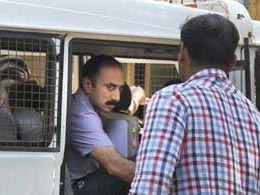
Bhatt was arrested on September 30 in connection with an FIR filed against him by a police constable K D Pant in June, for allegedly threatening him and making him sign false affidavits regarding a meeting called by Chief Minister Narendra Modi on February 27, 2002, hours after the Godhra train carnage.


Rail Roko from 9th October

Wednesday, 5 October 2011

Hyderabad, October 05: Unlike last time when all services were stopped following the two-day Rail Roko call by the pro-Telangana parties, the South Central Railway would operate its services during the three-day Rail Roko call from October 9.
SCR Assistant General Manager Vijya Mohan on Wednesday stated that the railways were ready to operate trains on October 9-11 in the event of State Government provides proper security.
Talking to media persons after holding discussions with Chief Secretary Pankaj Dwivedi at the Secretariat, he said that railways might operate all the services if adequate is provide to its properties and passengers.
Mohan said that the Chief Secretary has assured to look into issue after discussing with Chief Minister N Kiran Kumar Reddy, Home Minister P Sabitha Indra Reddy and Director General of Police V Dinesh Reddy.
Admitting that railways have lost huge income due to Rail Rokos, he said that the railways have proposed this new security system considering the interests of commuters and to reduce inconvenience to passengers.
Courtesy
-----INN

Sanjiv Bhatt Arrest: Citizens protest demanding release in many cities


10/4/11

NEW DELHI - Civil rights groups, students, teachers and activists have come together to stage protests in different parts of the country against ‘arbitrary and unconstitutional arrest’ of suspended DIG Sanjeev Bhatt by the Gujarat Police. According to Shabnam Hashmi of Anhad, protests were organised in over 40 cities across the country. The protesters demanded immediate release of Mr. Bhatt. 
In the capital, a protest was staged at Gujarat Bhawan at the Kautilya Marg, Chanakyapuri on Monday afternoon. “It’s a clear case of intimidation of whistle-blowers and shows totalitarian character of Modi regime”, said Delhi-based activist Mahtab Alam, adding “We are here to express our solidarity with Mr. Bhatt and his family”. The activists also submitted a memorandum to the Resident Commissioner for Governor of Gujarat at the Gujarat Bhawan seeking immediate and unconditional release of Mr. Bhatt.
Addressing the protest meeting outside Gujarat Bhawan, Filmmaker and Activist, Mahesh Bhatt said, “Sanjiv Bhatt's fault is that he dared to reveal the truth behind the 2002 carnage as also the murder of Haren Pandya.” Referring to his conversation with Sanjeev Bhatt, he said, “I spoke to Sanjiv the evening he was arrested, asking that since the worst had happened, what he needed to tell the world outside. He said it was now for the courts to ensure that the rule of law was imposed in Gujarat and the nation.” Mahesh Bhatt also appealed, “We as civil society should come together and fight this trend of communal and fascist mentality.”
Retired DIG and colleague of Sanjeev Bhatt, R B Shreekumar alleged, “The arrest of Sanjeev Bhatt is the peak of the policy followed by the Modi government since the conception, organisation, mobilisation and perpetration of an anti-Muslim carnage in 2002. Of all the actions, this is the most atrocious.” Shreekumar, who himself a victim of Modi further said, “After the 2002 carnage, the Modi government started terrorising the bureaucracy, including the senior police officer who dared to speak the truth.” “If electoral victory is the license for violating the Constitution, the rule of law then our freedom and democracy is under serious threat,” he added.
Activists Shabnam Hashmi, Himanshu Kumar, Sanjay Sharaf, Gauhar Raza, Sandeep Kumar, Faisal Khan, Maulana Ejaz Urfi, Shakeel Ahmed, Madhuresh Kumar, Vani and others also spoke on the occasion. Earlier a similar protest was staged at Jantar Mantar by Ram Vilas Paswan’s Lok Jan Shakti Party. “We want immediate release of Sanjeev Bhatt,” said Amanatullah Khan, a party factionary.  “Our party will launch a nation-wide campaign if Mr. Bhatt is not released,” he added.
While a  protest march was organized by Citizen Forum in Patna to show their solidarity with Sanjiv Bhatt.
Citizen forum held the view that the arrest of Sanjiv Bhatt was unwarranted and this is yet an attempt to quell those voices which rose to expose the Gujrat pogrom 2002.
It is worth to be noted that In April, this year, Sanjiv Bhatt had filed an affidavit in which he alleged that Chief Minister Narendra Modi was sole responsible for the 2002 riots. Since then Sanjiv Bhatt became an eye sore for the Narendra Modi.
More than hundreds men, women, youths, from across all sections of the society participated in the march which started from Akashwani rounabout via Patna Junction roundabout ended at Budh Smirti Park gate. The walk started with slogans like Fascist takte hosh me aao, Inquilab Zindabad, Narendra Modi Murdabad, sanjivBhatt zindabad etc.  
Prof Apoorvanand from Delhi University said Sanjiv Bhatt arrest is another recent example how Narendra Modi Govt has been trying to influence impartial probe of 2002 riots.
Whereas Prof Vinay Kanth from Patna University said fascist forces have been trying to impose its will at any cost over us. The situation is grim and we all should unite at this hour of need.
Social activist, Arshad Ajmal said the arrest was made with malafide intention and was full of malaise. We all should oppose in united voice.
The other prominent members and speakers present on this occasion were Sudha Verghese, Tanveer Akhatar, Pushpraj, Ashok, mahendra Yadav, Binod Kumar, Prem Nath, Dr Shakeel, Ashok Priyadarshi, Vishwajit, Rajkumar, Anish Ankur, Anil Kumar Chand, Shehela, Visakha, Rupesh kumar, Sarfaraz etc.  

Indian Americans decry arrest of Sanjiv Bhatt


Posted on: 04 Oct 2011, 09:41 AM


Washington: Condemning the arrest of Gujarat IPS officer Sanjiv Bhatt, Indian-Aemricans have demanded the Indian Government to conduct a full-scale investigation into the allegations made by him.

"The government's alacrity in arresting Bhatt, stands in stark contrast to its criminal inaction against police officers who have been charged with complicity in the riots," said Shaheen Khateeb, President of Indian American Muslim Council (IAMC) in a statement.

IAMC said the CBI should be tasked with conducting a full-scale investigation into the allegations made by Bhatt against the Gujarat Chief Minister, Narendra Modi, and other state functionaries.

"As the Haren Pandya murder case remains unsolved, Bhatt's claim of possessing documentary evidence that would point to his killers, should be probed without any regard to the status and position of the people he has implicated," IAMC said.

Another NRI group, Non Resident Indians for Secular and Harmonious India (NRI-SAHI) strongly condemned the Gujarat government for arresting Bhatt, who gave affidavits and presented information on the actions of the Gujarat Government and its police on February 27, 2002 for the control of riots.

"We the NRI-SAHI ask the Gujarat government to remove all charges against Bhatt and release him immediately. We ask the Gujarat government to let the judicial process started by the Supreme Court to take its course," it said.

"We ask the state government to stop intimidating police and civilian witnesses such as has happened with constable Panth who has recanted his testimony he gave in front of the SIT and Amicus Curiae," NRI-SAHI said in a statement.
(Agencies)

NEW COLLEGE NCC CADETS CELEBRATE GANDHI JAYANTHI WITH HOSPITAL PATIENTS.


Chennai: 4 October, 2011.

                 (R-L) Dr.Elongo,Sub.Maj.Bavas, Dr.Capt.Zahid Hussain

On the occasion of the Gandhi Jayanthi,October 2,the NCC cadets of New College (2 Company I, Tamil Nadu Battalion NCC,Army Wing) celebrated the day identifying the  inpatients of Government Royapettah Hospital, which is  adjacent to the college, in Chennai, says its press report.

The social service was organized by around 150 NCC cadets under captaincy of Dr.Capt.Zahid Hussain. He is the Commander of NCC Army wing of the college. Also Sub. Major Bavas from 1 TN Battalion NCC participated on the occasion.
                     Sub.Maj.Bavas,Dr.Capt.Zahid Hussain with hospital children

The NCC cadets met every ailing in-patient, and spoke kind words, wishing them a speedy recovery of their health. They shared the pains of the ailing patients of the Hospital, says their press report.

 The Resident Medical Officer (RMO) Dr.Elango extended a warm well come to the NCC cadets, and its Commander Dr.Capt.Zahid Hussain. On behalf of the college army cadets, and its officer, Dr.Elango distributed refreshments, biscuits to the sick children. Thus the occasion turned the hospital into  a cheerful atmosphere.
                      Cadets with a child offering snacks
The press report further adds that the in-patients of the hospital appreciated the cadets’ selfless service, and were grateful to them. The New College NCC cadets do not neglect any fine events to render civic services, be it cleaning the hospitals or conducting blood camps. Their contribution in community development is renowned and date back to 13 full years as a remarkable record.