Saturday, March 5, 2011

FINAL LIST OF SEAT SHARING PARTIES WITH DMK


DMK                                                                       122
CONGRESS                                                              60
PATTALI MAKKAL KATCHI                                31
VIDUTHALAI CHIRUTHALAI KATCHI              10
KONGU NADU MUNNETRA KAZHAGAM           7
INDIAN UNION MUSLIM LEAGUE                        3
MUVENDAR MUNNETRA KAZHAGAM               1
TOTAL                                                                     234
.

Lecture on Arab Revolutions at MANUU


Friday, 4 March 2011
Hyderabad, March 4: MANUU, Centre for Social Exclusion & Inclusive Policy is organizing a lecture on “Democratic Revolutions in the Arab World: The Implications” on 4th March, 2011 at 3 p.m. at Conference Hall, Administrative Building, MANUU Campus. Prof. Kancha Ilaiah, Director, CSSEIP will deliver the lecture. Prof. Amina Kishore, Dean, School of Languages Linguistics & Indology will preside over

Students of MANUU commemorate Faiz birth centenary


Friday, 4 March 2011

Hyderabad, March 4: The sweetness and evocativeness of Urdu still holds considerable sway today. Drawn particularly by the musical charms of the ghazal, people are then impelled to further explore its subtleties by paying closer attention to the language in which it is conveyed.
A living testimony to this is the oral certificate course “Tahseen-e-Ghazal” offered by the Maulana Azad National Urdu University (MANUU). And a practical demonstration, lending new hope for the future of Urdu in the country, was the programme “Ek Shaam Faiz ke Saath” organised by the students of the course as part of the birth centenary celebrations of the revolutionary poet Faiz Ahmed “Faiz” under the aegis of the university’s Centre for Urdu Language, Literature and Culture & Dept. of Urdu at the Ramanuja Chary Hall at Maheshwari Complex, Masab Tank, here on Wednesday, March 2, 2011.
The function was presided over by Vice-Chancellor Mohammed Miyan. The chief guests were the doyenne of cultural activities in the city, Lakshmi Devi Raj, and noted critic Prof. Khalid Qadri. Director in-charge of the centre Prof. Khalid Saeed and head, department of Urdu, Dr Naseemuddin Farees were the joint-conveners. Dr Khaja Naseer introduced the guests and the programme was compeered by Sarah Matthews, which owed so much to lawyer-philanthropist Mehmood Ali who has made the premises freely available for the conduct of the course as a whole.

Saudis to hold 'Day of Rage' rally


Friday, 4 March 2011

Riyadh, March 04: A group of Saudi activists have called for a “Day of Rage” rally in the oil-rich Eastern Province after Friday prayers, following the arrest of a Shia cleric.
The Friday event in Al-Hufuf is organized by a group of 500 cyber activists on Facebook.
The organizers have called on the protesters to call for the release of Sheikh Tawfiq al-Amer, AFP reported.

Amer was incarcerated after he called for a “constitutional monarch” in the kingdom.
Amer has been arrested several times over his demands for giving Saudi Shias further freedom to exercise their religious rights.
This comes as tens of thousands of people are preparing themselves to attend the protests after the Saudi youths named March 11 the Day of Rage on the social networking website, Face book.
On February 23, Saudi King Abdullah suddenly promised a $36-billion package of extra benefits for his people, upon his return from a long medical journey to the US and Morocco.
He also granted pardon to some prisoners indicted for financial crimes and ordered the implementation of a 15-percent pay hike for state employees as well as an increase in the cash available for Saudi housing loans.
Analysts believe the huge hike in benefits introduced by the Saudi king is actually intended to avert an uprising in the country.
In recent weeks, a wave of revolutions and anti-government uprisings has spread across the Arab world.
Agencies: Courtesy Siasat

How I Became A Successful (Part-Time) Import/Export Agent

Justin Power  


“Several years ago, when I was invited to sit on the board of Wade World Trade, an educational institution established in 1946 to help entrepreneurs become import/export agents, I thought I would try it out for myself. I have to say that although I am not a natural entrepreneur (I hate anything which smacks of 'selling') I have never regretted the decision”


“My first challenge was to find something to import or export. After much thought I decided I had to pick an area I was interested in anyway so I chose food. Since 'artisan' food producers are not very commercial it was a good decision. They find it easy to sell their products locally but tend to be hopeless at marketing overseas. I soon negotiated agency agreements with half a dozen companies for a range of related products - jams, chutneys, oaten biscuits, relishes, tea, hot chocolate and chocolate. All were manufactured (or at least packaged) in the UK and none had ever been exported”


AMITY INDIA’S GUIEDS UNEMPLOYED GRADUATES


After having read this article, www.amityindias.blogspot.com designed schemes to guide unemployed graduates for a prospective export import enterprise as liaison agents where no much funds required conducting this line.Have good working knowledge,both spoken and written English.


Select the product that you wish to be liaison agent with the foreign customers. Register a company with internationally secular  sounding style. Obtain an import and export code,after registering your firm commercial tax office. Get in touch with an honest auditor. He/she will guide you with respect of these formalities, how to obtain a pan card and establishing an account with reputable bank in India. Initially you should allow a gestation period without despairing. Visit number of manufacturers of the product you have chosen. The more the often you visit manufacturer, the greater the knowledge gained with respect to quality, quantity and price factors of the product.If you are honest to both sellers and buyers,you can win your bread sure after a gestation period.


From the following link, select the product item, and explore possibilities from respective export promotion councils, on the product you will deal, get in touch with them regularly asking the prospective overseas buyers' websites eamail ids, and they will be happy to guide you. www.amityindias.blogpost.com will be happy to guide you further. Clarify your doubts sending emails to press.sha@gmail.com. All these services will be totally free and spread the message to your friends too.


Follow the link below and study well selecting a particular product for export.
http://exim.indiamart.com/reference-directories/directory-of-epcs.htm


NRIs want to vote, but through postal ballot


Washington, March 04: Indians in America have welcomed the Election Commission's move to permit non-resident Indians to vote back home, but feel it would be a tough call to go to India just to vote.
 Instead NRIs should be allowed to vote by postal ballot, electronically or at Indian missions abroad. They could also be given separate representation in the Indian parliament, community leaders told IANS.
 "We very much welcome this," said Thomas Abraham, Founder President, Global Organization of People of Indian Origin (GOPIO) International recalling, "We have been campaigning on this since 2000."
 "On the other hand, it will be extremely difficult for 10 million or more Indian citizens to travel to India during the election time to vote in their constituencies," he said.
 "With the advancement of technology, it would be easier to have electronic voting and the government should consider implementing this process," said Abraham who is also the founder president of the national Federation of Indian American Associations (NFIA).
 "An effective way for overseas voters to actively participate in the democratic process would be to have representation for overseas Indian citizens in the parliament," he said suggesting a constitutional amendment to provide for five Lok Sabha seats for ten million Indian citizens living outside India.
 As a beginning, a couple NRIs should be nominated to the Rajya Sabha by the President of India, he said adding, "If India is aspiring for progress, such opportunities have to be provided to Indian citizens living outside India as full participants for India's development."
 George Abraham, General Secretary of Indian National Overseas Congress, USA described the Election Commission's move as "a significant step in getting the NRIs voices heard for the first time through the ballot boxes."
 "However, it would be impractical for most of the NRIs to travel to India for the sole purpose of participating in an election," he said.

SC issues notices to Advani, Joshi and others


UPDATED  4/3/2011 1:56:16 PM


New Delhi: The Supreme Court on Friday asked BJP leaders LK Advani and Murli Manohar Joshi, Shiv Sena supremo Bal Thackeray and others to spell out their stands on a CBI plea for restoration of charges of hatching a criminal conspiracy to demolish the Babri Masjid in 1992 against them.


A bench of justices V S Sirpurkar and T S Thakur sought to know their stands while issuing notices to them and asking them to file their replies within four weeks. The apex court issued the notices after Solicitor General Gopal Subramanium, appearing for the CBI, questioned the legality of the Allahabad High Court`s order last May, upholding a special CBI judge`s decision to quash the charges of criminal conspiracy against the leaders.


The CBI has moved the apex court challenging the High Court`s May 20, 2010 order, dismissing the CBI plea for revival of criminal conspiracy charges against top BJP and Sangh Parivar leaders, which also included Ashok Singhal, Giriraj Kishore, Vinay Katiyar, Vishnu Hari Dalmiya, Sadhvi Rithambara and Mahant Avaidya Nath.


The other leaders were former Madhya Pradesh Chief Minister Uma Bharti and former Uttar PradeshChief Minister Kalyan Singh. Challenging the High Court order, the CBI has said in its petition that "it appears an artificial distinction was made by the trial court attempting to assign a role in respect of each of the accused persons and to see which offences were made out. The trial court erroneously came to the conclusion that 21 persons were not entitled to be tried in the case (pertaining to the demolition on December 6, 1992).


"The order passed by the High Court results in serious miscarriage of justice, violates the principle of consolidated investigation, consolidated charge sheet and also disables an effective trial," the petition has said. (PTI)


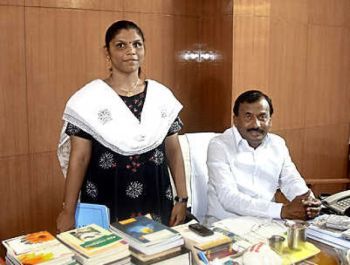
Visually impaired woman clears civil service exam.


Shafee Ahmed Ko

Chennai March 4:

Never let impairment be a deterrent factor to lead a normal life with par with those blessed natural inborn, inherent qualities.

 A visually impaired J.Sujitha (24), from Tindivanam, Tamil Nadu, never considered her physical short coming as a defeat. Instead she had an insightful vision that she would, challenge life and over come this deficiency. Being a candidate of the Civil services, her happiness grew multi fold, when the Union Public Service Commission announced result on Thursday, and   she stood cleared the (Main) in civil services  papers. As she dreamt, she will occupy a position as an deserving post of Indian Foreign Service.

She hopes that she would score well in the personality test to be conducted at the UPSC in New Delhi, later this month, her dreams will come true.

She is all praise to her parents who stood caring in all respect despite their illiteracy that Sujitha has to win her goal. A B.A (English Literature) graduate found the help of the Manithaneyam IAS/IPS Free Coaching Centre in Chennai. As many as 68 candidates who attended the free classes conducted by the centre have cleared the Main examination.


                                      J.Sujitha with Manithaneyam  Saidai Durai Swamy

“The training for Mains exam at Manithaneyam IAS/IPS Free Coaching Centre was free of cost. It was very helpful. But I refused a free training offer from the Excell Career India for my prelims coaching. There are many persons with disability who are not able to achieve because of poor financial condition. That should change,” she said
“I am very thankful to the Manithaneyam IAS/IPS Free Coaching Centre and Excell Career India where I received training,” said Ms.Sujitha.
.
“The service of Manithaneyam IAS/IPS Free Coaching Centre is very helpful for rural students,” she added. 

Friday, March 4, 2011

THIS MONTH'S CALENDAR


March, 2011 calendar

SuMTuWThFSa
  12345
6789101112
13141516171819
20212223242526
2728293031  


March 4th, 2011 i

CartoonSpeaks:Unrest in the Middles East


Breaking the Muslim stereotype


VIDYA SUBRAHMANIAM

Yet there is something about the current mohtamim (Vice-Chancellor) that has got the country talking — that has got the country's Muslims talking. The VC's troubled presence at the Islamic seminary has triggered a “tradition versus modern” debate that some have audaciously compared to the exploding Arab unrest.Wittingly or unwittingly, Vastanvi has become a metaphor for change.

Less than four per cent Indian Muslim children go to madrasas. So logically, it should make no difference whether Maulana Ghulam Mohammed Vastanvi stays on at Darul Uloom Deoband or is sacked. Yet there is something about the current mohtamim (Vice-Chancellor) that has got the country talking — that has got the country's Muslims talking. 

The VC's troubled presence at the Islamic seminary has triggered a “tradition versus modern” debate that some have audaciously compared to the exploding Arab unrest. The suggestion is that Indian Muslim society is in aspirational churn and Mr. Vastanvi is a surface symptom.Consider the questions: Why has the Maulana become a hate figure for some in his community and a sign of hope and uplift for countless others? Why has a Facebook fan club, “Fans of Mo. Ghulam Vastanvi,” sprung up for this cleric, when going by his recent record, he ought to have no Muslim supporters, much less an entire fan club? Indeed, what explains the Muslim crowds that gathered to receive this alleged Narendra Modi supporter when he touched down at the Ahmedabad airport recently?Up until two months ago, not many knew or recognised the Maulana from Gujarat who ran colleges and institutions in the border areas between Maharashtra and Gujarat.

 Mr. Vastanvi was certainly not among the who's who in New Delhi. In the Capital's theatre of competitive Muslim politics, where a leader's worth was measured by the VIP attendance at his iftaars, the rousing statements he issued, the photo-ops he managed and the crowds he mustered at his rallies, Mr. Vastanvi simply did not count.Yet the Maulana hit the national stage like a storm. Barely did one digest the information that the new Vice-Chancellor at possibly the world's most influential Islamic seminary was a forward-looking educator and MBA degree-holder, when he turned into a veritable disaster, chased by controversies, hounded by opponents, and forced into a situation where the end seemed imminent. On January 10, 2011, Mr. Vastanvi won the post of rector defeating his nearest rival Arshad Madani, theologist, leader of one faction of the Jamiat Ulama-e-Hind, and a member of the powerful Madani clan whose history of association with the Darul Uloom Deoband was part of folklore. The import of the election was not lost on observers: Mr. Vastanvi had, in effect, challenged the entrenched forces at the seminary. Would he survive the backlash?Less than two months later, on February 23, the same Majlis-e-Shura (the seminary's governing council), which had declared Mr. Vastanvi elected, reconvened to decide his fate.

 Would the wise men of the council judge him guilty as charged? Or would the embattled VC convince them that the institution stood damaged — not by anything he was perceived to have done but by the wily machinations and politics of his opponents? The Shura put him on hold — the verdict would come from a three-member committee appointed to probe the disturbances that had followed his appointment.
Vicious commentaries

Many sins had been laid at the door of the Maulana, among them his perceived tilt towards Mr. Modi. For the head priest of the uber-orthodox Darul Uloom Deoband to take the wildly unpopular position that Gujarat's Muslims were not badly off, was incredible in itself. If nothing else, Mr. Vastanvi ought to have known that the wounds of the 2002 anti-Muslim pogrom ran deep. 

The VC subsequently clarified that he could never have condoned the pogrom; he also issued an unconditional apology in the event the perception remained.But important sections of the Urdu press were not so easily cajoled. They skewered him: stinging editorials, vicious commentaries and full-page advertisements filled up the newspaper pages even as reporters dug up more dirt: At an October 2010 Eid Milan function in Beed in Maharashtra, Mr. Vastanvi had presented a Radha-Krishna figure to a Hindu Minister.
 Idolatory was sacrilege in Islam and the papers called for statements and fatwas to be issued against the rector. Chain e-mails transmitted the Radha-Krishna image to millions of Muslims across the world.Just as the drum beats reached a crescendo, Mr. Vastanvi, quite unexpectedly, began to get support — three Urdu newspapers, Hindustan Express, Jadid Khabar and Nai Duniya dissented. The Hindustan Express systematically uncovered the plot against the Maulana. News Editor Shahidul Islam argued that Islam did not permit flogging a controversy when an apology had been offered. He also showed that the alleged Radha-Krishna image was a small, insignificant picture. In the hands of Mr. Vastanvi's opponents, it had morphed into a life-size deity. The English newspapers picked up the cue, and the theme slowly changed from the indiscretions of Mr. Vastanvi to the gang-up against him
Support for Vastanvi
But the bigger surprise was still to come. 
At a gathering at Delhi's Ghalib Academy on February 21, some 300 Muslim clerics, skull cap, flowing beards and all, lined up behind Mr. Vastanvi. They were mainly from western Uttar Pradesh, some among them from Deoband, the cradle of conservative Muslim thought. But here they were, defying the stereotype of the obscurantist Mullah and raising their collective voice against rudiwadi soch (regressive thinking).Nai Duniya editor Shahid Siddiqui used the occasion for some inspired oratory: “This is a revolution not unlike what is happening on the Arab streets,” he thundered to background chants of Allah-ho-Akbar. 

Mr. Vastanvi derived his significance from being able to bridge the gap between “deen” (religion) and “duniya” (worldly affairs), Mr. Siddiqui said, adding, “Let not people say, there goes the Maulvi who is a terrorist. Let them say, there goes the Maulvi, who is a doctor, who is heart-surgeon.” Later, Maqsood ul Hasan Qasmi, president of the Imam Council of India and the organiser of the meet, would tell me: “As a graduate from Darul Uloom Deoband, I know that students there are thirsting for democracy, reform and modern education. Vastanvi is their hope, and if he is removed, it will send out a bad signal.” None of the speakers gave any credence to the Modi controversy.

This was puzzling. A few years ago, no Muslim, much less a Maulana schooled in Deoband or an Imam offering prayers at a masjid, could have and would have dared publicly defend a person seen as Mr. Modi's friend — whether or not the charge was true, whether or not an apology had been offered. Mr. Vastanvi himself would have been summarily sacked. 

Obviously, some of the clues for this change were to be found in Deoband.On the day of the February 23 Shura meet at Darul Uloom, all eyes were on the Mehman Khana (guest house), where Mr. Vastanvi was being grilled. But away from the glare, and in a packed room in a nearby building, a group of Muslim citizens, among them politicians, Deoband scholars, and a sprinkling of Muslim reporters, were in a heated discussion over the place of education in Islam.When expelled Samajwadi Party leader Naseem Usmani argued that modern education had no place in Darul Uloom, he was roundly rebuffed by the rest: “Do you even know that ilm [knowledge] is the third most recurring word in the Koran? Find us the passage in the holy book that tells Muslims not to broaden their horizon.” I raised the Modi issue and was instantly put down: “We are not saying that Muslims should forgive Modi or forget 2002. 
But all of you in the secular media want the Gujarati Muslim never to get out of his grieving. Hindu or Muslim, the Gujarati is a businessperson, and that is what Vastanvi was trying to say.”The words stung but they were true. The Congress and the secular media wanted the Gujarati Muslim forever to fight Mr. Modi but neither was there to protect him.
 In any case, unbeknown to most of us, the debate seemed to have progressed beyond the rights and wrongs of supporting Mr. Modi. I had a long chat with young Shahnawaz, a student at the Deoband seminary.Mr. Shahnawaz worshipped the new mohtamim, who even without announcing major reforms, had shown that some things could easily be done, such as building a dining room for the talaba (students). Plate in hand, and waiting in serpentine lines, they currently made a pathetic picture. 

A brand new filtering system would provide clean drinking water. In time, and given the space he needs, Mr. Vastanvi would also introduce vocational courses.There are some student firebrands who make a lot of noise, but “most of us have tired of the jalsa-jaloos [procession-protest] politics of the Muslim leadership,” Mr. Shahnawaz said. He was awfully proud of his cousin Saba Karim, who was training to be a pilot in Patna — the first to do so in two decades. “There is no disputing that deeni taleem [religious education] is the foundation of Darul Uloom. But being computer illiterate or not knowing English is not the solution. Right now we cannot even fill up a form,” said the young man, who made a stunning parting remark: “Do you know the Islamic revelation started with the word, iqra, which means to read?”Muslims have long given up on government. 

On the plus side, the terrorism label has started to come off, and the sense of siege over identity and security has given way to aspirational hopes and dreams. Naturally there is anger with the old Muslim leadership and its crass opportunistic politics. Time will tell whether Mr. Vastanvi is just another political player or a reformer. 
For now, an unlikely mohtamim seems to have become a metaphor for change.Keywords: Muslim stereotype, Vice-Chancellor, Maulana Ghulam Mohammed Vastanvi, controversy

Courtesy:The Hindu:Chennai 

CEO justifies election schedule


A number of factors such as requirement of paramilitary forces considered”
Chief Electoral Officer Praveen Kumar on Thursday sought to justify the Election Commission's decision on the election schedule for the Assembly elections.
Addressing a crowded press conference at Fort St. George here, the CEO said the Commission, while drawing up the election schedule, had taken into account a number of factors such as the requirement of paramilitary forces. Besides, the Commission saw four States and the Union Territory of Puducherry as one block so that the principle of apparent impact did not operate anywhere. This was why the date of announcement of elections in Tamil Nadu or Kerala had been determined only after the poll process was completed in West Bengal.

Pointing out that the Assembly election in Assam would be over (April 11) ahead of Tamil Nadu, he said Kerala would face the elections on the same day (April 13) Tamil Nadu would be having. So, it was not unique to Tamil Nadu that it had to wait for a month to know the results.
In 2006, Tamil Nadu was covered in the last leg of the polls while, now, it would see the elections in the middle.

To a question whether the elections in Tamil Nadu would be postponed, the CEO replied, “I cannot answer it.” He hastened to add that “normally” it was not done once the schedule was announced.
The views of political parties in Tamil Nadu about the date of the Assembly election, including the remarks of DMK president and Chief Minister M. Karunanidhi, have been conveyed to the Election Commission, Mr. Praveen Kumar said. Asked by reporters whether the concerns of Mr. Karunanidhi, who had wondered what the EC's compulsions were in fixing April 13 as the date of polling, and other parties would be conveyed to the Commission, Mr. Kumar responded, “For your information, we convey [to the EC] every day [as to what is happening in the State].”

On the rate of conviction of those who were found to have indulged in electoral malpractices since 2006, the CEO said that so far, three convictions had taken place. Several other cases were pending before courts.

On the strength of paramilitary forces to be requisitioned, he replied that the decision had not yet been taken.


Apart from the requirement of the State, the needs of other States, which would be going to the polls, and the position of the Union Home Affairs Ministry had to be considered.
On the transmission of bulk messages sent through mobile phones, the CEO said this would be treated like an advertisement insertion.

As regards his directive on the distribution of free colour television sets, he explained that this was done as a pre-emptive move.

He reiterated that no new beneficiaries could be identified and given any assistance. No tenders should be invited hereafter. If tenders had been invited before the model code of conduct had come into force, no contracts should be awarded.

In case contracts had been awarded, no work orders could be issued now. If work orders had been given, the work should not be allowed to be taken up. He also clarified that there was no bar if the execution of works was under way.

Courtesy:The Hindu/Chennai

DMK-Congress to sign seat sharing deal: DMK sources


NDTV Correspondent, Updated: March 03, 2011 21:24 IST


                                         M.KARUNANIDHI           

Chennai:  DMK sources have told NDTV that they have finalised a seat-sharing deal with the Congress. Under the new deal that has been thrashed out, the Congress will get 60 seats. 

In the last state election, the Congress was given 48 seats. 

This deal comes after high-level negotiations through the day. A third round of talks held late last night had failed and Ghulam Nabi Azad - the Congressman in charge of Tamil Nadu - skipped a scheduled meeting this morning with DMK chief Karunanidhi. 

Currently the Congress supports the DMK government in the state. If the alliance wins the election, the Congress wants to be included in the government.


Minority tag would damage Jamia Millia Islamia


  UPDATED  3/3/2011 11:07:11 AM

Vivek Shukla                                    

New Delhi :The case and controversy and debate over the minority character of Jamia Millia Islamia (JMI), a university established by Muslim leaders, are refusing to die down.

In an important development, education activist Firoz Bakht Ahmed has decided to challenge in Delhi HC, the National Commission for Minority Educational Institutions` order to declare Jamia Millia Islamia as a minority institution. Added Bakht, the way local Muslim community around Jamia distributed sweets on the decision of JMI being declared as an institution with a minority tag, was only to be lamented.

Talking to News 24, Mr. Ahmed confirmed thisdevelopment, expressing his opposition to the grounds on which Jamia was declared a minority institution, which he is going to challenge legally in the court.

Commenting on the history of JMI, Bakht said, “In fact the institution was to give a concrete shape to cosmopolitan culture and the Hindu-Muslim unity that the Khilafat movement had brought about.”
Ahmed said that if we, as a nation, have to grow, we have to free ourselves from the petty hold of the traps like “minority”, “majority”, “quotas” etc and have to forge ahead with a combined effort to eradicate illiteracy, poverty and obscurantism amongst India’s masses irrespective of religion, region, language, caste, creed or clan of the disadvantaged. Any impudent move to dilute the secular credentials of thiscentral university would foster the revival of communalism that can’t be afforded at any cost now.

In his petition, Firoz Bakht Ahmed said that the card of “minority Character” has sent the message going out that the ethos of the composite culture of the institution has changed and is bound to hurt the reputation of the Jamia Millia Islamia.

Bakht was upset that truth is that this tag of JMI being a “minority institution” will further alienate Muslims. There is a potential threat that the historic Jamia might fall into the clutches of fundamentalists after this. Not only this, merit will take a back seat as well. Inclusive growth is only possible with an eclectic diversity of teachers and the taught.

In fact Mr Ahmed will base his argument on what the founding fathers say about reservations. The petition states, “Interestingly, Sardar Patel did vehemently support the charter of providing political safeguards to the minorities according to articles 292 and 294 of the Draft Constitution in 1949 but five leaders out of seven, namely Maulana Abul Kalam Azad, Maulana Hifzur Rehman, Begum Aizaz Rasul, Hussainbhoy Laljee and Tajammul Hussain opposed.”

Bakht also added that during his constituent assembly meeting on May 26, 1949 Nehru said, “If you seek to give safeguards to a minority, you isolate it… May be, you protect it to a slight extent but at what cost? At the cost of isolating and keeping it away from the main current.”

One of the main arguments of Firoz Bakht Ahmed will be to challenge all kinds of reservations including the SC/ST, OBC, Dalit, Kashmiri migrants, the army personnel and the latest one in Jamia that have actually pushed the general category to the wall and they suffer the most. He will say that there are cases where reservations have resulted in the SCs/Sts amassing wealth where the poor general category people are pining for basic necessities.

In fact Mr. Ahmed is going to argue that JMI was never governed by Muslims even before the implementation of the Act. Instead it was a society named as Jamia Millia Islamia Society (1939) which used to run and administer the institute before the enactment of the Act.

Mr. Ahmed is of the view that the minority tag associated with Jamia will isolate the students and youths from the community and thereby will lead to educational ghettoization, some thing which stands contrary to the purpose of the establishment of Jamia. JMI was established to bring Muslims into the national mainstream, he argues.

Firoz Bakht Ahmed, also a grandnephew of Maulana Azad believes that the offering of minority status to JMI reminds him of the two nation theory of Jinnah that had been opposed by Maulana Azad throughout. He has traditionally opposed the case of Jamia’s minority status, even before the NCMEI where he was one of the intervener in this case which was pending before the commission since 2006.

Bakht was concerned that the NCMEI delivered this judgment in violation of the judgment of the Supreme Court in the case, “Azeez Basha vs Union of India, AIR-1968 Supreme Court 662”. The case is subjudice and the minority tag has been given to JMI rather hastily and illegally. 

Courtesy :news24online