Thursday, September 29, 2011

10 point programme for Islamic Banking in India!


H Abdur Raqeeb proposes 10 point programme for Islamic Banking in India. The following is the paper presented by the champion of Islamic Banking in the Islamic Investment and Finance conference on March 28, 2010 at India Islamic Cultural Centre in New Delhi. 
Banking institutions have emerged as very necessary for everyone, poor as well as rich. It is needed to deposit and protect the saving however meagre it may be.
Poor labourers, construction workers and others migrating to the urban centres of the country from remote corners must have access to banking to transfer their earning to the families in far off places. Besides, several social initiatives, welfare programmes and schemes of the government both state and central do require bank accounts of those targeted – below poverty line segments – to receive money safely in their account. Also credit is provided to people through banks. All these requirements make banking an inevitable part of life of today’s men and women.

But the stark reality is that even after forty years, since nationalisation of the banks about 60% population do not have access to formal banking and only 5.2 % of villages have bank branches. Marginal farmers, land less labours, oral lessees, self employed and unorganised sector enterprise, ethnic minority and women, Aam Aadmi of our great country continue to form the financially excluded class.

The financial exclusion of a large segment of the population has far-reaching implications for the socio-economic and educational uplift of the masses. These financially excluded classes would not hesitate in sharing a “return” on their investment but they often find it difficult to meet the demand of a pre determined return unrelated to the yield. If finance is available without the burden caused by pre-determined interest rates, it will be a welcome development for the marginalized and also especially for SME’s. Interest-free Islamic Banking can fill up this gap.

For Muslims, as per the Sachar Committee report based on census 2001 data, the percentage of household availing themselves of banking facilities is much lower in towns and villages where the Muslim population is high. This is due to a certain mindset prevailing in the banking sector which has categorized Muslims and Muslims dominated areas as ‘Negative Zones’ as documented in Sachar report. Prohibition of interest and thus for reasons of faith Muslims are away from the conventional banks as referred to in the report of the Committee on Financial Sector Reforms –CFSR of the Planning Commission headed by Dr. Raghuram Rajan

Interest Free Banking

In the absence of an alternative to the convention based on interest, in the state of Kerala where Muslims make up around 25% of the population of Kerala, which was 31.8 million according to the 2001 Census, it is reported that thousands of crores earned in interest is kept in suspended accounts, as believers do not claim it. Muslims both rich as well as those employed in the Gulf invest their money on gold and real estate which are not productive investments. They also indulge in lavish spending in marriages and other rituals and many of them fall into trap of bogus financial institutions lose their hard earned money.

Therefore there is a strong case to have an alternative system based on equity instead of the debt based banking system catering and caring to the unbanked segments more specially of the marginalized and minorities -particularly Muslims in the country

Government Initiative


RBI Working Group
In 2005, Government of India asked Reserve Bank of India to examine Islamic banking instruments and constituted a Working Group headed by Mr. Anand Sinha, Chief Manager, Department of Banking and Operation and Development along with senior Bankers from SBI, ICICI and Oman International Bank that came up with its report in 2006 which said: In the current statutory and regulatory framework it would not be possible for banks in India to undertake Islamic Banking activities and concluded that if the banks are allowed to do Islamic banking appropriate amendments are required in Banking regulations Act 1949.

National Workshop
After the GOI announcement that Islamic banking is not feasible in India, several interactive sessions were held by ICIF, one of them was a National Workshop on “Road Map on Islamic banking” in Sept 2006, which was participated by prominent National and International Islamic experts and bankers. It passed resolution that Islamic Banking is relevant in the 21st century and India may implement the same by obtaining inputs from the global example in UK, Malaysia and Singapore. It also chalked out a plan of action as well.

CFSR-Planning Commission Recommendation

In August 2007, Govt. of India under the Planning Commission constituted a high level committee on Financial Sector reforms (CFSR) under the chairmanship of Dr. Raghuram Rajan, former chief economist, IMF along with other eleven members who are the finest financial and legal minds in the country.
CFSR submitted its final report in Sept. 2008 to Prime Minister with the specific recommendation of interest free banking in the country:
“Another area that falls broadly in the ambit of financial infrastructure for inclusion is the provision of interest-free banking. Certain faiths prohibit the use of financial instruments that pay interest. The non-availability of interest-free banking products (where the return to the investor is tied to the bearing of risk, in accordance with the principles of that faith) results in some Indians, including those in the economically disadvantaged strata of society, not being able to access banking products and services due to reasons of faith. This non-availability also denies India access to substantial sources of savings from other countries in the region.


While interest-free banking is provided in a limited manner through NBFCs and cooperatives, the Committee recommends that measures be taken to permit the delivery of interest-free finance on a larger scale, including through the banking system. This is in consonance with the objectives of inclusion and growth through innovation. The Committee believes that it would be possible, through appropriate measures, to create a framework for such products without any adverse systemic risk impact.”(Chapter 3: Broadening Access to Finance, Page: 72)
Why Islamic Banking?


The collapse of leading Wall Street institutions, notably Lehman Brothers, and the subsequent global financial tsunami and economic recession, Islamic banking is seriously being considered and has emerged as a possible alternative to the conventional banking because of the followings:
• It is based on Ethical and Socially Responsible Investments (SRI)
• It aims at Equity and Justice and leads to poverty alleviation and
• It acts to new dimension to assets and actual projects aiming to support real economic growth instead of financial engineering.
• It provides services to under banked populations ignored by conventional banks

Efforts Undertaken – Meeting RBI & FM

When it was learnt that RBI is considering implementing a few recommendations of Dr. Raghuram Rajan Committee on Financial Sector Reforms (CFSR), ICIF contacted the Governor RBI and sought an appointment to plead for the case of the recommendation of CFSR regarding Interest-free banking. Accordingly a delegation of ICIF met the Deputy Governor Dr. K.C Chakrabarty on September 11, 2009 and presented a memorandum along with the important documents. RBI conveyed that it has no reservation regarding interest free banking but for that an amendment in the Banking regulations has to be passed in the Parliament which can be done by the Central government.

A memorandum was submitted to FM, Mr. Pranab Mukherjee to accept the recommendation of CFSR committee on interest free banking and suitable legislative amendment. Several meetings and interactions have taken place with the officials of the Finance Ministry and RBI in this regard till now.
In order to amend the Ranking Regulations Act 1949 and accommodate a level playing field for Islamic banking, a bill has to be passed in Parliament. For this, Banking Amendment Bill has been prepared and vetted by Dar Al Shariah, Dubai Islamic Bank and submitted to Parliament secretariat by an MP to be undertaken as a Private Member’s Bill in the next session of Parliament.

Kerala & Islamic Banking

Another significant development has taken place in the state ofKerala. Govt. of Kerala under
KSIDC (Kerala State Industrial Development Corporation) has taken a courageous and commendable step to form an Islamic Investment company named Al Barakah Financial Services Company, an NBFC after an exhaustive feasible report undertaken by a reputed international consulting firm Ernst & Young. This NBFC will be turned into a global Islamic bank as soon as the RBI accommodates it after an amendment in the Banking regulations. Dr. Subramaniam Swamy has submitted a petition in the High court to stop the participation of the Kerala Government. Admission of his petition has put a hold on the proceedings for the time being.

Misunderstanding

To bring Interest free Islamic Banking, misunderstanding and misinformation among the Muslim masses as well as non-Muslims have to be removed. The need and necessity of interest free Islamic finance and banking has to be spread among the Muslims, common people, religious scholars, business men, bankers, politicians, and other stakeholders.
• Among Muslims, criticism has been raised against the banking approach itself. Some allege that it is nothing but the changes of nomenclature only. Some other questions its capability to meet all the financial requirements of modern day economy. Some go further to say that the whole exercise is futile, with the macro level money creation process remaining the same, what is attempted through so called innovative products is nothing but a cosmetic touch and even in international arena, Islamic banks have to price their investments on Global standards like London Inter-bank Offered Rate (LIBOR) which are essentially interest based. These issues have to be addressed properly by the Islamic scholars, finance experts and those who campaign for Islamic Finance and Banking.
• Justice Mufti Muhammed Taqi Usmani, Chairman, AAOIFI (Accounting and Auditing Organisationfor Islamic Financial Institutions) mentions in his famous book titled ‘An introduction to Islamic Finance’:

“Islam, being a practical way of life, has two sets of rules: one is based on the ideal objectives of Shariah which is applicable in normal conditions, and the second is based on some relaxations given in abnormal situations. The real Islamic order is based on the former set of principles, while the latter is a concession which can be availed at times of need, but it does not reflect the true picture of the real economic order.

Living under constraints, the Islamic banks are mostly relying on the second set of rules; therefore, their activities could not bring a visible change even in the limited circle of their operations. However, if the whole financing system is based on the ideal Islamic principles, it will certainly bring a discernible impact on the economy”. (Page 24)
• In the plural and secular country like ours, misunderstanding among majority community has to be addressed; Islamic banking is not just for Muslims. It is only a mechanism for financing business without providing debt. It is also to be focused that it is based on ethics and Socially Responsible Investment (SRI). It has to be show cased that 40% customers in Islamic banks in Malaysia are Chinese of other communities and also in UK, 20% customers are Non Muslims.
Ms. Perrine Fiorina of CELENT, Strategy consulting for financial institutions, talks of ‘Promising Future of Islamic Banking’ thus:
“In addition to the large and untapped Muslim population, Islamic Banking is currently beginning to attract Non-Muslim customers, who are interested in alternative way of banking. Indeed, a growing number of Non-Muslims are turning to Islamic Banking as customers spooked by turmoil in the western banking system increasingly see the sector as a safe and more connected to the real economy. In my opinion, Islamic banking will benefit from this new customers interest and grow even more quickly than it recently did”.
Even Vatican has offered Islamic Finance principles to Western banks as a solution for worldwide economic crisis. “The ethical principles on which Islamic Finance is based may bring banks closer to their clients and to the true spirit which should mark every financial service” the Vatican’s official newspaper, L’ Osservatore Romano said.
Recently, France has amended its laws to issue SUKUK –Islamic Bonds based on assets-of one Billion Euro.
• Post 9/11, oil money has stopped being invested in U.S and is looking for a safe investment destination, and India could well be that destination given its safe economic scenario, huge market, skill and educated labour and good growth rate.
• Among the intellectuals, scholars and politicians, a doubt is lurking in the mind whether banking operations are feasible without the base of interest.
• As Dr. Hussein Hamid Hassan, Chairman, Shariah Board, Dubai Islamic Bank has said “Conventional banks have since inception, had only one product, that is loan with interest, Shariah has unlimited products to suit every customer and every project under any circumstances”.
Various products with Arabic words have to be suitably presented in the prevailing banking terms and the reasons why they are preferable to the conventional banking products and practices provided as they are based on real economy rather than financial engineering in conventional banking has to be suitably highlighted.
Modern, secular and industrialized countries like Britain, Singapore, Hong Kong and Japan have become hub of Islamic finance and banking. If London, Tokyo, Singapore and Hong Kong can become hub and house of Interest free Islamic finance and banking Why not Mumbai and Cochin?
10-Point Programme of Action

A 10-point programme of action is suggested to this august house for consideration and serious follow up to make the dream of Islamic Finance and Banking become a reality which will change the face and fortune of the community as well as the country, if Almighty wills.
  1. Interest free Islamic banking is emerging as a possible alternative to conventional Finance and Banking – Know why?
  2. Start discussion in our circle & make it an integral part of our all programmes.
  3. Bring out special issues and supplements in the print media, create space for discussion in electronic media, usage of internet to share the latest development & progress.
  4. To remove Misconception among Non-Muslims that interest-free banking is not only for Muslims, a group of strong supporters among them- Abu Talibs has to be included in our efforts to spearhead this great cause.
  5. Create awareness among Muslim Scholars, Students and the General Public by using Jum’a Sermons, Conferences, seminars, etc.
  6. Human Resource Development – Skills & Spirits, Competence & Character specific to Islamic Shariah – Fiqh ul Muamilat and modern finance and banking has to be produced.
  7. General awareness in Media – lobbying for Islamic Banking, Takaful – Islamic Insurance, Sukuk – Islamic Bonds.
  8. Conduct seminars & symposium – Contact B-Schools, Professional associations, etc.
  9. Create political will – contact & convince MPs of all parties to enable amending Banking Regulation act, 1949 in Parliament.
  10. Planning for Islamic Micro finance & Mega Private Islamic Banks when permission granted.

http://luthfispace.blogspot.com/2010/03/10-point-programme-for-islamic-banking.html

Terrorism,Muslims and Media bias


WEDNESDAY, SEPTEMBER 28, 2011


What is rarely visible in the Indian media, however, are the brutal, illegal methods used against suspected terrorists: torture cells, illegal detention, unlawful killings in “police encounters”; elimination of evidence against the illegal actions of the law-enforcing agencies; and rampant harassment of Muslims. In July 2009, The Week reported on the existence of at least 15 secret torture chambers meant to extract information from the detainees. The methods to extract information include attaching electrodes to a detainee’s genitals as well as the use of pethidine injections. To quote The Week, these chambers are “our own little Guantanamo Bays or Gitmos”, which a top policeman called “precious assets”.

In May 2008, a Muslim boy aged 14 was abducted by the Gujarat police. He was dragged to the police car at gunpoint and taken to a detention centre where he was tortured. He returned home ten days later when the court ordered his release following his mother’s petition. The police subsequently threatened the boy’s family with dire consequences if they pursued the case in court. The police harassment becomes even more acute in light of the fact that most lawyers often hesitate to take up the cases of “terrorists”. As a disempowered community - as the government-appointed Sachar Committee report (of 2006) minutely demonstrates - Muslims themselves don’t have adequate and qualified lawyers to pursue such cases. Muslims’ marginalisation thus renders their voice invisible in the media too.

It is believed that after SIMI was banned, soon after 9/11, its radical members formed IM. During my fieldwork (2001-2004) on Jamaat-e-Islami and SIMI I did not hear anything about IM. SIMI activists and other Muslims I met felt terrorised themselves. It is worth noting that since 2001 far more people have been arrested as “SIMI terrorists” than the actual number of SIMI members, which in 1996 was 413 (when founded in 1976, SIMI’s members numbered 132). Until today, the Indian government has still not legally proved its rationale for banning SIMI.
In the fight against terrorism, evidence and the rule of law are subservient to prejudice. As of this writing, the Indian government has not yet tracked the perpetrators of the July 13 attack. However, only two days after the attack, Subramanian Swamy, a prominent politician and former minister (with a doctorate from Harvard University) wrote an article called “How to Wipe Out Islamic Terror”. Without any evidence, he blamed Muslims for the attack, in the same way that The New York Times, The Washington Post, and The Sun suspected Muslim involvement in the Norway shooting nine days later.

What Swamy did is standard practice in Indian media. In September 2006, a blast killed 35 people at a Muslim graveyard in Malegaon (in the state of Karnataka). The media blamed Muslims. Likewise, in 2007, after a blast killed 10 Muslims praying in Hyderabad’s Mecca mosque, Praveen Swami freely wrote about the Muslim terrorists he believed caused it and about what he perceived to be the “Islamist threat to India’s cities”. However, investigations later showed that Hindu nationalists carried out the Malegaon and Mecca mosque terror attacks.

Returning to Subramanian Swamy, Swamy wrote: “We need a collective mindset as Hindus to stand against the Islamic terrorist. The Muslims of India can join us if they genuinely feel for the Hindus. That they do I will not believe unless they acknowledge with pride that though they may be Muslims, their ancestors were Hindus”. Those refusing to acknowledge this, Swamy advocated, “should not have voting rights”. He proposed declaring India “a Hindu Rashtra [state]”.

Stories of Muslim terrorists abound in both the Indian and Western media.
 Since the July 13, 2011 Mumbai bombings, vitriolic pieces like Subramanian Swamy’s have appeared frequently in the media. These pieces subtly influence the analyses of many liberal intellectuals. By contrast, stories portraying Muslims as the terrorised remain fairly sparse. One wonders if, and how, such stories will be told
Irfan Ahmed in Al Jazeera. 


Sunday, September 25, 2011

Modi's nasty 'fast politics': Shifting the BJP rightwards


Modi's nasty 'fast politics'

From: Rediff.com, September 23, 2011
September 24, 2011


by Praful Bidwai

Modi's fast has failed to put even a paper-thin moderate or secular gloss on his image. But he has succeeded in shifting the BJP politically to the far right, decisively and firmly, says Praful Bidwai.

Through his contrived sadbhavana mission and outlandish three-day fast, Gujarat Chief Minister Narendra 'Milosevic' Modi staged a grotesquely fraudulent act in ugly political theatre, which he hoped would catapult him to the apex of the Bharatiya Janata Party and make him the topmost contender as the prime ministerial nominee of the National Democratic Alliance.

But besides consolidating his image as a Hindutva hriday samrat, Modi's manoeuvres may achieve little. Yet they will inflict a heavy burden on the BJP by isolating it from its potential allies.

Modi's shenanigans will certainly do nothing to make him acceptable to the Muslims, who suffered Independent India's worst state-organised butchery under him in 2002. The presence of skull-capped men and burqa-clad women at his fast means nothing.

Modi didn't express remorse at the violence or signal moderation. He came through as an arrogant, duplicitous and hubris-driven politician bent on further humiliating Muslims. His fast wasn't about sadbhavana (goodwill or harmony), but about hyping himself up as a politician.

Modi even belittled his former mentor L K Advani

Yet much of the BJP's senior leadership danced attendance upon Modi. This encouraged him to flex his muscles. He even belittled his former mentor L K Advani by making him sit in a smaller chair than his own at the venue of the fast, thus symbolically challenging conservative notions of hierarchy.

Symbols apart, one of Modi's main objective was to undercut Advani's bid to regain his pre-eminence in the BJP through his unilaterally announced rath yatra, which is designed to politicise religious sentiment through the image of a mythical warrior riding a Bollywoood-style version of an ancient chariot.

Modi has queered the yatra's pitch and forced a shift in its starting-point to Bihar. Since then, the RSS has further snubbed Advani.

Two other motives inspired Modi: first, to celebrate the recent Supreme Court ruling in the Zakia Jafri petition as a 'clean chit' for him in the Gulburg Society massacre; and second, to use the fast, a tactic perfected by Anna Hazare, to show that the opposition space in politics isn't entirely occupied by civil society; the BJP still retains its relevance.

However, the Supreme Court by no means exonerated Modi or the Special Investigation Team's report which holds that there is no prosecutable evidence against him and 61 others named by Jafri. Although the court sent the case to a trial court in Gujarat, it directed it to examine that report, as well as the comments made on it by amicus curiae (friend of the court) Raju Ramachandran, and to give the petitioners a hearing.

Modi's credibility has been damaged by Mallika Sarabhai

The trial court can proceed against the accused even though the SIT didn't file a charge-sheet against them. Of course, how the court acts within Gujarat's vitiated political climate remains an open question, but it cannot simply bury the case or accept a closure report without hearing the petitioners, and summoning witnesses if necessary.

Meanwhile, Modi's credibility has been further damaged by the disclosure by dancer-activist Mallika Sarabhai, based on an affidavit filed by former top police official R B Sreekumar, that his government tried to scuttle her writ petition for prosecuting him for the violence by paying a Rs 10-lakh bribe to her lawyer.

This showed that the Modi regime could stoop to the rock bottom to suppress efforts to bring the culprits of the 2002 communal violence to book.

The Modi government undermined its sadbhavana platform by cracking down on Sarabhai, Jan Sangharsh Morcha activist-lawyer Mukul Sinha -- who has done outstanding work in exposing the cover-up -- and others, for attempting a symbolic protest fast.

This fast would have carried much more credibility than Congress leader Shankersinh Vaghela's own hunger-strike, not least because of his past association and numerous compromises with the Sangh Parivar. Preventing the activists' fast is one more black-mark against Modi.

It is shameful that Modi has not been criminally prosecuted

As for the objective of pressing the BJP's pre-eminent claim to the opposition space, Modi's fast was a laughable parody of the Anna Hazare original: pointless, artificial, insincere, cheaply self-justificatory, and patently lacking in introspection.

The farcical gimmick drew ridicule from the BJP's most valuable ally, the Janata Dal-United, with whom it shares power in Bihar.

The support extended to the fast by the Akali Dal, which is widely expected to lose the coming elections in Punjab and get marginalised, and the AIADMK, which isn't even remotely considering allying with the BJP, doesn't mean much.

Modi hasn't overcome even an iota of the stigma he earned by presiding over the anti-Muslim pogrom of 2002. It is of course utterly shameful that he hasn't been criminally prosecuted, and worse, even politically punished, for his role in falsely communalising the Godhra train fire, and systematically organising and colluding in the ensuing violence.

India's entire political class failed to compel the ruling NDA to dismiss the Modi government in March 2002 for manifestly violating the fundamental right to life of citizens and plotting the massacre of more than 1,000 people.

Modi's presence has been poisonous, not just in Gujarat

Arguably, had the secular opposition, including the Congress's Sonia Gandhi, the Communist parties' Harkrishan Singh Surjit, Jyoti Basu and A B Bardhan, and centrist leaders like Lalu Prasad, Mulayam Singh Yadav and others, insisted on its dismissal through a sustained agitation, the NDA might have had no choice but to impose President's Rule.

Similarly, assembly elections were held in December 2002 despite Gujarat's communally charged atmosphere, the terrorising and disenfrachisement of a whole community, and the near-total absence of rehabilitation of the violence-affected.

After rightly raising objections initially, the Election Commission unfortunately agreed to hold elections, citing a questionable legal precedent. Modi cynically capitalised on Hindutva hubris and won even as the Congress adopted a soft-Hindutva line, reducing itself to the BJP's 'B Team'.

Instead of cooling his heels in prison, Modi continues to occupy the seat of power in Gandhinagar. He has methodically covered up his crimes even as his police have brutalised people and intimidated witnesses.

His presence has been poisonous, not just in Gujarat. No one has brought as much international disrepute to India. No other Indian chief minister has been denied a visa in numerous countries for complicity in gross human right violations.

Modi's ambition is to win the Gujarat elections due next year

Modi has ruled Gujarat despotically, and pampered big business by offering it huge tax breaks at the expense of public welfare and human development. Gujarat has stagnant or falling indices in health, education and gender equality:

Seventy four percent of Gujarat's women and 46 percent of its children are anaemic. The state's sex-ratio is an abysmal 487:1000 in the 0-4 age-group and 571 in the 5-9 age-groups (national averages, 515 and 632 respectively). Gujarat's health indices are barely higher than Orissa's. In social sector spending as a proportion of public expenditure, Gujarat ranks a lowly 19 among 21 major states.

Modi's fast has failed to put even a paper-thin moderate or secular gloss on his image. But he has succeeded in shifting the BJP politically to the far right, decisively and firmly. Not only has he imposed his will upon the party; he has drawn praise from such unlikely sources as Sushma Swaraj, a party rival.

Even Advani now says Mr Modi can handle "any responsibility", presumably including the nation's top job.

Modi's ambition is to win the Gujarat elections due next year, probably by advancing their date, and then become BJP president when Nitin Gadkari's term ends in December 2012. This would give him a definite edge over other "second generation" leaders like Swaraj, Arun Jaitley, M Venkaiah Naidu and Rajnath Singh.

The BJP will soon realise Modi is more a liability than an asset

He then hopes that with the backing of powerful business lobbies, he will become the NDA's prime ministerial candidate.

However, such a pre-poll arrangement can be safely ruled out. The JD-U will certainly oppose it. It's also extremely unlikely that former NDA constituents like the Biju Janata Dal and Telugu Desam will return to the alliance under Modi's leadership.

It's only in the unlikely event of the BJP winning 200-plus Lok Sabha seats that a post-election alliance will emerge. But it's difficult to see how the BJP can increase its tally by 84 seats or over 70 percent (from the present 116) unless it does miraculously well in Uttar Pradesh, where it's currently Number 4.

Ironically, by shifting the BJP rightwards, Modi will have narrowed its base and electoral appeal. A hardline Hindutva party will massively and irrevocably repulse the religious minorities, which form one-sixth of the national vote, or roughly one-half of what's needed for a party to win a national election. That's a recipe for losing elections.

Narrowing of the BJP's base will probably open up new political spaces while weakening the trend towards bipolarism. This would offer interesting opportunities to secular Left-of-Centre forces, admittedly amidst some endemic national-level instability.

The BJP could soon find that Modi, with his insufferable arrogance, megalomania and obnoxious ultra-individualism, is more a liability than an asset both for itself and its allies. It stands warned.

Tuesday, September 20, 2011

Gujarat’s Wounds


Can Fasting bring harmony, while the scars remain unattended to?

Ram Puniyani


Ram Puniyani


Life is full of strange paradoxes. Narendra Modi undertook fast for three days for Sadbhavna (Harmony), to mark complete peace, unity and harmony (Sept 2011). This came in the backdrop of the Supreme Court verdict which has asked the trial court to examine all the evidence and amicus curie’s report so that his culpability or otherwise in Gulbarg society case is decided. The Supreme Court order has directed the Special Investigation Team (SIT) to file its final report into the allegations of Narendra Modi being the architect-in-chief of the 2002 Gujarat massacre. This was interpreted by BJP as a clean chit to Modi. Modi in turn took sigh of relief and pronounced, ‘God is great’. Shrewd as Modi is, he has tried to project that this has exonerated him from his sins of Gujarat carnage 2002.


On one hand this fast is seen as an attempt to project him on the national scene, as after the political absence of Atal Bihari Vajpayee and the eclipse on the fortunes of Lal Krishna Advani, there is tussle for the top slot in BJP. So far Modi has been projecting an image of man for development, but we know that the minorities and many allies of NDA are keeping a safe distance from Modi. This is a hindrance for his Prime Ministerial ambitions. BJP on other hand is celebrating the Supreme Court verdict just to create an impression of victory, which it is not. Now the process of justice is wide open and the path is open for the legal battle in times to come. It also seems that many goals have merged together leading to this fast by Modi.


One aim of course has been that Modi can never be acceptable for the Prime Ministerial candidate by NDA, unless he comes clean of his role in Gujarat 2002 by seeking an apology. This has a problem as seeking apology will also be a confession of guilt, which will alienate his hard core constituency who were made to believe that they are insecure because of the tiny Muslim minority. Cleverly Modi even refused to take the moral responsibility of 2002 by mocking the interviewer by retaliating as to what is this moral responsibility! The second goal seems to be a longing for image change over without really apologising for the 2002. The idea for such a fast must have come from the Anna’s fast, which was successfully elevated into a spectacle for the hidden goals of RSS and the corporate, the backbones of Anna movement. Seeing the success of Anna experiment, Modi has been quick to grab the idea of creating similar spectacle by using the public money. Thirdly, it seems that the ground is slipping from under Modi’s feet, so in order to retrieve the ground he undertook this exercise with the hope that it may help him retain Gujarat and then claim National leadership.


As such the truth is that at National level most of the allies of NDA know that the allegations against Modi have gone down too deep in the psyche of people. The acts of commission and omission of this person who was called as the ‘classic fascist person’ by the prominent social scientist, Ashish Nandy, are too glaring to be put under the carpet. Modi is trying to deflect all the criticism against him by saying that it is an insult to the six crore Gujaratis. This ploy may not work as a large number of citizens from Gujarat know that Modi may be the elected Chief Minister of Gujarat, but he is not the one who represents the essence of ‘Gujarat of Gandhi’ or Gujarat of dalits, Adivasis and Minorities, who also live in Gujarat in large numbers. Modi has done his best to create an image of ‘man of development’, thanks to the policies which have supported the large corporate houses, who have got state loans at minimal rate of interest, while the farmers continued to commit suicide burdened by loans etc. It is remarkable that while ‘shining Gujarat’ is projected, the ‘whining Gujarat’ is cleverly hidden from public vision.


The claims of Harmony in Gujarat are far from true. Those working at ground level know that post Gujarat carnage the divides between religious communities have widened. The place like Juhapura, Ahmadabad is a good example of that. In Juhapura Muslims from all over the state are trying to settle, in search of safety, physical and emotional, in the hostile environment created by post carnage situation. The average banking and other social facilities are not reaching to such places. Not only Muslims, even the Christians minorities are feeling insecure despite the lapse of close to a decade after the carnage. The Godhra train burning verdict clarified the attitude of state authorities, where the chief accused of the train burning Haji Umarji was tried for years without any evidence whatsoever and then was exonerated by the Court. The minorities are feeling discriminated against and marginalized. On the top of that the lack of justice for the victims is a major issue. Despite one after other police officer coming out with sworn affidavits the high handed attitude of state leadership continues.


The beginning of Sadbhavna has to be by seeking sincere apologies by Naremndra Modi. You cannot have peace and amity on the foundations of ‘hidden hate’ and ‘overt injustice’ prevailing in Gujarat. The polarization of religious communities has become more or less structural and the victims of carnage are finding no respite in their daily lives. Even the Human rights activists who have been taking up the cases on behalf of victims are being targeted and there are no brakes on the authoritarian nature of Narendra Modi. The gimmick of fasting for peace is a hollow move as the beginning of harmony has to be with the remorse for injustices which have been heaped on the minorities. Times and over again the TV anchors and social activists have tried to urge upon Modi to begin the process of harmony by apologizing for the carnage of 2002, but all these well meaning appeals have fallen on the deaf years.


The process of Harmony fast revealed many things about the nature of politics being pursued by Modi. While he was more than keen to be wearing the head gears offered by other priests, he refused to put on the Muslim cap. While he could mobilise some victims on the stage, many a victims of injustices were not permitted to come anywhere close to him. We also witnessed that protesters were not allowed to vent their grievances while the fast for amity was in progress. All this is a clear reflection of the shape of things to come. The attempt to win over minorities of the state and the country will not cut any ice. The factors related to mis-governance may come to the fore and be a counter to the five star fast undertaken by Modi.


This present move of fasting has deeper political agenda and has nothing to do with the longing for peace. One wishes the genuine aspirations for harmony are begun through a process of remorse, reparation and proper justice to the victims who have been languishing in ghettoes, bereft of proper rights as citizens. We do need to distinguish between genuine efforts for harmony from these hollow attempts meant to consolidate the politics of Hate...  


Thursday, September 8, 2011

Updates: Delhi blast leaves 11 dead; sketches of suspect released


AIIMS HELPLINE: 011-2610 1925 
RML HOSPITAL HELPLINE: 011- 2374 4721/ 2336 5525
SAFDARJUNG HOSPITAL HELPLINE: 011- 2670 7444 
**********************
9:30 pm: Was the day, site of the blast chosen carefully by bombers?

The day - Wednesday - and the site - Delhi High Court - were chosen purposefully by the bombers for maximum casualties, it would seem. It is the day of the week that is fixed for filing public interest litigations, and Gate No. 5 is the place where the litigants crowd to enter the court premises.

If the blast had taken place on any other day of the week, the casualties would certainly have been lower, said lawyers.

Wednesday is especially kept for taking up or filing public interest litigations before the bench of Chief Justice Dipak Misra.

The day was fixed for hearing PILs to make it convenient for both petitioners and respondents. Earlier, varying days were given for the hearings which caused a lot of chaos, a lawyer said.  Read on

9:15 pm: Police suspect attacker may be among injured or dead

A police official said investigators were not ruling out the possibility that the attackers, or at least one among them, might have injured himself or been killed in the blast.

'It may be possible that the bomb planter could not escape from the spot before the explosion took place. We are verifying and tracking all the injured and dead,' said the police officer.
9:00 pm: Delhi blast a heinous attack: Sarkozy
Terming Wednesday's blast in Delhi a 'heinous terrorist attack', French President Nicolas Sarkozy said France is on India's side in fighting the 'barbaric scourge' of terror.

'At a time when New Delhi has once again been struck by a heinous terrorist attack claiming tens of innocent victims, I would like to express my complete solidarity and heartfelt condolences on behalf of France and myself,' Sarkozy said in a letter to Prime Minister Manmohan Singh.

'France is at India's side during this distressing ordeal and I am more determined than ever to fight this barbaric scourge together. The combat against terrorism unites us and we shall always pursue our efforts relentlessly,' he said in a statement that was issued here.

'Please accept, Prime Minister, the assurances of my highest consideration and friendship,' Sarkozy said.

8:45 pm: Some leads to Delhi blast, says PM
Prime Minister Manmohan Singh said there were 'some leads' to the Delhi High Court blast but it was too early to say which group was behind the bombing.

There were 'weaknesses' in the security system that needed to be plugged, he said while speaking to reporters on board his special aircraft while returning home after a two-day visit to Dhaka.

He said: 'Several mechanisms were put in place after the Mumbai blasts... there are weaknesses in our system, we must work hard to plug the weaknesses.'

He added that he was confident that India would win the war against terror.

'I am confident that this is a war we will and we must win,' said Manmohan Singh in reply to a query on the blast in which 11 people were killed.

8:30 pm: Can't speculate on blast: Dikshit

Appealing to people not to panic in the 'tragic moment', Delhi Chief Minister Sheila Dikshit said it would not be fair to hazard a guess on the reasons behind Wednesday's bomb blast.

Asked why the Delhi High Court was targeted, Dikshit said: 'I can't be clear on that as there could be several reasons.'
8:15 pm: Security alert in Kolkata following Delhi blast
A security alert has been sounded in this West Bengal capital following the Delhi High Court blast.

Checking at the entry and exit points of the city was tightened after police received an alert.

'We have received an alert. Therefore, we are taking all types of security arrangements. Security arrangements are being tightened,' Commissioner of Police R.K. Pachnanda said.

Top police officers held a meeting chaired Director General of Police Naparajita Mukherjee to assess security situation in the city.

8:00 pm: Come in the open and fight: Anna Hazare

Anna Hazare challenged terror elements and groups to 'come out in the open and fight' rather than target innocents.

'Come out in the open and fight. Don't target innocents in this manner,' Hazare declared, expressing his sympathies for the victims of the terror attack in New Delhi.

7:45 pm: Apex court may have parliament-like security
In the wake of the bomb blast at Delhi High Court Wednesday, the Chief Justice of India S.H. Kapadia is considering a security cover for the Supreme Court on the line of parliament in order to thwart any terror attack.

Chief Justice Kapadia, who visited the blast site later in the evening, asked senior counsel and MP Abhishek Manu Singhvi to give a detailed note on the security arrangement in parliament complex and the estimated cost of putting in place a similar system in the court. Read on

7:30 pm: Plastic based deadly explosive used in Delhi blast

Terrorists may have used hard-to-detect plastic-based explosive PETN in Wednesday's Delhi High Court blast -- the same substance used in the underwear bomb plot on a 2009 Northwest Airlines Flight 253 and by the 'shoe bomber'..

Sharing details of the 'preliminary' investigations, Secretary Internal Security U.K. Bansal told reporters that traces of pentaerythritol trinitrate (PETN) have been recovered from the blast site.

'But this is the result of preliminary investigation. Rigorous investigations are in progress,' Bansal said, indicating that the explosive traces found were not conclusive. Read on

7:15 pm: NO CCTVs in Delhi court even after May blast
There are no CCTVs in the Delhi High Court complex although Delhi Police had been reprimanded by the same court for security lapses after the May 25 blast.

'After May 25, Delhi Police should have learnt a lesson and installed CCTVs at all the nine gates of the court.

'This security lapse was highlighted in May when a bomb exploded in a parking lot near Gate 7 of the court,' said Delhi bar association chairman Rakesh Tiku. More on this story

7:00 pm: PM sanctions Rs 2 lakh each for victims of Delhi blast

Prime Minister Manmohan Singh sanctioned Rs 2 lakh to the families of each of those killed in the blast outside Delhi High Court, an official statement said.

Rs.1 lakh each has been sanctioned to those injured.

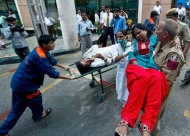
6:40 pm: Blood donors flock to help blast victims

Volunteers flocked to donate blood at the Ram Manohar Lohia Hospital where most of the victims of the Delhi High Court blast were rushed today.

'Ever since news spread that the blast victims have been brought here, we have been getting a lot of donors for blood donation,' an official of the RML hospital handling the helpline told.

'We have enough stock (of blood). So if anyone wants to donate, then they can enquire and come,' the official added.

Social networking sites like Twitter were abuzz that hospitals like RML were running short of blood.

6:20 pm: Suspects in Delhi High Court blast

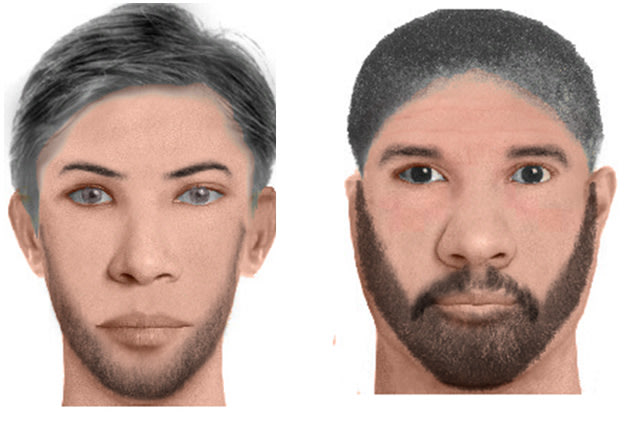
6:00 pm: Delhi police release sketches of two suspects

Delhi Police on Wednesday evening released sketches of two suspects said to be behind the blast outside the Delhi High Court.

Police said one of the suspects was aged around 26, while the other was in his 50s. They added that these two suspects may have been part of a larger terrorist module of about four to five persons. 
5:45 pm: Delhi High Court functions after lunch
The Delhi High Court resumed work post-lunch, barely hours after a powerful blast at Gate No.5 of the compelx left 11 dead and 76 injured.

Putting up a brave face, Secretary of the Delhi High Court Bar Association D.K. Sharma said work was resumed to send across a message.

'We are functioning normally so that a clear message goes to the public at large that we are not bogged down by the terror attack,' said Sharma.

'It is the only the symbolic hearing that is happening in the courts. I hope that the government should learn some lesson on beefing up security outside court premises,' he said.

5:30 pm: Delhi blast exposes security, intelligence loopholes

Top security experts say that blast outside the Delhi High Court has 'exposed the loopholes in our security system' which 'has an inadequate and incapable intelligence gathering system and a weak counter-terrorism mechanism'. More on this story 

5:24 pm: Delhi High Court blast captured on mobile phone

5:17 pm: Delhi blast: US offers assistance to India

Condemning the bomb explosion outside the Delhi High Court that killed 11 people, the US Wednesday underlined solidarity with India and offered its assistance in bringing the perpetrators of the crime to justice.

'On behalf of all Americans, I extend deep condolences to the government of India and the families of those harmed in this morning's attacks on the New Delhi High Court,' US Charge d'Affaires Peter Burleigh said in a statement.

'Terrorism is a crime that affects us all. Bombings like today's demonstrate that our shared struggle continues against those who would commit such atrocities,' he said.
5:13 pm: Delhi bombing act of senseless violence: 
'This act of senseless violence, directed at one of the institutions of government, appears to have been planned to cause a high number of casualties among the general public,' Australian Prime Minister Julian Gillard's office said in a statement.

'We extend our sympathy and concern to the government and people of India at this time. Our thoughts are with the families of the innocent people who have been killed, and with those injured by the blast,' said the statement. 

5:10 pm: Rahul Gandhi visits hospital, blast site

Rahul Gandhi was heckled when he visited Ram Manohar Lohia hospital, where the maximum number of people injured in the bomb blast at the Delhi High Court have been admitted. He later visited the blast site.

5:00 pm: Delhi police releases sketches of two suspects behind the bombing.

4:50 pm: No CCTV at the Delhi High Court were working, IBNLive reports.

4:35 pm: HuJI claims responsibility for Delhi blast 

The Pakistan-based Harkat-ul-Jehadi Islami has claimed responsibility for the terror bombing outside the Delhi High Court complex.

In an email sent from an unknown location to various media houses, the HuJI claimed that the blast which left 10 people dead was the handiwork of the terror group, which also an affiliate in Bangladesh.

It demanded that the death sentence of 2001 parliament attack convict Afzal Guru should be immediately 'repealed'.

'We own the responsibility of today's blast at (the) high court (in) Delhi. Our demand is that Afzal Guru's death sentence should be repealed immediately else would target major high courts and the Supreme Court of India,' the email read.

4:25 pm: There was blood all over, says eyewitness
Delhi blast: There was blood all over, says eyewitnessA powerful blast took place at 10:15 am this morning at the Delhi High Court at Gate no 5. This is the second blast in four months at the Delhi High Court.

4:15 pm: Photos: Horror at Delhi High Court

4:00 pm: The death toll in the Delhi High Court bombing has risen to 11 making it the third worst terror strike since the November 2008 Mumbai attack.

3: 45 pm: Ammonium nitrate possibly used
'There is a possibility that ammonium nitrate was used,' Additional Commissioner of Police KC Dwivedi said.

In a July 27 notification, exactly two weeks after the July 13 triple bombings that killed around 25 people in Mumbai, the Indian government listed ammonium nitrate under the Explosives Act, 1884, and banned its open sale, purchase and manufacture.
3: 40 pm: Horror at high court: Splattered blood, flying body parts
Blood splattered on the street, tatters of what were till a few minutes ago litigants' papers, heart-wrenching wails, disfigured men raising hysterical screams -- what was a regular bustling weekday morning turned into a nightmare.

Horror-struck lawyers, journalists, litigants and locals ran in all directions, stumbling into victims, bags and what looked like their remains, lying on the road.

It was only after the heavy smoke triggered by the 'terrible explosion' withered away did they come to terms with the monstrosity of the act. More here
3: 30 pm: High court blast is 19th attack in Delhi in 15 years
The bomb blast that killed at least 10 people and left 65 injured outside the Delhi High Court Wednesday morning is the 19th strike in the capital since 1996. Chronology of earlier blasts in Delhi
3: 00 pm: High alert in Andhra Pradesh after Delhi blast
Police were put on high alert in Hyderabad, Visakhapatnam, Tirupati and other major towns of Andhra Pradesh Wednesday after a bomb blast near the Delhi High Court killed ten people.

Three platoons of policemen were deployed at the Andhra Pradesh High Court.

Security was beefed up around the Nampally Criminal Court complex, other court buildings here in the capital and also at the assembly and secretariat complexes, places of worship and other important locations. More here
2: 45 pm: Don't speculate on blast: Khurshid
Law Minister Salman Khurshid urged people not to speculate on who exploded the bomb. 'It is a very sensitive issue and there is not enough information available immediately, we should not speculate,' Khurshid told reporters.
2:30 pm: NIA chief has announced that HuJI has sent mail claiming responsibility. The mail is being seriously looked at. More
2:10 pm: Injured to be compensated
Delhi govt announces compensation: Rs 1 lakh compensation for those seriously injured and Rs 50,000 for those who sustained minor injuries.
2: 00 pm: Rs 4 lakh to kin of dead

1: 55 pm: Blast is shocking and numbing, says Abhishek Manu Singhvi

Congress leader Abhishek Manu Singhvi addessed the media outside the court. He said, "this is a terrible tragedy. This is something which is shocking and numbing. Our hearts go out to each litigant. They've come with great pressure and to be torn away suddenly out of the blue is terrible. 

1: 50 pm: Chemical analysis on bomb likely by evening, CNN IBN

1: 45 pm:
 Sheila Dikshit at RML hospitalDelhi CM visits the injured in RMLhospital and says doctors are doing the best they can.

1: 35 pm: Will not succumb to pressure of terrorism: PM
Dr Singh said that all political parties and people of India must stand united. The PM is expected to return to India this evening.

1: 25 pm: Major metros placed on high alert after Delhi HC blast
Major metros of India have been placed on a state of high alert after Wednesday morning's explosion outside gate number five of the Delhi High Court.

A decision to this effect was taken at a meeting of senior Home Ministry and police officials. The emergency meeting was chaired by Union Home Secretary R.K. Singh.

Thirteen members of the National Investigation Agency (NIA) and the bomb squad are at the blast site collecting evidence as to what caused the explosion at around 10. 15 a.m. this morning. More here

1: 20 pm: Terrorism in Delhi - A timeline
With today's bomb explosion outside the Delhi High Court, the number of terrorist attacks on the capital since 1997 has gone up to 30.

Among the most recent incidents, 59 people were killed and 155 injured during the October 18, 1997 serial bomb blasts that ripped through the markets of Sarojini Nagar, Paharganj and Govindpuri.

On September 13, 2008, five low-intensity explosions were set off within minutes of each other, beginning with Ghaffar Market, two explosions at Connaught Place, one at Barakambha Road and another near the Central Park Metro station at 6.31 pm. Blasts also rocked M-block market in Greater Kailash-I. Within seven minutes another bomb exploded in the same market. Twenty-five people were reported killed and 150 injured.

On September 27, two men on a motorcycle dropped a polythene packet containing a low-intensity explosive in the crowded Flower Market in Mehrauli. Three people, including a nine-year-old boy who picked up the bag, were killed and 21 people were injured.

On September 19, 2010, two armed men opened fire at Taiwanese tourists as they boarded a bus in the crowded Jama Masjid area. A Maruti car also went up in flames near the mosque, triggering panic. No casualties were reported though 14 injuries were claimed. The attack came two weeks ahead of the Commonwealth Games. 

1: 15 pm: PM's statement on the blast
Dr Manmohan Singh says the terror strike is a "cowardly act". Meanwhile, Delhi CM Sheila Dikshit visits at the RML hospital and HM Chidambaram visits the blast sight.


1: 10 pm: 
4 kg explosive used for the blast:  HT
Hindustan Times tweets, "4 kg explosive used for the blast, crater of 4x4 feet formed at the site: reports"

12: 36 pm: Chidambaram addresses Lok Sabha; 10 dead, 65 injured
Addressing the parliament on the blast, Home Minister P Chidambaram said 10 people have died while 65 are injured. The investigation into the blast will be handled by the NIA. He added, "Delhi is a target during parliament session. Delhi  is on high alert. Intelligence pertaining to threats from certain groups was shared in July. Right now it is not possible to identify those behind the attack yet. Despite Delhi Police remaining alert, the tragic incident occurred today. Govt unequivocally condemns today's attack...Condolences to families of those who lost their lives...I appeal to the parliament and the entire nation, we must remain resolute and united..." Read more

AIIMS HELPLINE: 011-26101925
RML HOSPITAL HELPLINE: 011- 2374 4721/ 2336 5525
SAFDARJUNG HOSPITAL HELPLINE: 011- 2670 7444

12: 29 pm: Number of injured rises to 50
Special Commissioner Dharmendra Kumar said the number of injured admitted in various hospitals is at 50. Most of them have sustained leg injuries.
12: 07 pm: Opposition parties react to blast
BJP's Ravi Shankar Prasad: It is a matter of great distress...Why isn't the government taking any action? How many more deaths? There is no proper security, no intelligence inputs...We condemn the attack.
CPI's D Raja: We condemn the attack in all possible terms...the government should come up with the right probe and share what went wrong... what is going on, what is wrong with our intelligence network?  We strongly condemn this attack.  Nobody should go scot-free. There is a failure on the government's part.

12: 00 pm: SAFDARJUNG HOSPITAL HELPLINE: 011- 2670 7444 
11: 55 am: No intelligence inputs on the blast: MHA
11: 47 am: High intensity bomb used
Lok Sabha condemns the blast, is adjourned till 12:30 pm, reports HT.
11: 45 am: All metros on high alert
11: 35 am: MHA assesses situation
Times Now reports the MHA is in constant touch with investigative teams at the blast sight. The bomb was concealed in briefcase and place outside gate no 5.
11: 27 am: Delhi Blast: There was blood all over, says eyewitness
"It was a powerful blast...there is a lot of blood there," said a shocked woman lawyer, who was just driving up to work at the Delhi High Court when the explosion took place near Gate no 5.

Lawyers said the blast could be heard at the Patiala House two or three kilometers away. Kavita, an eyewitness said she was in a judge's chamber when she heard the blast. "The windows rattled she said."  More
11: 17 am: 9 dead, 45 injured: Union Home Secretary
Medium to high intensity bomb used. He added that Delhi is on high alert and that investigations have begun.
11: 15 am:  Parliament adjourned, Home Minister to make a statement at 12:30 pm
11: 12 am:  NIA to help investigate
Besides the Delhi police and the forensic team, the NIA and NSG are also being rushed to the spot. 
11: 09 am: 4 dead, 30 injured: Special home secy
A lawyer tells NDTV, that gate no 5 used to issue passes to litigants. He also said that 10 am is peak hour. Special home secretary tweets that so far four have been confirmed dead and 30 injured.
11: 04 am: Officials confirm four are dead, reports HT
Hindustan Times tweets that officials have confirmed four people have died in today's blast.
11: 00 am: Second blast in 4 months
This is the second blast in the Delhi High Court premises. On May 25, also a Wednesday,  there was a low intensity blast.
10: 53 am: Blast happened at 10:17 am: Police
The blast happened in the area where people wait for passes to enter the court premises, said special officer Special Commissioner Dharmendra Kumar.
10: 46: Bomb could have been placed in a briefcase: Police
A police officer at the blast area say there is a possibility that the bomb could have been placed in a briefcase. Delhi police have asked people to clear the High Court area. The injured have been taken to Safdurjung hospital and RML hospital.
10: 43 am: HC building being evacuated: Lawyer
A lawyer present at the blast sight tweets, " Blast in delhi HC. Right in front of me. *shudders* the whole car shook" ..."The bomb was very powerful it seems. Everyone is outside. Lots of injured. The gates are closed now. Can hear sirens"...The bomb was very powerful it seems. Everyone is outside. Lots of injured. The gates are closed now. Can hear sirens"..."Many hurt. Building being evacuated. The Judges are themselves out in the corridor."
10: 40 am: Two feared dead, says NDTV
The nature of the blast is yet to be identified. So far, two people are feared dead in the explosion, reports NTDV, while CNN IBN says the number of injured may be around 20.
10: 38 am: Police cordon off the blast sight, fire tenders rush in. 
10: 35 am: The injured are being taken to Safdarjung hospital, reports Times Now
10: 30 am: Ambulance rushed in
Ambulance arrives at the explosion site. The number of injured is still not confirmed. The reason for the explosion is not known yet.
10: 25 am: Explosion outside Delhi High Court gate no 5

Blast outside Delhi High Court. Television channels report of injuries to people. There are more people at the court premises than other days of the week since Wednesdays are when PILs are heard.