Wednesday, June 27, 2012

Kerala Govt to appoint 1000 Minority Welfare Promoters

Thiruvananthapuram: The Kerala govt has ordered to appoint 1000 Minority Welfare Promoters across the state in order to ensure effective distribution of the central and state minority welfare schemes. The govt has also decided to organise 1000 Minority Welfare Scheme awareness camps across the state by including maximum minority institutions and minority concentrated regions under it.

The Promoters will be appointed in accordance with the minority population density of each region by specifically setting targets for these promoters. There are already such promoters working in the scheduled caste/tribe concentrated regions of the state and the Minority Welfare Promoters too will be appointed in similar manner. The promoters will be working under the control of minority cells of each District Collectorate.
In order to run the Minority Welfare Scheme awareness camps, the Govt will provide Rs 5000 under conditions to minority welfare organisations, Mahal Jama’ath’s and educational institutions

http://dcescholarship.kerala.gov.in/dce/main/index.php


Types of scholarship

Contact Us


Online Scholarship - Previous Year Details
 Help Desk Numbers: 9446096580;  0471-3270202;   0471-2326580
For any queries please send mail to dcescholarship@gmail.com

Posted in the public interest and voluntary service by

Indian Minorities Welfare Trust (Regd)
No .10/6 Anaikar Complex, M.V.Badran Street
Periamet,Chennai 600 003 India.
Contact : Mr.Shafee Ahmed +91 91767 88678
email: imwt2012@gmail.com


Monday, June 25, 2012

Gopalgarh violence, firing victims losing hope for justice

Special Correspondent

 
Victims of the September 14, 2011, violence at Gopalgarh in Rajasthan, where 10 persons were killed and 30 injured in the firing and attack on a mosque, are gradually losing hope for justice with the Central Bureau of Investigation giving a clean chit to the top district officials and the State government failing to restore faith among Meo Muslims targeted by communal forces.

A delegation comprising representatives of Muslim groups visited Gopalgarh earlier this week, nine months after the horrific violence, and found an atmosphere of fear and distrust in the town amid allegations that the CBI officers were threatening the Meo community leaders willing to depose as witnesses against the policemen and Gujjars who allegedly attacked the Jama Masjid.

The delegation visited the town in Bharatpur district under the banner of Rajasthan Muslim Forum on the repeated requests of the next of kin of the deceased. The victims complained of “prejudiced approach” of the CBI’s investigating officers and the ruling Congress’ “complete indifference” to their plight. The much-touted judicial inquiry into the violence is yet to begin.

The CBI has arrested a local Muslim leader, Abdul Ghani, and his three sons on the basis of five first information reports and filed the charge-sheet in the court highlighting the police claim that if the policemen had not resorted to firing, there would have been large-scale violence. The 14 FIRs lodged by Muslims, identifying the policemen as accused, have been taken up for probe only recently.

Collector, SP reinstated

The State government has since reinstated the then Collector, Krishna Kunal, and Superintendent of Police, Hinglaj Dan, who were suspended for dereliction of duty, after they obtained stay orders in their favour from the Central Administrative Tribunal. Muslim groups have accused Chief Minister Ashok Gehlot of deliberately leaving technical loopholes giving benefit to the suspended officers.
The delegation comprised Irada Society president Mohammed Hasan, Jamaat-e-Islami Hind State president Khurshid Hussain and national secretary M. Salim Engineer and Forum members Nazimuddin and M. Alam Khan.

In a statement issued here, the Forum alleged that the CBI was trying to protect the accused and implicate Meo Muslims in the Gopalgarh case. By not clubbing the 14 FIRs with the initial five FIRs, the CBI has found an escape route for the Collector and the SP and ignored the evidence of their complicity in the crime, it said.

“How is it possible that a premier investigating agency like the CBI could not notice the simple fact that for 24 hours after the police firing on the mosque, the police were in-charge of the site during the curfew when the bodies were dragged [out] and thrown into wells and cut into pieces and burnt,” stated the Forum.
Mr. Gehlot had himself admitted two days after the firing that the policemen had fired 219 rounds, while claiming that it was done to contain a direct clash between Meos and Gujjars. It was later revealed after the curfew was relaxed that all the bullets were aimed at the mosque, which suffered extensive damage.
Mr. Salim Engineer pointed out that the Meos whose houses and shops were looted and burnt had refused to accept the paltry amount of Rs.3,000 to Rs.4,000 each offered by the State government. The total damage of property, caused by fearless rioters during curfew when the Meo families had vacated the town, is estimated at Rs.2 crore.

The Forum took strong exception to the State government’s attempt to protect Mr. Kunal and Mr. Dan and demanded that a fearless atmosphere be created in Gopalgarh to enable the victims to get their statements recorded. A demand was also placed for a fair survey of damage to property, followed by adequate compensation and rehabilitation of victims.

Courtesy: The Hindu 
http://www.thehindu.com/todays-paper/tp-national/tp-newdelhi/article3564641.ece?css=print

TISS report points to anti-Muslim bias of police

Meena Menon

http://www.thehindu.com/news/national/article3563333.ece


“Most of prisoners in Maharashtra jails victims of prejudice”
A report on Muslim prisoners in Maharashtra jails by the Tata Institute of Social Sciences (TISS) establishes that most of them do not have connections with criminal gangs, and points to an acute bias of the police for arresting them in some cases only because they belong to a particular community.

A Study of the Socio Economic Profile and Rehabilitation Needs of Muslim Community in Prisons in Maharashtra, 2011, by Dr. Vijay Raghavan and Roshni Nair from the Centre for Criminology and Justice School of Social Work, Tata Institute of Social Sciences (TISS), states that 96 per cent of the respondents have not been held under preventive detention charges, thus indicating that they are not viewed as a threat to law and order. 

The study which surveyed 339 Muslims, mostly between 18 and 30 years of age, in 15 prisons says this implies that most respondents do not have connections with criminal gangs or have any record which may be a threat to law and order. About 25.4 per cent of those imprisoned don’t have lawyers to represent them in their cases. 

The police’s bias against Muslims led to some of the arrests under the erstwhile Terrorist and Disruptive Activities (Prevention) Act (TADA), the Maharashtra Control of Organised Crimes Act (MCOCA) and even under the Official Secrets Act.

‘Two types of laws’
 
An agent in textile export, Murtuza, arrested under the Official Secrets Act on charges of spying, says in his interview to the research team: “There are two types of laws in this country. One is for Hindus and the other is for Muslims. The policeman is first a Hindu and then a policeman. The judge is first a Hindu and then a judge and the lawyer is first a Hindu then a lawyer. People who work against the State, indulge in rioting, kill thousands of innocent people, and harass women and children roam free in this country. They are not punished. I am suffering only because I am a Muslim.”

Murtuza strongly feels that the discriminatory attitude is one of the major reasons for his arrest. He says that the police do not have enough evidence against him and yet he remains in prison. Two years have passed and the case is dragging on in court. He misses his court dates because the escort to take him to court is often not available. He has applied for bail thrice, but it has been rejected each time. He also applied for transferring the case to a different judge, but nothing has happened yet.

Poor victimised

Another prisoner Moiz says that “every time he tries to start life afresh, the police arrest him in some false case. They also demand money from criminals and those who can pay are set free. The poor are victimised. The police are very powerful and can do anything.”

Some interviews reflect the deep despair and alienation of the people interviewed. Muneer feels that after the demolition of the Babri Masjid, the rift between Hindus and Muslims has widened. Due to the riots and bomb blasts in 1992-93, the police perception of Muslims has become negative. The police view them as criminal minded. Migrants from Uttar Pradesh and Bihar are viewed with prejudice by the police.

Shoaib expressed his fears about the breakdown of the social fabric if the bias against Muslims continues. “The police have a negative perception of the Muslim community and act with bias. Due to the actions of the police and fundamentalist politics, the perception of Muslims is negative in society. If the situation continues to be like this, the next generation may get into further crime and vested interests could use them. Society’s perception and the negative feelings of hatred have to be reduced. Only then there is hope for a better tomorrow. Otherwise the situation will get worse for individuals, their families and society.” 

About 70 per cent of the 3,000 Muslims prisoners in 15 jails were under trials and 30 per cent were convicted prisoners. What is of concern is that 52.8 per cent are charged with violent crimes mainly murder, attempt to murder, rape, assault and kidnapping. Among the under trials interviewed charge sheets have only been filed in 47.4 per cent of the cases and a mere 3.8 per cent have reached judgement stage, indicating the slow pace of trials. Of those interviewed 75.5 per cent were arrested for the first time and 25.5 per cent are repeat offenders. 

The percentage of Muslims in jails is also a high 36 per cent, says Dr. Raghavan, quoting recent official figures. Along with Gujarat and Kerala, Maharashtra is one of the States with the most disproportionate number of Muslims in prisons.

The Sachar Committee report says that in Maharashtra, Muslims account for 10.6 per cent of the general population; yet they comprise 32.4 per cent of the prison population. For those incarcerated on terms of less than a year, the figure rises: 42 per cent of prisoners on short-term sentences in the State are Muslims.
This study was done at the behest of the Maharashtra State Minorities Commission in response to the charge of a disproportionate number of Muslims in jail. It makes a slew of recommendations relating to rehabilitation and correctional programmes, and the need for steps to sensitise the police and prison administration.
Last month the findings were presented at a meeting with Arif Naseem Khan, State Minister for Minority Affairs. 

The Minister accepted most of the recommendations, especially those relating to legal aid, adult education, vocational training, release on probation, and awareness and counselling centres in Muslim areas.
The Additional Chief Secretary of Minority Development will call a high-level inter-departmental meeting soon to work out ways to implement the recommendations.

Keywords: Muslim prisonerMaharashtra jails

Courtesy:The Hindu Sunday,June 24, 2012

Saturday, June 23, 2012

Source links for Minority Pre-Matric and Post-Matric Scholarships in few States of India


In view of   Prim Minister's 15 point programme, the  provision Indian Minorities are listed below as  online links of Government bodies of few states offering pre as well as post matric scholarships. Students are directed to browse the links and get benefited. Most of the schemes  are ending by July 30, 2012 as last date. Students are advised to have direct contact with concerned officials.
The kind and generous persons are requested to down-load the application and Xerox or print and distribute freely to the needy students.

Government of Karnataka
Directorate of Minorities,
20th Floor, V.V. Towers, Dr Ambedkar Veedhi,
Bangalore - 560001.


 List of Students Sanctioned Pre matric Scholarship 2011-12 Renewal
(Karnataka)


Andhra Pradesh State Minorities Finance Corporation Ltd


Minorities Welfare Department,Uttar Pradesh

Tamil Nadu


Compiled in the common interest of the students
INDIAN MINORITIES WELFARE TRUST (Regd)
(Charitable Trust)
N0.6/10 Anaikar Complex,M.V.Badran Street,Periamet,Chennai 600 003 India.
Contact Person:Shafee Ahmed 09176 7886 78


Pre-Matric and Post-Matric Scholarship for Indian Minority Students.


‘Prime Minister’s New 15 Point Programme for Welfare of Minorities’.
http://ncm.nic.in/PM%27s_15_Point_Programme.html
(A) Enhancing opportunities for Education.
(1) Equitable availability of ICDS Services

The integrated Child Development Services (ICDS) Scheme is aimed at holistic development of children and pregnant/lactating mothers from disadvantaged section, by providing services through Anganwadi Centres such as supplementary nutrition , immunization, health check-up, referral services, pre-school and non-formal education. A certain percentage of the ICDS projects and Anganwadi Centres will be located in blocks/villages with a substantial population of minority communities to ensure that he benefits of the scheme are equitable available to such communities also.

(2) Improving access to School Education

Under the Sarva Shiksha Abhiyan, the Kasturba Gandhi Balika Vidyalaya Scheme, and other similar Government schemes, it will be ensured that a certain percentage of such school are located in villages/localities having a substantial population of minority communities

(3) Greater resources for teaching Urdu

Central assistance will be provided for recruitment and posting of Urdu language teachers in primary and upper primary schools that serve a population in which at least one-fourth belong to that language group.
(4) Modernizing Madarsa Education

The Central Plan Scheme of Area Intensive and Madarsa Modernization Programm provides basis educational infrastructure in areas of concentration of educationally backward minorities and resources for the modernization of Madarsa education. Keeping in view of importance of addressing this need, this programme will be substantially strengthened and implemented effectively.

(5) Scholarships for meritorious students from minority communities

Schemes for pre-matric and post-matric scholarships for students from minority communities will be formulated and implemented.

(6) Improving educational infrastructure through the Maulana Azad Education Foundation.

The Government shall provide all possible assistance to Maulana Azad Educaion Foundation (MAEF) to strengthen and enable it to expand its activities more effectively.

(B) Equitable Share in Economic Activities and Employment

(7) Self-Employment and Wage Employment for the poor

The Swarnjayanti Gram Swarojgar Yojna(SGSY), the primary self-employment programme for rural areas, has the objective fo bringing assisted poor rural families above the poverty line by providing them income generating assets through a mix of bank credit and Governmental subsidy. A certain percentage of the physical and financial targets under the SGSY will be earmarked for beneficiaries belonging to the minority communities living below the poverty line in rural areas.

The Swarnjayanti Shahary Rohgar Yojna(SSRY) consists of two major components namely, the Urban Self-Employment Programme (USEP) and the Urban Wage Employment Programme(UWEP). A certain percentage of the physical and financial targets under USEP and UWEP will be earmarked to benefit people below the poverty line from the minority communities.

The Sampurna Grameen Rozgar Yojna(SGRY) is aimed at providing additional wage employment in rural areas alongside the creation of durable community, social and economic infrastructure. Since the National Rural Employment Guarantee Programm(NREGP) has been launched in 200 districts, and SGRY has been merged with NREGP in these districts, in the remaining districts, a certain percentage of the allocation under SGRY will be earmarked for beneficiaries belonging to the minority communities living below the poverty line till these districts are taken up under NREGP. Simultaneously, a certain percentage of the allocation will be earmarked for the creation of infrastructure in such villages, which have a substantial population of minorities.

(8) Upgradation of skill through technical training

A very large proportion of the population of minority communities is engaged in low-level technical work or earns its living as handicraftsmen. Provision of technical training to such people would upgrade their skills and earning capability. Therefore, a certain proportion of all new ITIs will be located in areas predominantly inhabited by minority communities and a proportion of existing it is to be upgraded to ‘Centres of Excellence’ will be selected on the same basis.

(9) Enhanced credit support for economic activities

The National Minorities Development & Finance Corporation (NMDFC) was set up in 1994 with the objective of promoting economic development activities among the minority communities. The Government is committed to strengthen the NMDFC by providing it greater equity support to enable it to fully achieve its objective.

Bank credit is essential for creation and sustenance of self-employment initiative. A target of 40% of net bank credit for priority sector lending has been fixed for domestic banks. The priority sector includes, inter alia, agricultural loans, loan to small-scale industries & small business, loans to retail trade, professional and self-employed persons, education loans, housing loans and micro-credit. It will be ensured that an appropriate percentage of the priority sector lending in all categories is targeted for the minority communities.

(10) Recruitment to State and Central Services

In the recruitment of police personnel, State Governments will be advised to give special consideration to minorities. For this purpose, the composition of selection committees should be representative.
The Central Government will take similar action in the recruitment of personnel to the Central police forces.

Large scale employment opportunities are provided by the Railways, nationalized banks and public sector enterprises. In these cases also, the concerned departments will ensure that special consideration is given to recruitment from minority communities.

An exclusive scheme will be launched for candidates belonging to minority communities to provide coaching in Government institutions as well as private coaching institutes with credibility.

(C) Improving the conditions of living of minorities.

(11) Equitable share in rural housing scheme

The Indira Awaas Yojna(IAY) provides financial assistance for shelter to the rural poor living below the poverty line. A certain percentage of the physical and financial targets under IAY will be earmarked for poor beneficiaries from minority communities living in rural areas.
(12) Improvement in condition of slums inhabited by minority communities.

Under the schemes of Integrated Housing & Slum Development Programme(IHSDP) and Jawaharlal Nahru Urban Renewal Mission(JNURM), the Central Government provides assistance to States/UTs for development of urban slums through provision of physical amenities and basic services. It would be ensured that the benefits of these programmes flow equitable to members of the minority communities and to cities/slums, predominantly inhabited by minority communities.

(D) Prevention & Control of Communal Riots

(13) Prevention of communal incidents

In the areas, which have been identified as communally sensitive and riot prone districts and police officials of the highest known efficiency, impartiality and secular record must be posted. In such areas and even elsewhere, the prevention of communal tension should be one of the primary duties of the district magistrate and superintendent of police. Their performance in this regard should be an important factor in determining their promotion prospects.

(14) Prosecution for communal offences

Severe action should be taken against all those who incite communal tension or take part in violence. Special court or courts specifically earmarked to try communal offences should be set up so that offenders are brought to book speedily.

(15) Rehabilitation of victims of communal riots
.
Victims of communal riots should be given immediate relief and provided prompt and adequate financial assistance for their rehabilitation.

Friday, June 22, 2012

Quota for backwards: Struggle for Social Justice


Ram Puniyani

After Supreme Court Bench had expressed unhappiness about the ways in which the Muslim sub Quota was created last December, the Government has been trying to submit the necessary data. Supreme Court wanted Centre to explain the basis of the move to reserve this 4.5% for the Muslims. With due support from relevant studies and documents Govt is trying to put forward the justification for its move. This Supreme Court verdict was in the backdrop of Andhra High Court decision to quash the minority sub quota. (June 2012) Andhra High Court had raised the point that the reservation on the basis of religion is unconstitutional. It is a strange reading of the constitution. The spirit of the constitution is that there shall be no discrimination on the basis of caste, religion or class. However, if certain communities suffer social discrimination and deprivation, the Constitution provides reservation as an instrument to neutralize the prevalent social disparities.

Bharatiya Janata Party (BJP), as per its anti minority and anti reservation stance welcomed the Supreme Court's refusal to stay Andhra Pradesh High Court's decision quashing the minority sub-quota. Its spokesperson also charged the Congress-led government with having a communal agenda and going in for "vote-bank politics". The implications of this understanding mean that the prevalent disparities should continue. BJP’s goal is not a society based on equity and justice as it is guided by ‘religion based nationalism’. Some others pointed out that the ruling party Congress, as such does not want the quota for Muslims in the real sense. This perception comes because Congress party does show a lack of will power in the direction of affirmative action for weaker sections of society as a whole and about Minorities in particular.  

As such Constitution does allow quota to educationally and economically backward classes. Today Muslims are educationally and economically very backward community in India. Its educational backwardness has been repeatedly pointed out by HRD ministry and Home Ministry in their reports for a long time. And the economic condition has been highlighted by Sachar Committee (2006) and Rangnath Misra Commission (2007). In this light how can the sound legal case be made to actualize the social and political need of our society to get economic justice to minorities, is a challenge for the Government.

Congress Government started taking this issue seriously and overtly from the time of UP assembly elections 2012. It promised for this 4.5% reservation for Muslims. As this promise came in the wake of the forthcoming assembly election, it sounded like one more election gimmick. As such we are riddled in a society where the affirmative action for the weaker sections of society is a must. Already we have the reservation for SC, ST and OBC. The reservation policy was all through opposed by BJP saying that reservation undermines merit. We are living in a society where merit has been successfully bypassed by the power of money. Capitation fees, buying seat in professional colleges with money is a big business. This has bypassed the ‘merit’ in a very direct way. Merit is also influenced by the social-economic inequalities, which is the major cause of backwardness of some sections of society. There have been agitations time and again which have tried to oppose the reservation for the weaker sections of society.

There are many issues involved here. The major issue is the principle that that the reservation should not be based on the grounds of religion. This point is well taken and here the issue is that this section of Muslims, which is backward economically and socially, is being considered for its backwardness not for its religion. To put it the other way around, can a religious community deprived of the constitutional provision of reservation just because it belongs to a particular religion? That will become a discrimination of grossest variety. All Muslims are not being considered for this provision, only OBC Muslims are being thought of. There was a time when section of Muslim Ulema claimed that this reservation is invalid as Islam does not permit caste system, it does not have caste system. Very true, theologically Islam does not have caste system, but caste system amongst the Muslim community is a social reality, confirmed time and over again and recognized by different commissions. The technical point that this quota should be approved by Commission for Other Backward caste is valid and Government has to go through this procedure.


The Supreme Court query about the ground for justification for this quota needs to be answered. Already Sachar Committee and Rangnath Mishra Commission have done a meticulous job and we need to stick to those findings and Government needs to argue the case on that basis. It has to judiciously use the data of these two reports to make the case for reservation. Why 4.5% is being asked for? Mishra Commission recommends 8.4%. These matters are related to proportions and the quota is necessarily in proportion to the population and the quota meant for it. For 52% of OBC, 27% of Quota was fixed. So now it is within this segment that the sub quota is to be created.

Other matching action which is needed is in the electoral arena. We have been seeing that the representation of Muslims is constantly declining in our Parliament and assemblies. Before independence the separate electorate had created havoc and was also the foundation of divisiveness and the tragic partition of the country. That is ruled out lock stock and barrel. The appeal to the political parties to give more number of seats to minorities is dodgy and has not worked. We can think of reserved constituencies for minorities. We cannot have lop-sided representation system. We have to create a future where we rise above these considerations, but at the moment such actions have to be part of our policy making. Needless to say ‘Equal Opportunity Commission’ has no substitute and we must intensify our efforts in that direction not only for Minorities but also for other disadvantaged sections of society.

The biggest hurdle to these policies related to quotas is the opposition to these policies from communal parties. The communal parties interpret and propagate about affirmative action in a twisted way. They keep on harping that these actions tantamount either appeasement of minorities or it is a way of practicing communalism. This is like putting the reality upside down. Desire for equality also needs to consider the causes of inequality and to overcome them through all means. These measures must be interim in nature, with a resolve to build the nation where religion and caste are not the factors retarding the growth of the community. The attempt of to polarize communities along religious lines, on these issues needs to be countered and the path of a just society laid down through social initiatives and administration support of the democratic Government. 
 -
response only to     ram.puniyani@gmail.com

All claims rest on the writer of this article.


Monday, June 18, 2012

“INDIAN MINORITIES’ WELFARE TRUST”,Chennai,India


An NGO, “INDIAN MINORITIES’ WELFARE TRUST” has been registered as a TRUST in Chennai, this day having its office at 10/6 Anaikar Complex, M.V.Badran Street, Periamet, Chennai 600 003with the main object of rendering service to deprived, oppressed and abused genre,  and also to obtain all benefits of Government Schemes to the MINORITIES. Following members readily subscribed their names to act as trustees, and the TRUST as whole salutes them in gratitude:

1. Jb.Ibnu Soud Shabdeen, Chennai
2. Kasim Sait, Anna Nagar Chennai 600 040
3. Dr.Sumayaa, Principal TABAK, Kilakkarai Ramnad Dist
4. Dr.KKA Hussain Ali M.D., Erode, 1.
5. Jb.Mohammad Saleemuddin, Chennai, 600 012
6. Mrs.Umai Banu Basha, Salem 635 001.
7. Jb.P.Usman Basha, Chennai, Park Town, Chennai 600 003
8. Jb.K.Saleem, Egmore, Chennai 600 008
9. Dr.Akmal Hussain, Ismailpur, Kannauj UP
10. Jb.Syed Anver, Advocate, Hosur, Krishnagiri Dist
11. Jb.Faizuddeen, Kancheepuram 631 501
12. Shafee Ahmed Ko,Chennai 600008.
Jb.Sulthan Musathick IARS has promised his support as an adviser.
Our email id: imwt2012@gmail.com


Friday, June 15, 2012

The Going Gets Tougher:The country’s difficult state of affairs


Dr.Mohammad Manzoor Alam
Remember the famous remark of presidential candidate Ronald Reagan: It is the economy, stupid. Everything must begin with the economy, on which we don’t have much to write home about. After all, what is optimistic in Standard & Poor’s report about our growth story? That in April industrial growth rate was 0.1 percent and in March  3.2 percent?

The strategic affairs expert and Time magazine columnist Fareed Zakaria wrote recently that if the economic decline was not arrested quickly, the  of BRICS would be for Indonesia not India.

Qateel Siddiqui and his wife and child
Statistics and strategic affairs are not the staple of aam aadmi. What concerns him / her is whether they are getting their daily bread, have a proper roof on their head and a stable job, or some other source of income. Also, whether they are allowed to live a life free from state oppression.

On all these counts we are in dire straits. But what bothers one more deeply and consistently is the grim human rights situation, to which we will get back in a while.

There is a general sense among the preponderant majority of the country that the prices of food like grains, vegetables, edible oils and fruits, besides fish, chicken and mutton have virtually shot through the roof. This is one issue that is top of the list for most wage earners and housewives.

Pune Yarawada Prison
The point is whether hundreds of millions of people can go on living in such a severe situation. The ruling UPA does not have much to offer, but its counterpart, NDA, has even less. That is, if you do not count NDA leader BJP’s great talent for constructing spectacular anti-minorities stir.

That leaves us with the airy-fairy idea of a “Third Front”, which some people are enamoured of, even though it is a symbol of hope overcoming experience. Interestingly, the uncontrollable ambitions of individual leaders, who have never been known to compromise for a larger cause, are already manifesting themselves in different forms.

So, where does the aam aadmi find shelter? The answer is: Nowhere at present, but things would change and aam aadmi would get the opportunity to decide the fate of the political class.

Finally, the human rights situation. It is at a record low, and Muslim organisations have made representations to government leaders regarding the lawless campaign of Central and state agencies against Muslim youth.

We have written to the Prime Minister, the UPA chairperson and the Union home minister several times, bringing all this to their notice. Over the last week, too, we have repeated the exercise, followed by a press conference. We have still to hear from the government.

The two latest high-profile cases (there are many others that are less known) show the connivance of state organs. We are talking about the murder of Qateel Siddiqui in Yerawada high-security prison and the disappearance of Fasih Mahmood. The UPA government has much to answer for. We are looking forward to hearing from it.

Sunday, June 10, 2012

Every day is a battle for 19-year-old


Published: June 10, 2012 08:34 IST | Updated: June 10, 2012 08:34 IST 


R. Sujatha


Feroz Khan's toothy smile is infectious and his courage, awesome. For the past seven years, he has been in and out of hospitals, determined to fight a disease that saps the energy out of him. 
At the age of 12, Feroz began falling ill frequently. He was diagnosed with systemic lupus erythematosus (SLE), ordinarily referred to as lupus. It is an inflammatory, auto-immune disease that affects nearly every organ in the body, and the central nervous system. It could lead to kidney failure, if the patient is prescribed strong antibiotics and painkillers frequently.

Feroz's father, I. Razik Fareeth is an auto rickshaw driver and his mother, Mumtaz, takes tuition to support his treatment cost. 

“We hail from Kizhakarai in Ramanathapuram. We were rich then but the treatment cost has made us poor,” Feroz said. His older brother is a final-year engineering student in a city college.
In 2009, he developed chronic kidney disease and was admitted to the Government General Hospital. Doctors suggested renal transplant but finding a donor was tough. “The only course left was dialysis until I could find a donor.” 

His family could not afford dialysis in private hospitals. He had to drop out of school. Then, they were directed to TANKER Foundation for subsidized dialysis in December 2010. It was turning point for him. Feroz gained confidence and health, and returned to school to finish class XI.

But the disease returned the next year and he was on a twice-a-week dialysis regimen. Between December '11 and February '12, he was coached at home and scored 75.1 per cent in class XII. 

“I want to do B.Com and then do a CA. It will take eight more years of study, but I will make it,” 19-year-old Feroz said. 

Keywords: kidney disease
Printable version | Jun 10, 2012 1:04:38 PM | http://www.thehindu.com/news/cities/chennai/article3509862.ece

Courtesy: The Hindu

Amity India suggests the following link so as to reach this boy:

http://www.batchmates.com/institution/institutelist.aspx?Locationname=Kilakarai&Lcode=10446&partid=9&gclid=CNeKjLGXw7ACFcsa6wodBCVlkQ

Saturday, June 9, 2012

Can Sita be the Role Model for Contemporary Women?


 Ram Puniyani

Women’s struggle to break the shackles of patriarchy and come of their own is a part of democratization/secularization process of society. In India while this equality has been granted right with the implementation of Constitution in free India, the social realities are far from those of equality. With the rise of cultural, religious and social norms, which accompany politics in the name of religion, the matters are worse off as far as struggle for gender justice is concerned. While women’s movement has been asserting the longing for equality, this process has got several obstacles and these obstacles, when couched in the language of religion become much more difficult to overcome.

The observation of Bombay High Court (March 2012) that married women should be like Goddess Sita and should give up their all to accompany their husband like Sita did, is what is desirable. The learned judges were opining on a case of divorce in which woman is not willing to join her husband, who has got a job in Port Blair and she is living in Mumbai. The judge’s observation and taking a cue from the mythological figures itself has lot of problems. On the top of that the analogy of Sita may be most painful as far as women are concerned. Despite various versions of Lord Ram story prevailing around the most common and well known in this part of the country is the one of Valmiki. This Valmiki version has been made more popular byMahrshi Ramanand Sagar through his serial Ramayan. Here the character of Sita is most servile and subservient to the Lord. For example when Ram faces the dilemma of banishing her to forest on the alleged rumours of Sita’s chastity, Sita in Ramanand Sagar’s version herself prods her husband to send her to forest, quite a retrograde fall over the version of Valmiki himself.

Sita's Agni-Pariksha
As such in most versions of Lord Ram Story what is common is that Sita is an abandoned child found by Raja (King) Janak while doing the ritual and ploughed the field. She is married off to Ram, who is exiled by his father Dashrath to keep the promise to one of his queens, Kaikeyi. From here the misery of Sita starts. Ravan, who wants to take revenge of insult of his sisterSurpnakha at the hands of Ram- Laxman duo, abducts Sita and takes her to Lanka, where she is made to live in Ashok Vatika. Ravan, himself shows a desire for him but she refuses.  Her rescue is also full of insult for her. Lord Ram tells her that he has rescued her to save his own honor! Sita is made to give ‘Trail by Fire’, agnipariksha to prove her chastity. She passes the test and is brought back to Ayodhya to be coroneted along with her husband.

The misery intensifies. There is a rumour questioning the chastity of the queen. The King, Lord Ram, is witness to the agniparikshka. At this point instead of protecting his wife, who is pregnant, he asks his loyal brother Laxman to dump her in a forest. Exiling a pregnant wife can not by any standard be part of the justice at any time in the history. Years later when Ram meets Sita by coincidence, Ram hesitates to take her back and at this point Sita commits suicide. Probably amongst all the mythological figures, Sita’s is the most tragic tale.

While all this is part of the popular folklore, how come the learned judges give the advice to any married woman to emulate Sita? No woman can have a life worse than this. The other point is in the present society trying to march towards democratic values; can we think of giving the examples from mythology to be emulated today? The period of society depicted in mythologies is the one which was having values of kingdoms. Kingdoms had the values of ‘birth based hierarchy’ of caste and gender. While the claims are that in ancient India, women had a glorious and respectable life, the truth comes out from the values given in the Manusmirti, a book where the women has the status totally subservient and secondary to man. It was precisely because of the caste and gender hierarchy of this ‘holy’ book, that Dr. Ambedkar burnt it.

With women’s movement coming up and gender subservience being questioned, surely our laws and courts have to be sensitive to the aspirations of women. The very concept of woman losing her basic identity after marriage has to be consigned to the dustbin of history. The adjustment between couples has be more innovative, few examples of which one sees in the contemporary times more so in western countries and in good measure around here as well. Here in India also there are couples who chart their own course for togetherness, without losing their basic identities and choices. We need to bring our thinking in tune with the times, the democratic set up, away from the birth based hierarchies towards the concept of equality. The intrusion of feudal and other primordial values has been wearing the garb of fundamentalism, in various religions. Christian Fundamentalism, Islamic Fundamentalism and Hindutva are examples where the subordination of women is legitimized in the language of religion.
In India with the rise of religion based politics with Ram Temple movement, there has also been a religio-cultural accompaniment in the form of  Godmen, modern Gurus, who are talking of status quo of social relationships in a refined language. Manu Smriti’s values are being dished out in the clever disguise by the five star Gurus, with massive following. Many a television serials are also playing a very retrograde role as far as the norms of gender equality are concerned. The TV-Baba combination is very lethal for values desirable in a democratic set up, in a set up where we create social situations to dump patriarchal norms for good.
The analogy of Sita in particular is very painful but as such any analogy from mythological and periods of history before the democratic culture starts coming in has to be shunned. One hope courts and legal structures think of the fate of Sita before ordaining such a life for women in current times.

 Please contact author: rpuniyani08@gmail.com


Thursday, May 31, 2012

IOS Book on Freedom Struggle


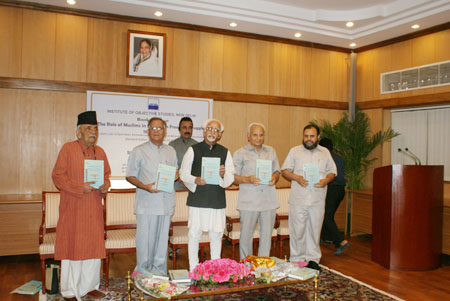
L-R: Shri Akhilesh Mittal, Historian; Prof. Z.M. Khan, Secretary General, IOS; Shri M. Hamid Ansari, Hon'ble Vice President of India; Prof. Refaqat Ali Khan, General Editor of the Volumes; Prof. M. Afzal Wani, Member, Governing Council IOS

New Delhi, May 31: The Vice President of India, Shri M. Hamid Ansari released a three-volume book from the Institute of Objective Studies (IOS) titled “The Role of Indian Muslim’s in the Indian Freedom Struggle (1857-1947)” at the Vice President’s House here last evening.

As the chief guest of the ceremony, he said that he had already inaugurated the first volume sometime ago at the same venue, and had expressed the desire to the IOS Chairman Dr. M. Manzoor Alam to soon inaugurate the entire set.

Dr Alam was not in the country yesterday. The Vice President said he missed him on such a momentous occasion.

He said the freedom movement was a response of Indian people to British colonial dominance. They fought as Indians, not as followers of some religion or members of some caste or ethnic group.

However, they often articulated the struggle in religious terms like Jehad for freedom, or Gandhiji’s ideal of Ram Rajya.

The series editor of the book, Prof. Refaqat Ali Khan, emphasised the fact that 1857 was a people’s movement in which all sections participated. “The urban India at revolt had the armed support of the peasants and tribes.”

He said the Muslim struggle for independence was inclusive, a part of national struggle for freedom, in which all sections of society worked together. During the Non-Cooperation Movement, in many areas as many as two-thirds of those arrested were Muslims.

The argument that such massive participation of Muslims in Non-Cooperation Movement was due to the Khilafat Movement does not hold ground if one considers the equally large Muslim participation in the Civil Disobedience Movement.

Historian Akhilesh Mittal said the communal divide was the handiwork of the British. “In 1857 the country stood as one man. Among the warriors against the British, 31 percent were Brahims and 34 percent Rajputs.” However, over the decades the British succeeded in dividing them, he concluded.

The programme was conducted by Prof. Afzal Wani.