Friday, March 2, 2012

Ooty and other beautiful summer hills in Tamilnadu, South India


Category: UNESCO Heritage Sites    


  Ooty Railway Station
 
By Shafee Ahmed Ko

The supernatural beauty of Ooty, in Nilgiri District, was unknown to India and to the world and was found by British in 1800, it became almost an English looking town, and the rich natives also settled down in this place.The Ooty, the name is a name from Uthagamandalam,the British who ruled India pronounced it as “Ootacamund” and natives called it “Ooty”.The cool climate with its exotic beauty proved a popular tourist spot world wide and is best suited for a summer resort for all clases of people.

Ooty-Best Tourist spot in Tammilnadu


Ooty is the best Summer Hill in Tamilnadu,South India and one should visit to look her beauty-being at a height of 6000-8000 ft, and its peak hill is Doddabetta 8,652 ft. Nilgiri hills are a proud, renowned summer resort both in India and abroad. The cool atmosphere ranging from 25-10 degree C, in summer, and is peak 21-5 degree in winter. In the chain range of the Western Ghats, the Nilgiris extends from the North East region of Kerala, Tamil Nadu, and Karnataka. She has pet names such as Uthagamandalam, Uthagai, and Blue Mountain. If you are looking for Ooty travel guide, this is the article for you.

Relaxation is most important to every man and woman. Mental stress is a hidden disease one does not how to get away from it. Of course meditation, music, painting, reading and writing are all the good form of relaxation. And once in week we have made rule one full day we have relax, and Sunday is very sweet and every await for a Sunday, and good lot of entertainments take place on Sundays.Similarly once in a year one has relax at least one week we should find a place to relax, and it is out of town or city, much more preferable.
This is the reason we select a resort, where we could forget our daily chore, and enjoy life, and keeps the mind quite fit and healthy. Hence, there a good quote also on relaxation: "The man who doesn't relax and hoot a few hoots voluntarily, now and then, is in great danger of hooting hoots and standing on his head for the edification of the pathologist and trained nurse, a little later on." Elbert Hubbard.

Now summer is approaching very fast and all the schools will be closed, children will have many dreams how to spend the summer holiday. Tourists from Tamil Nadu,and elsewhere from India and abroad will be planning for a holiday trip after a near exasperated hectic life of with the vociferous and wearied mob of school boys and girls, with their parents ready to please their wards, and also the toiled and moiled genre business and professional groups do feel to relax well after a ten or eleven months hard work, seeking a soothing place to go around a hilly places to relax, rest, in quiet place, a place for disposition to get free from stress, and for sure such things are very important in consideration of physical and mental hygiene.

Hills in Tamil Nadu


Let us have a glimpse how many Hill resorts in Tamilnadu, and analyse one after the other.

Few districts of Tamil Nadu are enriched with lush and verdant green summer resorts, some are well known to people and few are oblivious although they are economically viable. The districts such as Nilgiris, Salem, Namakkal, Vellore, Dindigul, Thirunelveli, Theni, Trichy and Cuddalore have such hilly places. The all suit to all echelon particularly to the super tired writers, and rest-and - leisure addicts, and film makers who need to avoid ogling crowd to their overt filmy costumes, and stars make ups in covert.

1. Blue Mountain Hill is nothing but English translation as Nilgiri Hills, is an English version is situated in Nilgiris District. The range of Western Ghats, it spans considerably large to three major districts, Tamil Nadu, Karnataka, and Kerala. Ooty, is a municipal town, and is district head quarter Situated at an altitude 7,347 feet above sea-level in the Nilgiri district.

2. Shevroys, Britishers called Servarayan Malai Shevroy in a style. This small hill is near Salem Town Tamil Nadu, is split hill range with area of 50 Sq.M with a height of around 5000 ft above mean sea level.

3. Yelagiri – in Javadhu hill range, in Vellore District between Katpadi and Jolarpettai railway junction.

4. Kollimalai or Kolli Hills ('Kolli Malai') in the district of Namakkal. The mountain ranges are about 1000 to 1300 meters in height, is part of the Eastern Ghats

5. Pachaimalai, 960 feet above ground level, 3 km from Thuraiyur in Tiruchirappalli district nearest.

6. Anamalais The Anamalai Hill is a range of mountains in the Western Ghats in Tamil Nadu. They form a southern portion of the Western Ghats. They are between Udumalpet and Munnar,

7. Pulneys

8. Podhigai malai These Hilly areas have Tribals with agriculture, and cattle breeding – good climate considerable mixture in physiographic, variant climate, soils, irrigation, rainfall, cropping pattern quite different place to place.. The rainfall varies from 850 mm in Kalrayan Hills to 4500 mm in Anamalai Hills.

Ooty is more popular to the people of India and the tourist from abroad too. Although the name Ooty comes as summer resort, it has a very good history behind it, with regards to its place, people, culture, ethnicity and metamorphism taking place closer akin to ecological variations, and we have to consider to what extent the extinct of rare species of birds, animals and insects have been in conservation. Ooty is "Queen of Hills" of Nilgiris. The Ooty,the name is derived from Uthagamandalam,fell to English tongue as “Ootacamund” and still reduced to a familiar term “Ooty”. A Stone House was built by John Sullivan, the then Governor of Coimbatore in 1822, which was also known as “Kal Bangala” which is now housing the Principal of Govt. Arts College.

Mettupalayam is the key center to access Ooty either by train or by road, the nearest broad gauge railway head which lies at a distance of about 46 kilometres from the city. Regular bus services connect Ooty to places like Bangalore, Mysore, Coimbatore, Calicut, Kanyakumari, Thanjavur, Tirupathi and Cochin. A toy train is not only for children, but the accompanying parents also feel the glee and charm of the lush green scenario nature’s gift. 4 hours time the scenic journey through the lush green hills, the tea plantations, the tunnels and the viaducts make it a optical gorgeous and luxurious for any traveller.

Ooty the best summer resort is widely spoken, written and heard that its cool climate and the beautiful summer resorts with full of green trees, curved and winding uphill narrow roads, traffic quite busy with all sorts vehicles, small and big, green bushy elegant, nimble, attractive tall eucalyptus trees arrayed in plethora need words more to describe. When the sun is about set in, the native women and children in good number walk the road with no care fast fleeting in general as forest trees, having conical apex with great height and filling their aroma in the entire region. We never miss the 22 acre botanical garden, Rose Garden having 22,000 varieties, Ooty Lake, Stone House, Toda Huts, and Mountain Rails et al.

People, Tribe, Cultutre, feature Nilgiris Badagas


If one becomes familiar the history and habitats about the natives of Uthagamandalam, or Ooty as whole, the trip will be more enjoyable. One should also know the region's people and their cultures and their origins. There is a misconception related to Badagas of Uthagamandalm to the migrants of Mysore, because the very term Badaga implies northerner. But the Tamil epics relate a different message.


An extensive research scholar B.Balasubramaniam, a Badaga, who has done before writing his book" Paamé " – The history and culture of the Badagas of the Nilgiris feels that "Badagas migrated from Southern Karnataka [then Mysore State] about 700 years back, much before Tipu's time, around 1311 AD during the plundering raid of Malik Kafir".


So the theory which goes deceitfully that the people from North, Mysore fled Uthagamandalam in dread and anxiety that the Sultan was coercing conversion does not hold water; again there is evidence that the British had played divide and rule is raging and notorious and tyrannical fallacy. Tippu Sultan had many Hindu scholars as his ministers, and advisor.Tippu Sultan is the one who fought with British colonists tooth and nail. Tippu had built Hindu temples and contributed to the deserving Hindus.

When we speak Christianity, mention has to be made on St.Stephen's.Stephen Rumbold Lushington,the then Governor of Madras, felt a selective and privileged cathedral for Britishers in Ooty, on April 23,1829 laid the foundation for the church in commemoration of birthday of King George IV.Only in 1947 the Church came into Church of South India.


TODAS


Among the early settlers the Todas, are known with different names such as Tudas, Tuduvans, and Todar.They have a language spoken but no script. The Government of India has identified the Toda as one of the six Primitive Tribal groups of Tamil Nadu. The Linguist Emeneau (1958: 47 - 50) said that, "Toda dialect is an independent language of the Dravidian family affiliated with Tamil - Malayalam. Other tribal mostly found are the Kothas, Kurumbas, Irulas, and Paniyas the all form the main tribes of Nilgris.They are in a smallest population.


 Badaga Films

Badaga Film directed by S.Mahesh Babu


There is interesting news that Udhagamandalam had also ventured in celluloid domain in an effective way in order to make a vivid the life and culture of Badgas, of course with the element of filmy addition and deletions, but it had great impetus of local culture and morale. Director S.Mahesh Babu has been in news on venturing such films. In the mid 1970s and an Ooty ex MLA B.Gopalan had taken a revolutionised a step forward by making the first black and white Badaga film Kaala Thappitha Payilu and a film titled Kemmanju was much talked about. Hosa Mungaru and Gavava Thedi which means 'in search of love or affection'. It was followed by “Hosa Mungaru” following is “Gavava Thedi” which means 'in search of love or affection'. Villages such as Kenthala and Keithorai villages had come handy for shooting in the pictures in a green lush location.

Few most important sightseeing places around Ooty are, Doddabetta Peak: It is within 10 Km,height 2,623 m,the Pykara Dam is an attractive location,the two waterfalls range 55 meters, 61meters respectively, and it has a power plant.Pine forest: Wenlock Downs,Kamaraj Sagar Dam, Mudumalai National Park,
Avalanche Lake.

Ooty, “The Queen of Hill Resorts” in Nilgiris” is matchless eco friendly and tourist spot, has to be enjoyed and should preserve its natural atmosphere without infringing its biosphere. Many water bodies, forests are restricted to visiting tourists to protect ecosystem. The rampant visitors are known to have been damaging the eco system of this beautiful place and they have a responsibility in conserving the flora and fauna of Ooty and its atmosphere.

How to reach Ooty by Rail from Chennai


Kovai Express to Ambur, Katpadi, Jolarpettai, Salem, Erode, Coimbatore
Inter City Express to Ambur, Katpadi, Ambur, Katpadi, Jolarpettai, and Salem, Erode, Coimbatore, Jolarpettai, Salem, Erode, Coimbatore.

How to reach ooty from Chennai to Comimbatore by Road

There are pretty numbers of buses plying from Chennai both operated by Tamil Nadu Government and also private buses. There are air conditioned buses also running to Ooty.

Vellore, Ambur, Salem, Erode: 535Kms/Coimbatore to Ooty 105 Km,from Coonur 18 Km,from Mysore(via Gudalur 155 Km, from Calicut 187 Km, from Bangalore 290 Kms,from Kochi(Coimbatore,Palakad)281,from Kodaikanal(Coimbatore,Palani) 236/ Ooty is on National Highway 67. The three states, Tamil Nadu,Kerala, and Karnataka is well connected by road through five main Nilgiri Ghat Roads.Ooty can also be well accessed by road through Mettupalayam (Coimbatore District) via Kotagiri, and this road does not lead through Coonoor. The district towns such as Coonoor, Gudalur, Kotagiri and other villages can be well accessed through frequent bus connections.

There is train service from Mettupalaym, Niligiri Mountain Railway (NMR) date back several decades. In July 2005 UNESCO has declared the Nilgri Mountain Railway (NMR) as the one of the worldUNESCO Heritage Sites, and it's prestigious to India and particularly to Tamil Nadu. The Nilgiri Mountain Railway in Tamil Nadu had been operated from in 1908, and it was known as Madras Railways. Although many trains running in India have changed to diesel to electrically operated, The Nilgiri Mountain Railway still maintains the steam locomotive system. NMR comes under the jurisdiction of the newly formed Salem Division. The film fame Shahrukh Khan acted on the roof top of NMR singing the well-known Hindi song "Chaiyya Chaiyya" from the film "Dil Se"

The British and Ooty Schools


Britishers found Ooty a congenial place for administration and schooling for their children. During their rule, the local economy was taken care and they had great concerned special care, since facilities, standard of education were high in India. Among the upper echelon Ooty boarding schools had a name and fame in India and also neighbouring countries, and Good Shepherd International School was considered very prestigious.

The most interesting thing in Ooty is the wild life and bird sanctuary which is divided into 5 ranges - Masinagudi, Thepakadu, Mudumalai, Kargudi and Nellakota.The endangered species and vulnerable birds can be of great mention here. Endangered Indian Elephants, Gaur, Chital, Indian Leopards are few worthy of mention. Critically endangered species of birds are Indian White rumped Vulture, and long billed vultures are in the bird sanctuary. The entire Western Ghats ranging from 2300 Sq.Mi, and Nilgiri Sub-Cluster and entire Mudumalai National Park is under consideration by the UNESCO World Heritage Committee for selection as a World Heritage Site, says Wikipedia.

Ooty STD CODE-0423 :National code +91
Emergency Numbers in Ooty:
Police Control Room Town East, Ooty, Tamilnadu, India 2442200
Police Out Post Pudumund, Ooty, Tamilnadu, India 2444065
Police Station Kandal, Ooty, Tamilnadu, India 2443941
Police Station (Rural ) Ooty, Tamilnadu, India 2443973
Police Station LoveDale, Ooty, Tamilnadu, India 2443942
Police Wireless Station Ooty, Tamilnadu, India 2443972


http://www.tamilspider.com/resources/8681-OOTY-THE-NATURE-S-CRADLE-OF-NILGRIS.aspx


Photos do not appear in the original article:"Amity India" editor has added them from the courtesy sources for the readers interests. Shafee Ahmed,the editor contacted director Mr.Mahesh Babu over the phone, and in turn Babu has invited the editor for a wider discussion on the History of Uthagamandalam.
Please write your comments in the comment box

Hijab: An Open Letter to the World

Mg-mast-head

Dear masses of the human race,
With due respect, I request you to hear me out and to read this letter with an open, unprejudiced mind.
Catholic nuns wear veil as a symbol of holiness. Sikhs wear a peculiar turban. Kippah is the skull-cap worn by Jewish men. In Hindu society, women often cover their head on entering religious places and follow it traditionally as a sign of respect in front of elders. European women of the Middle Ages wore different varieties of veils in the form of hats, wimple and head-scarves. Depictions of Virgin Mary (Hazrat Mariam), mother of Jesus Christ show her veiled. Muslim women wear veil - hijab - which is modest dressing. So, what is this hue and cry about Muslim women’s hijab? Why is the world making noise?
Feb 11,2004: MPs vote overwhelmingly to ban the Islamic headscarf and other religious symbols from state schools.

June 7, 2011: Iran women’s soccer team thwarted by hijab ban. Iran’s women’s team was correctly prevented from playing a 2012 Olympics qualifier wearing Islamic head scarves, FIFA claimed.
Sep 1, 2011: American police officers in the state of New York clashed with Muslim individuals protesting an arbitrary ban on hijab at an amusement park and arrested at least 15 protesters. The incident occurred when one woman, Entisai Ali, protested to police officers over the amusement park’s headscarf restriction.
27 September 2011: Bishkek - A ban on the wearing of headscarf at schools sparked outrage in Kyrgyzstan, with human rights activists condemning the move as denying Muslim girls one of their basic rights. Many Muslim students were either forced to remove their headscarves or go home if they refused to take them off.
December 08, 2011: Eight Kazakh female students at a university in northwestern Kazakhstan say they will sue school officials for not allowing them to attend classes wearing head scarves.

School and university students wearing hijab in Turkey constitute the biggest front of the fight against hijab ban in public sector and educational places in the country. The hijab-wearing university students, in particular, hold daily gatherings in front of their universities and try to gain their right through lawful means.
Perhaps we are going to times benighted; to the Dark Ages because from the Ancient to Middle Ages to perhaps just a few years ago, women were free to wear a veil and it was not only admissible but was considered a mark of modesty and propriety in some traditions, while a virtue of prestige and nobility in others. The veil which was permissible and acceptable by various traditions and religions such as Christianity, Judaism, Hinduism and glorified in their religious scriptures, has become an idiosyncrasy for Muslim women, a note of oppression and subjugation of Muslim women. Muslim women are perceived as dimwitted and obtuse with no intelligence and maturity of their own and inspite of their protests around the globe that hijab is their choice, a momentum of forced liberation can be witnessed.  We are labelled as oppressed and discriminated against from times primitive and, therefore, it is the duty of our Western empathizers to liberate us and to make a choice for us, because being feeble-minded, the Muslim woman cannot distinguish right from wrong.

When I say that the hijab I wear liberates me, you either smirk at me or look at me with pity - pity at a persona naive and simple-minded. Islam requires both men and women to cover certain areas of their bodies out of modesty.

How do I feel wearing Hijab? I feel empowered, respected and dignified. When people talk to me, they concentrate on what I say and not how I look. People talk to me for ME and not for my appearance. I feel seen for who I truly am - a human being. When I wear hijab, I feel that perhaps I reflect some glimmerings of modesty of Mother Mary, the holiness of nuns. Its like living in a church everyday. I feel pure. Hijab requires purity of character - to live a principle-centred life based on humility, modesty, honesty, love, compassion and kindness and to elevate oneself with a conscious endeavour.

So, please do not prejudice. You respect the veil of a nun for her holiness and modesty and perceive the veil that I wear as a symbol of subjugation and injustice. Islam does not provide for oppression of woman. I am free to choose. Hijab is my choice. I am liberated. Your truly,
Wajiha Mehdi

  A follower of equality and liberty for all,  a girl who wears Hijab

wajiha_mehdi_90@yahoo.com
This article appeared in The Milli Gazette print issue of 16-29 February 2012 on page no. 2

10 YEARS OF RESISTANCE Bol ki Sach Zindaa Hai Ab Tak Ten Years of Gujarat 2002


March 4, 2012
Constitution Club Lawns, Rafi Marg, New Delhi
10.30 am to 9.30pm

Ten years Journey through the voices of victims, activists, academicians, artists
A Day Long Convention and a Cultural Tribute


We invite people from across India to join us in remembering Ten years of Gujarat 2002, paying homage to the victims and taking our struggle forward to politically defeat the forces of hatred in Gujarat.  We are not in a position to support the travel or stay but we do hope that individuals and organizations will join in to commemorate ten years of Gujarat.

Over 250 victims from Gujarat and senior activists will be participating in the convention.

10.30am- Inauguration of the Exhibition: Reflections of a Journey- conceived and designed by Shabnam Hashmi . Sanjiv Bhatt will inaugurate the exhibition

11.00 am – 11.45 noon
BOOK RELEASE:
“Lest we Forget History” written by PGJ NAMPOOTHIRI and GAGAN SETHI
Panel: Justice Verma, Syeda Hamid, Farah Naqvi, PGJ Nampoothiri, Gagan Sethi

11.45noon – 1.30pm
List of speakers: BRINDA KARAT, DIGVIJAY SINGH, HARSH MANDER, JITENDRA AHWAR,  MAHESH BHATT, SANJIV BHATT, VRINDA GROVER

1.30-2.15pm- Lunch

2.15-4.00pm
List of speakers: HANIF LAKDAWALA, DR.HARSHVARDHAN HEGDE,SHABNAM HASHMI, SHEBA GEORGE, UTTAM PARMAR, ZAKIA SOMAN, VOICES OF VICTIMS

4-4.30PM- TEA BREAK

4.30-9.30pm

A Cultural Tribute
The artists include AVNI SETHI- a young kathak dancer and a designer, EKLEKTIKA- a rock band, DHRUV SANGARI-sufi singer, IMAAD SHAH- actor, singer, theatre and cinema artist, MANU KOHLI-singer, MEHMOOD FARUQI AND DANISH HUSSAIN- dastan goyee, NAMRATA PAMNANI- a dancer, SABA AZAD- an actress, singer and dancer from cinema and theatre, SANJAY RAJOURA- a standup comedian, SKA VENGERS -  a rock band. ( please see attached invite for schedule).


Programme Organised by ANHAD, BHARTIYA MUSLIM MAHILA ANDOLAN, JANVIKAS, SIASAT

Islamic School for Women Faithful or Fundamental?


By Sharmeen Obaid-Chinoy
Globe and Mail, Toronto
http://www.globeandmail.ca

In a modest industrial park near Lester B. Person International Airport in Mississauga, 150 women varying white head scarves and long, black Saudi style coats called abayas sit in a medium-sized classroom listening attentively to their teacher.

This morning's lecture includes a perspective on the recent earthquake in Pakistan. "We must understand why such calamities take place," says Dr. Farhat Hashmi, addressing the room in Urdu. "The people in the are where the earthquake hit were involved in immoral activities, and God has said that he will punish those who do not follow his path." He students nod and murmur in agreement.

The classroom walls are pinned with interpretations of passages from the Quran, giving instruction on how Muslims should live their lives-guidance on when to smile, cry, tell the truth, when to be angry. Outside the front door, a sign reads, "no men allowed without prior permission."

Since April, 2005, women from across Toronto and as far way as Australia have come here to the Al Huda Islamic Centre of Canada to take a 20-month course called Taleem-ul-Quran; the "education of the Quran." Its teacher, and the school's founder, Dr. Hashmi, says she has come from Pakistan to enlighten young Muslim women about their religion.

Her critics in the city's South Asian community say she is encouraging women to cover up, stay at home and accept outdated gender roles.

The school is the latest extension of Al-Huda International which Dr. Hashmi founded in Pakistan in 1994 after graduating with a PhD in Islamic Studies from the University of Glasgow. Through her teachings, she has since become a well-known Islamic scholar, specially among middle and upper-middle-class women in Pakistan.

The school now counts more than 10,000 graduates and she has offered lectures to women in Dubai and London.

She has moved to Toronto with her husband and family, she says, in response to demand for young women in the city to gain a deeper understanding of Islam. For a nominal fee of $60 a month, students attend classes four days a week for five hours a day. During a typical class, students p=recite prayers from the Quran, then follow up with a long session reading the Urdu translation of the Holy Book with Dr. Hashmi.

In order to obtain the non-certified diploma, students are expected to learn how to translate the 30 books of the Quran. Her lessons are also available on CD.

"My Canadian friends invited me here because they feel that there is an need to educate young Muslim girls in this society," explains Dr. Hashmi in an interview conducted in Urdu. "They come to me for answers," she says. "I teach them the Quran, and they leave with a sense of peace."

The young women who have come to the Al-Huda Islamic Centre seem to agree. They say their experience learning with Dr. Hashmi has transformed them.

Sada Mohsin, 17, says she wore jeans and t-shirts and often stayed out partying with friends in her senior year of high school in New York. "I was like an average high school student," she says. "I would go with the flow, listen to music, have both guy and girl friends."

When her father suggested that she move to Canada to go to the Al-Huda Islamic Centre, she initially resisted. "I knew that my parents were angry at me for pushing them away. They felt that I was becoming too American in my ways," she says.

But over the past few months, Ms. Mohsin has enjoyed the classes so much that he has stayed out of choice. "I'm giving up my old American friends and making new ones here in class. My whole life is changing," she says. "I've started wearing the abaya, and its this new environment and these new friends that have helped me do that."

Dressed in a denim jacket, white pants and a head scarf, Ayesha Awan, 20, makes her way to class every morning. She has cut her studies at York University to part-time to attend Al-Huda's 20-month course. "I wasn't religious when I started her class. I didn't cover my head before, but now I do," she says.

Her perspective on the role of women has also changed. "I agree with Dr. Hashmi that women should stay at home and look after their families," she says.

Ms. Awan was so impressed with Dr. Hashmi's sermons that she convinced 10 friends to enrol in the course. She believes that people who don't agree with Dr. Hashmi's message change their mind after they attend her classes.

"It takes time to get used to everything, because we are not sued to segregation and covering up," Ms. Awan explains. "But there are a lot of people in Canada who practise it, so it is possible to do so."

But Tarek Fatah, the communications director of the Muslim Canadian Congress is highly critical of Dr. Hashmi's teachings. "Her concept is a grave threat not only to Canadian values, but also to Canadian Muslims. She is segregating society and encouraging the ghettoization=of the South Asian Muslim community and making it very difficult for them to integrate into mainstream society," Mr. Fatah argues. "She is completely brainwashing these educated, middle-class women top stay at home."

His concerns are echoed by Ms. Kausar Khan, 37. "It has taken (Muslim women) so long to come out of our homes," the Brampton business owner says. "We have had to fight for an education and the right to work and Dr. Hashmi's message is negating all that."

"She is encouraging our women to stay home and be submissive to their husbands, and that settle well with the rest of us."

The reason that Dr. Hashmi's students are embracing her interpretation of  the Quran, Ms. Khan argues is that most of them are not well versed in Islam and cannot question her authority. "These young women are naive," she says.

Dr. Hashmi, who considers herself an Islamic feminist, disagrees. "I don't force anyone to do anything. They don't have to listen to me if they don't want to."

Furthermore, she says that she is only helping her students better  understand Islam. "People accuse me of preaching my views, they are confused," Dr. Hashmi says. "I refrain from using my personal opinion in my lesson. I just translate the word of God. So people don't have a problem with me, because my message is from the Quran, they have a problem with God."

She applies this explanation in response to the interpretation some put on her teachings that she preaches polygamy-a common accusation her critics direct at her. Dr. Hashmi denies the claim, but notes, "Islam gives women rights, so that a man cannot take advantage of her. If a man has relations with a woman outside of marriage, the Quran orders him to marry her."

Her student Sadaf Mahmood, 18, agrees with this logic, arguing that Western society accords less respect to women, allowing men to have affairs without taking any responsibility. "There are more women than men in this world," Ms. Mahmood adds. "Who will take care of these women? It is better for a man to do things legally by taking a second wife, rather than having an affair."

On the issue of women working, she again point to the Quran, asserting that women must recognise their own abilities and circumstances when entering the work force. "Women that should understand the limits set by Islam," she says. "Whichever field fulfills both the requirement of the individual and Islam, that would be the appropriate career."

But Canadian Muslims point to the Prophet Muhammad, the messenger of Islam from God, whose own wife was a business woman and renowned for her skills.

Muslim Canadians such as Kausar Khan are most alarmed at the possibility that the next generation of South Asian girls are embarking Dr. Hashmi's teachings. "We live in a secular society, where there is separation of religion and state. Then why is this woman being allowed to bring her extremist views to our country? She poses a danger to us and our Canadian way of life."

Dr. Hashmi insists her message will not confuse these young girls who are a product of western world; "Islam is for all times. Why does the environment here have to change the young girls, why can't they change the environment?"

Students such as 18-year old Madiha Khokar see the change. "I was a feminist...But after taking her classes, I don't think that way. I think that women have a place in society, and their rights are accorded to them by God in the Quran."


Wednesday, February 29, 2012

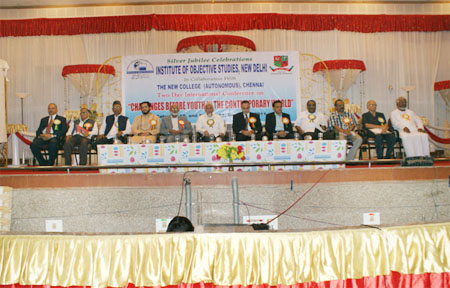
Two-Day International Conference on “Challenges before Youth in the Contemporary World” December 10-11, 2011 Chennai, Tamil Nadu


Organised by
Institute of Objective Studies
&
The New College, Chennai


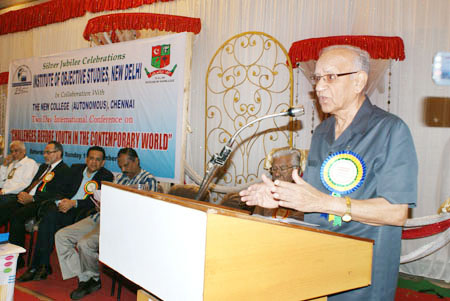
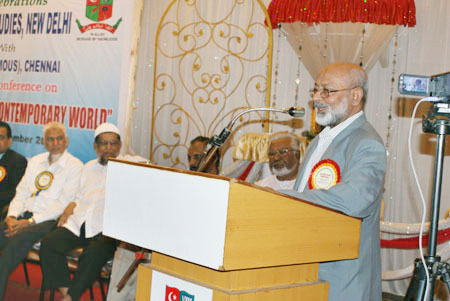
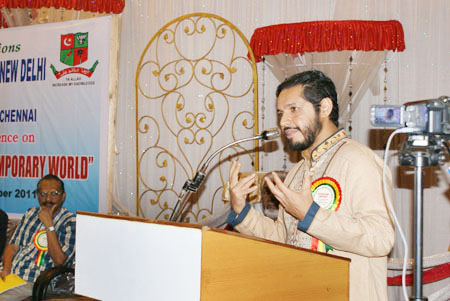
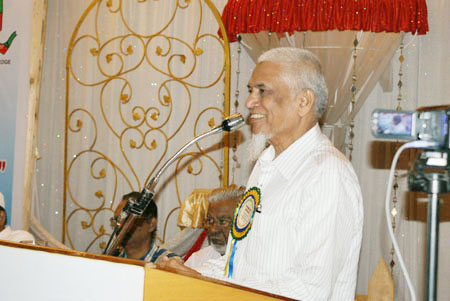
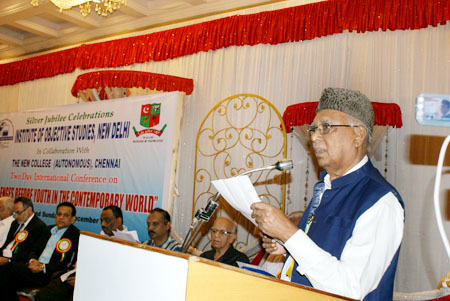
L-R: Dr. Altaff principal New College, Prof. Z.M. Khan Secretary General IOS, Capt. N.A. Ameer Ali Chairman Reception Committee, Abdul Qadir A.R. Buhari Pro Chancellor BS Abdur Rahman University, Dr. M. Manzoor Alam Chairman IOS, A. Md. Ashraf Secretary MEASI & New College, Dr. Ibrahim Bin Hamad Al-Quayid World Assembly of Muslim Youth Riyadh KSA, Dr. Dato’ Mohammad Iqbal Malaysia, Mecca Rafeeque Ahmed chairman FICCI Southern region, Dr. Christo Das Gandhi Addl. Chief Secretary Govt. of Tamilnadu, Mr. V.R. Lakshminarayanan IPS (Retd.) and Dr. Kaviko Abdur Rahman

IOS Conference on “Challenges before Youth in Contemporary World” at Chennai

By A U Asif

Youth are backbone of a society. That’s why every organization, whether it’s social or political, wills to have its own youth wing. However, there are a very few ones who takes care of the difficulties and challenges they face. From this point of view, the two-day international conference on “Challenges before Youth in the Contemporary World”, organized on December 10-11, 2011 by Institute of Objective Studies (IOS) in collaboration with Chennai-based Muslim Educational Association of Southern India (MEASI) as part of a year-long silver jubilee celebrations was important and extraordinary.

It was participated by a number of experts, scholars, other dignitaries and delegates from inside and outside the country. Besides inaugural and valedictory sessions, there were held five business sessions. The most remarkable point in these sessions was that the empowerment of youth got focus besides bringing back the moral values amongst them. The women empowerment was also discussed in detail.

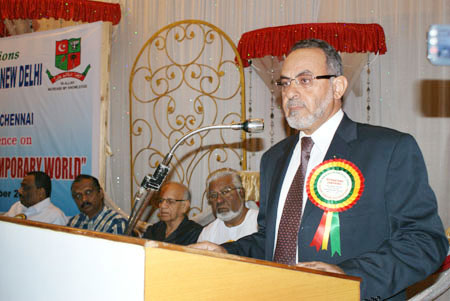
Delivering his address at the inaugural function, Dr Ibrahim Bin Hammad Al Quayid of Riyadh-based World Assembly of Muslim Youth (WAMY) said the youth today in general faced three kinds of challenges. According to him, they were of political, economic and socio-cultural nature.


Speaker: Dr. Ibrahim Bin Hamad Al-Quayid, World Assembly of Muslim Youth, Riyadh, KSA

“An ideal society can emerge only when these three challenges are tackled tactfully taking them into confidence,” the renowned scholar opined.


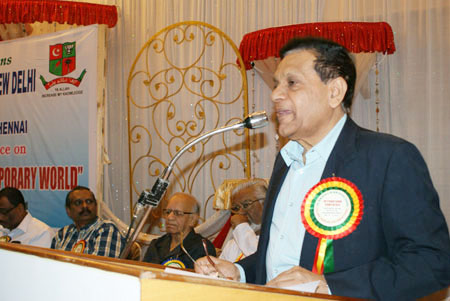
Dato Mohammed Iqbal, a well known scholar and United Nations representative from Malaysia, said Islam didn’t differentiate between persons other than piety.

Speaker: Dr. Dato’ Mohammad Iqbal, Malaysia
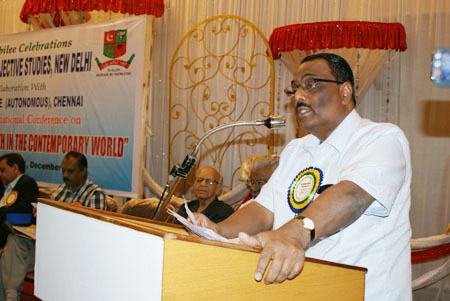
Padamshree Mecca Rafique Ahmed, Chairman, Chambers of Commerce, Karnataka and a business tycoon said the youth today were running after money and going materialistic. “That’s why they are full of tension, stress and strain,” he said.

Speaker: Mecca Rafeeque Ahmed chairman FICCI Southern region
According to him, capitalism and Socialism were only 200-300 year-old whereas the history of Islam and Muslims was of more than a thousand years. Therefore, only Islam could come as a natural remedy to the youth, he declared.

In the words of V R Lakshminarayanan, IPS (Retd), the main issue was how to provide education to the entire Muslim community.

Speaker: Mr. V.R. Lakshminarayanan IPS (Retd.)

Author of his master-piece “Role of Muslim Youth in the Reconstruction of Contemporary World” published 28 years ago, IOS Chairman and star attraction of the conference Dr M Manzoor Alam said he had discussed the issues 28 years ago in his book but they still remained relevant because situation changed with the passage of time but not the root cause.

Speaker: Dr. M. Manzoor Alam Chairman IOS
Dr Kaviko Abdur Rahman, son of business tycoon and educationist B S Abdur Rahman, discussed the difficulties faced by the Muslim youth in general and suggested its solution. He said whatsoever was being done at the government level, and how much it was effective, was known to the government, but the Muslim community should itself pay attention towards it.

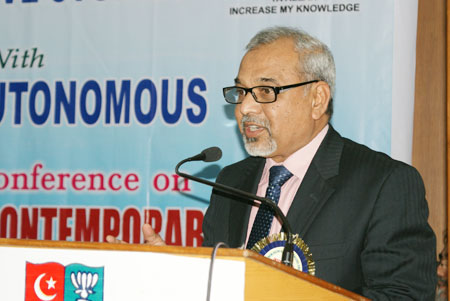
Speaker: Abdul Qadir A.R. Buhari Pro Chancellor BS Abdur Rahman University
In this connection, he dwelt in detail the efforts made by B S Abdur Rahman University and 14 other educational institutions in Tamil Nadu. He said his ageing father B S Abdur Rahman was now not in good state of health but had got concern about the youth even today. That’s why he had asked me to convey his good wishes and dua to them, Dr Kaviko Abdur Rahman said.

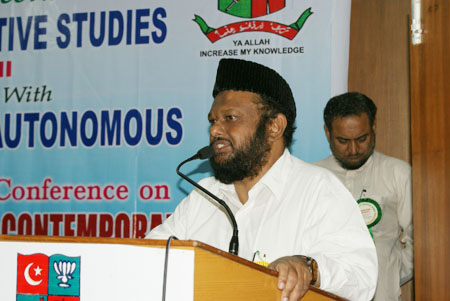
Muslim Educational Association of South India and New College Secretary A Muhammad Ashraf, in his presidential address, said the enthusiasm of the youth had increased a lot in the age of information technology but left behind the moral values in the race of development from the point of view of technical expertise due to which moral generation and crisis in mind developed.

Speaker: A. Md. Ashraf Secretary MEASI & New College
On this occasion, important dignitaries were given awards and citation. The inaugural function ended with a vote of thanks by Shafee Ahmed Ko. Earlier, the reception committee chairman Captain N A Ameer Ali delivered his inaugural address and IOS Secretary General Dr Z M Khan introduced the IOS.

Speaker: Captain N A Ameer Ali
Similarly, the valedictory function on December 11 was too attractive. Dr M Manzoor Alam, in his presidential address, said the IOS had decided to hold 14 international conferences in different cities under different topic covering the central theme “Towards Knowledge, Development and Peace: Outlining Road Map for Future” out of which the international conference on the “Challenges before Youth in Contemporary World” at Chennai was the eighth in number. He said IOS got opportunities to understand different problems faced by nation in general and Muslim community in particular through these conferences.

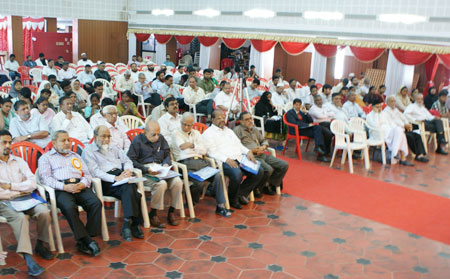
A view of audience
He said the youth had played their role in construction and destruction both in every age, and this was happening in this era too. “It is the responsibility of those keeping an eye on the situation and issues to pay attention towards them help in resolving the problems and challenges faced by them,” he advised.

Madras High Court judge G M Akbar Ali averred before a person passed through ageing, he should give importance to it and use it properly. He said he was not acquainted very well earlier with IOS but its multifarious activities had influenced very much. He hoped it would continue to guide the community and nation in coming year.

Speaker: Justice G M Akbar Ali, Madras High Court
On this occasion, Ibrahim Al Quaid of WAMY said his world body of youth looked with much hope and honour towards the activities of IOS. Summing up his view, he said today it was a fact whatsoever dream Dr Manzoor Alam had seen 26 years ago, had come to be true in the shape of this 25-year old think tank.

Tamil Nadu Assembly Member and President of Tamil Muslim Munnetra Kazhagham Dr M H Jawahirullah opined this think tank had earned a reputation not only nation wide but world wide too.

Speaker: Dr M H Jawahirullah, Tamil Nadu Assembly Member and President of Tamil Muslim Munnetra Kazhagham
On this occasion, former Madras High Court judge Abdul Bari, T Rafique Ahmed and New College Principal Dr K Altaf also expressed their views. The two-day conference ended with the adoption of a resolution presented by S M Abdur Raheem Patel.

The conference adopted the following resolutions in its concluding session.

RESOLUTIONS

  1. It is resolved that serious efforts be taken to set up a specialized ‘IOS Global Council for Youth Development’ in Chennai.

  2. It is resolved that Chennai Chapter shall draw a plan to approach regional institutions and policy planners to muster support for augmenting interaction with marginalised groups to study their issues and problems within their specific context. Collaboration with other societies to carry out these activities should be a priority.

  3. It is resolved that Chennai Chapter should also establish viable linkages with other regional chapters of IOS and try to create coordination with each other.

  4. It was resolved that effort should be made to involve the political, social and cultural segments of Tamil Nadu for creating awareness about the plight of Muslim youth and other marginalised sections of society.

  5. It is resolved to request the government to make quality education at higher levels affordable to weaker and marginalised sections of societies as it has become expensive and beyond their reach.

  6. It is resolved that special efforts be made to initiate programmes of soft and life skills development among youth at all desirable levels. A close contact with state government in these areas will be aimed at.

  7. It is resolved that efforts be made to include ethical and moral value systems in the school and college curricula.

  8. It is resolved to request the Tamil Nadu government to protect and promote all minority languages in the state.

  9. It is resolved that IOS sets up a separate fund to support Muslim youth who appears for IAS, IPS and other central and state services.

  10. It is resolved to make a survey of the Muslim youth and their family members who had undergone physical and mental agony during their incarceration in prisons for several years. Efforts should be made to take suitable measures for their rehabilitation.

  11. This conference appeals to the Muslim community to pay maximum attention in bringing up and character building of their children in Islamic perspective and also guide them in the selection of their career.
Shafee Ahmed Ko
Coordinator
IOS Chennai Chapter
Chennai,South India.


Wednesday, February 22, 2012

The Right of Children to Free and Compulsory Education Act, 2009: Some Reflections


Dr. Mohammad Manzoor Alam

Chairman, Institute of Objective Studies &
General Secretary, All India Milli Council

The right to education is part of the internationally recognised human rights. Universal declaration of Human Rights in 1948 first recognised this as a basic human right. As a corollary, this right has been incorporated in various international conventions and plans. A vast majority of countries has signed up to, and ratified, international conventions concerning this right, most importantly the UN Convention on the Rights of the Child. However, despite ratification and undisputed desirability of this right, very few countries have incorporated it in their domestic legal framework or created administrative frameworks to ensure realisation of this right.

India has enacted The Right of Children to Free and Compulsory Education Act, 2009 for ensuring free and compulsory education to children between the age of six and fourteen. This is a significant legislation. Realisation of the right to education to every child shall, indeed, be an important advancement of the society in general and weaker sections in particular. It is obvious that education shall enable people to develop skills, capacity and confidence to strive for realisation of other rights.

However, we should also keep in mind that this right to education does not mean that any education would be sufficient to fulfill our aspirations. Former UN Special Rapporteur on the Right to Education, Katarina Tomasevski, had said that for education to be a meaningful right it must be available, accessible, acceptable and adaptable.

In the Indian context, the scheme of the Act, we may describe these 4 A�s in the following terms:

Availability � means that education is government-funded, free, and there are adequate number of schools and trained teachers who may ensure quality education to a child in his neighbourhood.

Accessibility �means that the education system is accessible to all without any discrimination, but ensures positive steps for the marginalised sections of the society.

Acceptability � means that the education curriculum is relevant and of good quality with cultural acceptability for all, especially the minorities.

Adaptability � means that the education serves needs of the society and its suitable to specific contexts like religious education, etc.

In my opinion, the Act, in the present form, not only disregards all the 4 A�s but is violative of the rights of the minorities guaranteed under the Constitution. Without considering ground realities, the Act provides difficult and impractical standards.

For example, the RTE Act makes it compulsory for all schools to maintain a student to teacher ratio of 30:1. As per various surveys, schools in India are struggling with a ratio of 50:1 (and some schools with 80:1), while there are many, including those run by the government, which have just a single teacher. There are 5.23 lakh teachers� positions that are vacant while almost equal number of untrained teachers are employed at the primary level. How those teachers will be trained to make them qualified as per the norms prescribed by the RTE within the next five years is the moot question.

Accessibility is another problem. We have been witnessing fast commercialisation of school education. Instead of increasing government spending on school education, the RTE Act contains provisions making it compulsory for all private, unaided and minority schools to reserve 25 percent of total seats in elementary education for underprivileged and financially weak children.

The Act also provides stringent financial and legal punishments for violation of the clause making 25 percent seats reserved. However, while making this provision in the Act, rights of the minorities guaranteed under Article 29 and 30 of the Constitution were completely ignored.

Another important area that was not considered by the government was the madarsas, and other institutions imparting religious education. The Scheme of the Act has been such that a total ban would have been imposed on all institutions imparting religious education.

Almost all Muslim and other minorities� organisations have been raising their voice on these issues. Earlier, the HRD Ministry had on January 15, 2010 issued guidelines exempting madarsas and other religious education institution. However, the guidelines could not have overridden the provisions of the Act. Therefore, the demands for amending the Act continued.

Besides, the Muslim Personal Law Board and other Muslim organisations, Muslim members of parliament also put pressure on the government to bring in amendments to the Act itself so that these issues could be addressed. In December 2011, the government agreed to bring in amendment to the Act, exempting madarsas, Vedic pathshalas and other institutions imparting religious education from the purview of the Act.

Further, the demand for respecting rights of the minorities under Article 29 and 30 of the Constitution has also been accepted. An amendment making modified application of the law to the minority educational institutions is also going to be moved. It has been agreed that the provisions of the Act shall apply to the minority educational institutions subject to the provisions of Articles 29 and 30 of the Constitution. The government has further agreed that the School Management Committee, constituted under Section 21 of the Act, shall perform advisory functions only.

The HRD Minister has promised to move these amendments to the RTE Act in the coming Budget Session of Parliament. Let us hope that this shall be done.

Further, one more amendment that needs to be made pertains to the children studying in madarsas, Vedic pathshalas and other institutions imparting religious education.

Such children, who are studying in madarsas, Vedic pathshalas or other institutions imparting religious education, their guardians and parents should not be subjected to any disability, penalty and punishment for non-compliance with any provision of the Act or rules made thereunder.

This is a logical and consequential amendment that the government should agree to incorporate in the amending Act.

There are many other challenges of general and practical nature, like allocation of funds, commercialisation of school education, etc., that requires serious deliberation by the government, educationists and other planners to make the right to education a really meaningful right, especially for the poor and marginalised, and save this law from becoming an act of tokenism.
 g


February 21, 2012


Frontline cover story: A decade of shame


Frontline
Volume 29 - Issue 04 :: Feb. 25-Mar. 09, 2012 INDIA'S NATIONAL MAGAZINE
from the publishers of THE HINDU
Contents


Printer Friendly Page Send this Article to a Friend

COVER STORY

A decade of shame
ANUPAMA KATAKAM
in Ahmedabad
The victims of the 2002 anti-Muslim pogrom in Gujarat are still to get justice but are determined to continue the fight.

SIDDHARTH DARSHAN KUMAR/AP


GULBERG SOCIETY IN Ahmedabad today. Sixty-nine people died in the arson and massacre at the Society in the 2002 anti-Muslim pogrom 
 

SAIRABEN SANDHI and Rupa Mody sit quietly on the back benches at the Metropolitan Magistrate's Court in Ahmedabad watching the proceedings in the Zakia Jafri case. Both the women have witnessed immense tragedy. One saw her son killed, while the other has been searching for her missing son for the past 10 years. In the courtroom, there are others too who survived the gruesome massacre at Gulberg Society in Ahmedabad in 2002. All of them have gone through the trauma of seeing immediate family members hacked or burnt to death. The judge eventually postpones the hearing to another day and the survivors file out. They seem used to this routine. There is a level of tension and disappointment among them, but they are not entirely disheartened.

“We come for every hearing in this case. Until we are alive we are not going to give up. We are not going to leave him [Chief Minister Narendra Modi]. We know we will get justice even if it takes another 10 years,” says Rupa Mody.

The Zakia Jafri case has begun to symbolise the struggle for justice for all the riot victims and is reaching a crucial stage. It is the only case in which Modi is named as an accused and is, therefore, seen as critical in nailing the perpetrators of the pogrom. Coincidently, as the tenth anniversary of the Gujarat riots approaches, the case has taken a significant turn. The Special Investigation Team (SIT) has filed a “closure report” saying there is not enough evidence to prosecute Modi. Zakia Jafri's legal team has gone in appeal. Its main contention is that the riots were meticulously planned and those in seats of power deliberately turned a blind eye to the attacks on Muslims across the State.

In the past few years, Modi has tried hard to get rid of the taint of the riots and get what he calls a “clean chit”. However, each time the “clean chit” has been within grasp, the law has intervened to thwart him. With Assembly elections in Gujarat scheduled for later this year and national politics beckoning him as an aspirant for the prime ministership, Modi appears desperate to get the riots-responsible label off his back. Furthermore, he has worked the corporate sector to project himself as a forward-thinking leader who is interested in bringing prosperity and development to his State – and not as a saffron politician interested only in communal politics. Getting the Tatas to shift their Nano small car plant to Sanand from Singur in West Bengal was clearly a part of this agenda, say observers.

February 28, 2012, will mark a decade since the Gujarat riots, undoubtedly one of the worst chapters of communal violence in the country's history. Official estimates put the death toll, of both Hindus and Muslims, at a little over 1,000, while unofficially it has been pegged at more than 2,000. At least 600 children were orphaned and more than 400 were reported missing.
Ten years later, the wounds are still to heal. The investigation into the riot cases are plodding along with no closure in sight. The only case to reach a conclusion is Sardarpura, where a mob burnt alive 33 Muslims trapped in a house. Thirty-one people were imprisoned for life in this case. There are eight other cases that are pending trial.
For many victims the memories of the violence are still fresh in their minds. “Only justice will help heal. But nothing they do can bring back my son,” says Rupa Mody.

If the nightmares of the 2002 violence were not bad enough, the minority communities have had to cope with severe marginalisation. Thousands of families have been hounded out of the State, and they have moved with just the clothes on their back to areas such as Mumbra in Maharashtra. On issues relating to the minority community, the dominant view is that over the past decade Gujarat has become more polarised than ever before. Access to education, employment, housing and other fundamental needs is becoming increasingly difficult. What is worse is that there are few rays of optimism – there is only a sense of helplessness.

Zakia Jafri, a big hope

Zakia Jafri saw her husband, Ehsan Jafri, a former Member of Parliament, being hacked to death. Ehsan Jafri thought that his house in Gulberg Society offered the best protection to other residents of the locality from the rampaging mobs. Unfortunately, in spite of several phone calls to the police and senior politicians, help never arrived and Jafri had to handle the mob single-handedly. Eventually, he stepped out of his house in an attempt to placate the mob. They killed him and then burnt his body in front of his family and neighbours.


JANAK PATEL

Of the 30 homes and approximately 20 families, only one family continues to inhabit what is now virtually a ghost colony.
 

Zakia Jafri remembers vividly every moment of those two horrific days. As many as 69 people died in Gulberg Society and 28 went missing, one of them was Azhar, Rupa Mody's 13-year-old son. To date they remain missing.

Zakia Jafri, along with several activists and members of the Citizens of Justice and Peace (CJP), a non-governmental organisation, has maintained that the Gujarat riots were a pogrom and that there is enough evidence to prove this. Leading a protracted legal fight for justice for the past eight years, the feisty 70-year-old says she will not back down until the perpetrators and killers of her husband and thousands of other Muslims are punished.

“Now, at this stage, we won't let them close the case so easily. We will keep it going for however long it takes to get justice,” says Zakia Jafri, who lives with her son in Surat. “You cannot say that in 10 years nothing has happened. Modi's name is linked to terrible communal riots. His name is badnaamed (sullied) all over the world. Everyone knows his true colours since this case has got so much attention. The fact that he has blood on his hands… he cannot wipe that off so easily,” she said to Frontline.

Zakia Jafri's case reached a critical juncture in February, when the SIT decided to file a “closure report” citing lack of prosecutable evidence against Modi. Zakia Jafri's legal recourse is to appeal for the report. On February 15, she was told the report would be given within a month. This could mean the end of her case but she does have the provision to appeal in the higher courts and eventually in the Supreme Court.

In 2006, Zakia Jafri petitioned the court alleging that Modi and 61 others, including politicians, policemen and bureaucrats, had colluded to ensure that the victims of the mob attacks during the riots did not receive help. Zakia Jafri, along with other witnesses, testified in court that Ehsan Jafri repeatedly called Modi when they were under attack. But no help came. She accused Modi of abdicating his duty as the constitutionally elected head of the State government to protect the right to life of all its citizens regardless of their caste, community and gender and becoming the architect of a criminal conspiracy.

In 2007, the Gujarat High Court rejected her petition for a first information report (FIR) to be filed. Zakia Jafri and the CJP then filed a special leave petition (SLP) in the Supreme Court, which appointed Prashant Bhushan amicus curiae. In 2009, the court appointed a Special Investigation Team led by R.K. Raghavan, former Director of the Central Bureau of Investigation (CBI), to probe the Zakia Jafri case.
In 2010, Zakia Jafri and thousands of others saw some manner of justice when the SIT summoned Modi for questioning. This was the first time in the country's history that a Chief Minister was questioned in a criminal complaint that dealt with communal violence. But two years later the SIT in its report cited lack of substantial evidence to prosecute him.

In an interview to Frontline, at that time she said: “Yes. It has been a long time. But when I heard Modi had been summoned, I said, ‘ Insaf ho jayega' [Justice will happen]. Someone like Modi cannot be accused of such a major crime without adequate evidence. We have persevered at collecting every relevant detail to implicate him. One day it will pay off. If he admits his guilt, that itself would be a punishment for someone like him.”


In what seemed like a victory for both parties, in September 2011 the Supreme Court sent the Zakia Jafri case back to the trial court in Ahmedabad as it chose not to pass judgment on whether Modi should be prosecuted or not. Modi celebrated the order, saying this essentially let him off the hook. Zakia Jafri and Teesta Setalvad, activist and lawyer with the CJP, too, welcomed the order and saw it as a move in the right direction.

“This is part of the judicial process and we welcome and respect the Supreme Court's directive. It has not, by any length, given Modi a clean chit. They are just following the correct procedures,” said Teesta Setalvad. “Of course, we couldn't expect the Supreme Court to make a major decision, but this is as good. The reason why it is a victory for us and not for Modi or the BJP is that it has gone past the FIR stage,” she said.


This February the SIT, however, took what is now being seen as a predictable step and filed a “closure report”. Activists and those involved in the case exploded at the move. Sanjiv Bhatt, a suspended police officer who was named as a witness by Zakia Jafri and who testified against Modi, said: “In spite of substantial direct evidence and overwhelming circumstantial evidence to establish Modi's complicity in the anti-Muslim pogrom of 2002, the SIT says they do not have enough to prosecute him.” He added: “The SIT has deliberately suppressed and concealed data which would implicate Modi.”
In 2010, Raju Ramachandran was appointed amicus curiae as Prashant Bhushan stepped down. Informed sources say Ramachandran's report is damning and flies in the face of the SIT's “closure report”. The next few weeks will determine where this case goes, says Teesta Setalvad. “But we will pursue it relentlessly. The Zakia Jafri case has become a symbol of justice and we have to keep it going.”

Gulberg Society – A mother's story

Rupa (Tanaz) Mody, her husband Dara Mody, and two children were the only non-Muslims living in Gulberg Society. Her son Azhar has been missing since February 28, 2002. Until she sees his body, she says she will not be convinced he is dead. He is among the 28 persons missing from this colony, which was ravaged by a mob that set it on fire by throwing chemical-filled vials that burst into flames once they hit a surface.

Eyes brimming with tears, she says she has searched for Azhar for 10 years and will continue searching for him. The family has gone through every morgue in the city, every police station, and put up posters too. A film, Parzania, has been made on her son. They have done whatever it takes to locate a missing person, but there is absolutely no sign of the boy. Distraught and angry, she says: “I will fight until my dying day to see that Modi and his band of rogues are nailed. I was in Jafri Saheb's house and saw how our cries for help were ignored by Modi and the police. I want them to pay.”

On the eve of the Zakia Jafri closure report case, Rupa Mody spoke to Frontline about what happened at Gulberg Society 10 years ago. Her story is only one of many horrific incidents that took place during the pogrom. She summoned the courage to speak out where others could not:

“My children were at tuition when we heard of the train burning in Godhra. The TV was on in my house but I didn't pay much attention to it at that time. My husband, who is a film projectionist, called from his office to say there were reports of violence and we should be careful. I got the children home. Then we began to see our neighbours come out looking concerned. Ours was a small enclosed colony of houses and from my flat I could see people gathering on nearby terraces. That is when I saw one man holding a gupti [axe] pointing towards us – then I became concerned.


ASAM PANTHAKY/FP


CHIEF MINISTER NARENDRA MODI speaking at a BJP rally near Ahmedabad on September 25, 2011. 
 

“We started gathering in Jafri Saheb's house. He was an MP and we were sure he would organise help. Suddenly there were hundreds of men scaling the walls and entering the Society. They had hundreds of little vials of chemicals – resembling nail polish bottles, which they threw into our house. As soon as they hit a surface they would explode in flames. The mob had cleverly cut the water supply from the overhead tanks ,so we had no way of putting out the fires. They began gheraoing Jafri Saheb's house and demanding that he come out. We were 30-40 of us hiding, and we tried to hide the gas cylinders so that the chemicals would not hit them. They were using the cylinders to blast walls. Meanwhile, outside, our neighbours were being butchered by the mob. We could hear women shrieking – later I was told many were raped.

“By the evening almost every room was on fire. There was a ladder leading to the terrace at the back of the house. We started climbing towards that escape. By then many people had fallen unconscious because of the smoke. I could hear Jafri Saheb say, ‘Let me die if it saves you.' That was the last line we heard from him. He was killed by the mob. At this point I had both my children with me. In the commotion, I fell.

“As I fell I could hear my daughter shout: mummy get up, mummy get up. My daughter had been holding my son Azhar's hand right through the time we were hiding in Jafri Saheb's house. She had to let go of it to save me. When I managed to get up I only saw my daughter Binaifer not Azhar. We kept shouting Azhu! Azhu!, but could not find him. We finally made it up to the terrace, but even there we couldn't find Azhar. I tried going back down but everyone told me the mob would kill me. Still Zakiaben said, ‘Let her go – she is a mother.' Finally, when help came, we were told a boy matching Azhar's description was at the Saibagh police station. I rushed into the police station shouting ‘Azhu! Azhu!' but it wasn't him. I haven't stopped searching since then.

“We went back to Gulberg Society almost two weeks later. The entire colony had been burnt down. Ironically, my house was untouched. Perhaps because I had a picture of Mata on the wall they thought it was a Hindu house. Sometimes I wonder if I hadn't left my house we would have been safe and I would still have Azhar.”
Rupa Mody says Zakia Jafri's case is very critical to all the riot cases. This case names Modi as the prime accused. She says everyone in Gujarat will agree that Modi controls everything, and this violence could not have taken place without his consent and knowledge.

“What do you tell a mother who cannot find her child?” says Father Cedric Prakash, who heads Prashant, a human rights organisation in Ahmedabad. “Modi won't allow Parzania to be screened in Ahmedabad. Why? What is he afraid of?”

A ghost colony

Located in Meghaninagar, a suburb of Ahmedabad, Gulberg Society is a tiny colony of half a dozen houses and 18 apartments. To understand how cruel and violent the riots were, one has to walk through the Society compound today. The houses are burnt shells. Walls are broken and covered with soot from the fires started by the mob. There are no windows on any of the houses, and the ones that remain are either shattered or have fallen. The floors are covered with mud and ash. Here and there are burnt remnants of household materials – a painting, some slippers. It is an eerie feeling when one wonders how many dead bodies would have been found on these floors.

Zakia Jafri-Citizens for Justice and Peace case - a chronology (PDF)
Gulberg's compound is filled with weeds, overgrown foliage, garbage and stagnant water. Stray dogs have made it their home, and one can see a few passers-by stopping to ease themselves on the walls of what was once someone's home. A watchman from the nearby bakery is allowed to use one of the rooms of a bombed-out home, to sleep during the day. When awake he keeps an eye on the property. The property cannot be sold or developed as it is under litigation, testimony to a terrible crime and a numbing reminder to those who survived.
Of the 30 homes and approximately 20 families, only one family continues to inhabit what is now virtually a ghost colony. Kasimbhai Alanoor Mansoori lost 12 family members, including his wife, daughter and a son. Occupying the first house, he says he does not live here anymore but uses the premises for business.

“We built these houses with so much difficulty. The houses must be worth a least Rs.50 lakh. But that doesn't matter. We have lost so much more,” says Mansoori. “The Gulberg Society case is very important because of Modi's involvement. We have to keep fighting,” he says.

Every year on February 28, members of Gulberg Society gather in the compound and pay homage to those who were killed. This year will be no different. It can only be hoped that the Zakia Jafri case moves in the right direction. Anything other than that would be unfair to those who have lost so much.